Wry & Dry
Politics · Economics · Life
Wry & Dry #14-27 Housing cheaper, but less of it. Proportion, please. Ballot boxes in Israel.
23 October 2026
Copyright 2026 First Samuel Limited
Wry & Dry: a cynical and irreverent review of the week in politics, economics and life. For intelligent Readers who disdain the trivial.
Wry & Dry is Anthony Starkins’ personal publication. The views expressed are his own and do not necessarily represent the views of First Samuel Limited. It is not financial product advice.
Investment Matters
This week, a very different focus: Alternative Investments. Remember these names:
- Diraq
- EatClub
And, more generally, updates on:
- Bapcor
- Santos
- Cleanaway
- Healius
- Origin
- Mirvac
- Garda
1. Housing cheaper, but less of it
Uncle Albo and Grim Jim set out to make housing more affordable. Congratulations, lads: prices are falling. Unfortunately, so is the expected number of houses being built. Australia is watching the plumbers flood the kitchen.
Property developers Stockland and Mirvac report buyer inquiries down 71% and 30% respectively in three months to September. Construction insolvencies have doubled.
The flaw was elementary. Affordability needs supply, and supply needs buyers willing to sign off the plan. Scare off the investors, add three interest rate rises, and the cranes go home.
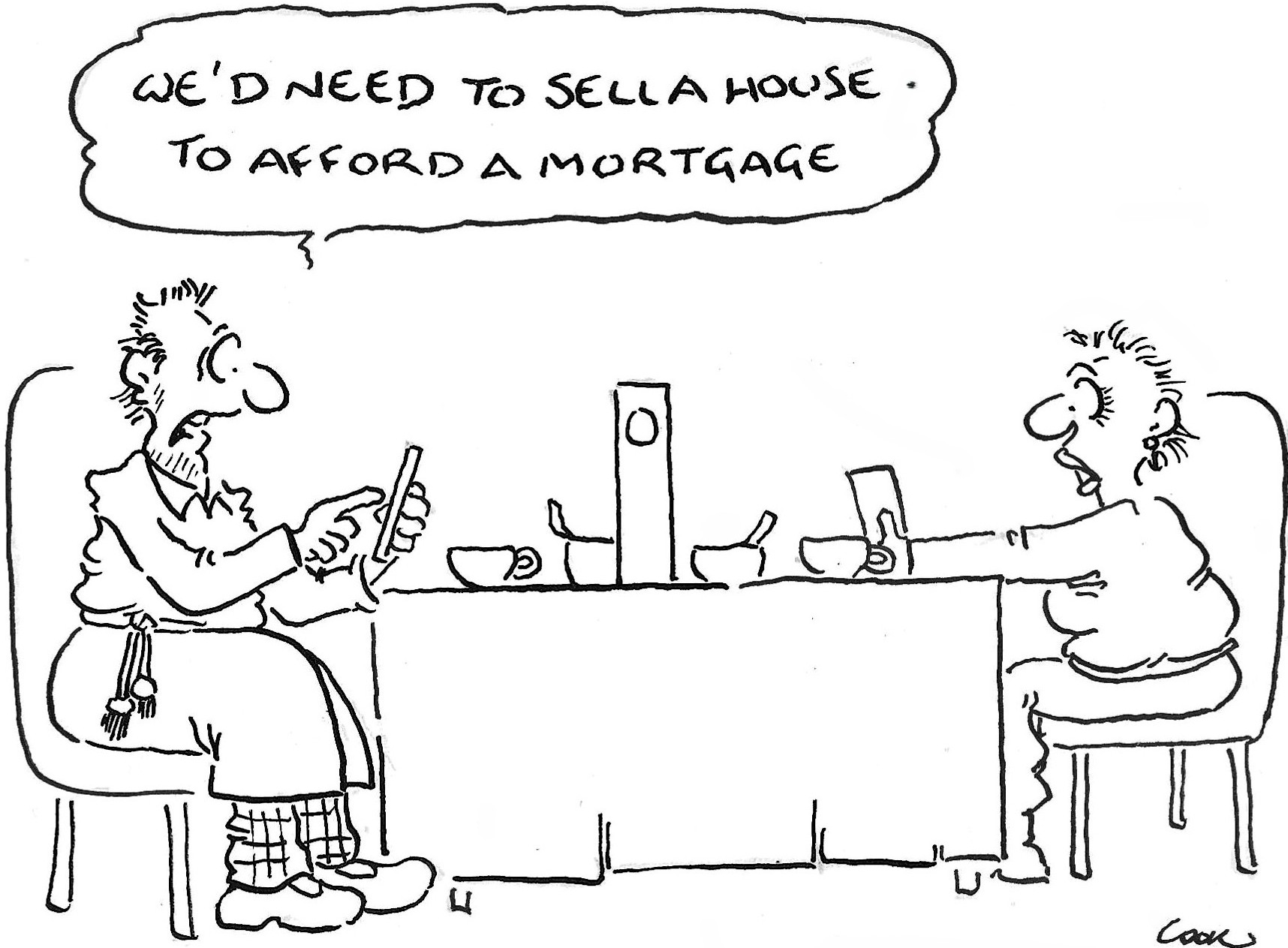
Meanwhile, Uncle Albo’s 1.2 million homes pledge staggers on. Completions ran at 173,400 in the year to March, 28% below the required pace. Even the government’s own housing advisory council now expects the target to be met in late 2030, 18 months late, and that forecast predates the slump.
Uncle Albo has made housing cheaper. He just forgot to make it exist.
2. Proportion, please
Helen Haines deserves every good wish coming her way. A nurse, a midwife and, by every account, a decent MP, she was allegedly rammed twice outside her own office. Her attacker should face the full weight of the law. But a little proportion would not go astray.
Victoria recorded more than 52,000 assault-related offences in the year to June, over a thousand a week. Police concede crime still sits above historical norms. Children were behind 60% of carjackings and more than half of home invasions, and machete incidents tripled in three years. Last year, two boys were stabbed to death walking home from basketball. Those victims, and the thousands assaulted every week, rarely prompt a procession of politicians lamenting the national temperature.
Why? Because Haines is one of them. That’s understandable, but it should not be the measure of outrage. A victim of violence is a victim of violence, whether she sits in Parliament or at a suburban bus stop.
The deeper problem is a justice culture that for too long treated the offender as the patient and the victim as a bystander. Remand as a last resort for children, a higher age of criminal responsibility, bail as the default: each made sense in a seminar room. Together, they told a generation of young offenders that consequences were negotiable. Victoria has since toughened bail and introduced “adult time” for violent youth crime, and offences have begun to fall. Repentance, it seems, follows polling.
Then there is the media. One newspaper dispatched a photographer to the Haines’ accused’s home to capture his unkempt garden, as if an overgrown lawn were a precursor to attempted murder. Journalism now apparently includes horticultural profiling.
Finally, the sermons. Politicians across the spectrum implore us to “turn down the heat.” But they are often the very ones who have spent a decade with the gas knob on ten. One federal minister, a world-class practitioner of the personal insult, lectured radio listeners on civility with what must have been a straight face. Sanctimony is cheap; restraint, apparently, is unaffordable.
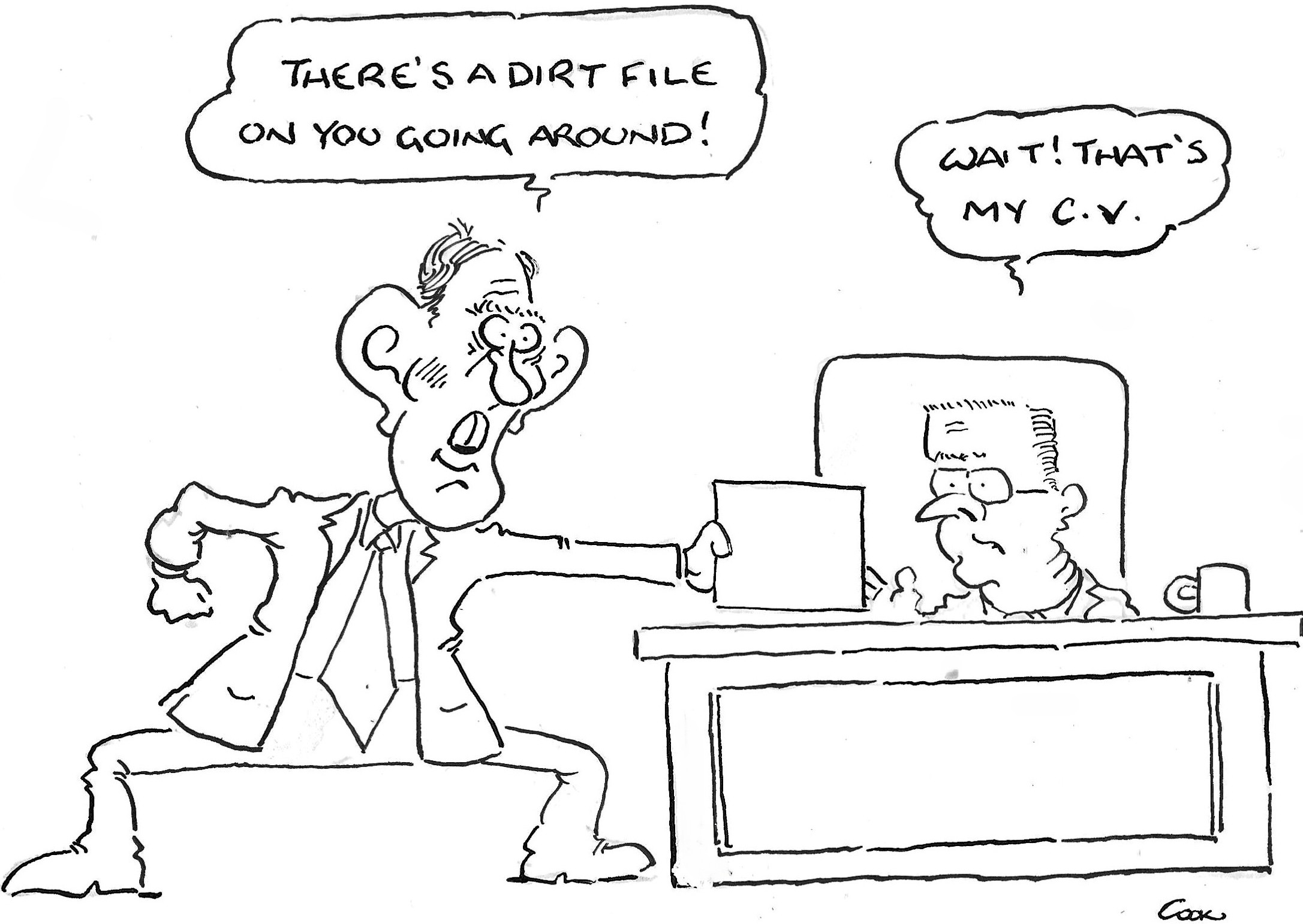
If Australia is serious about violence, it should treat every victim as if they mattered as much as an MP, and every offender as if consequences were real.
3. Ballot boxes on one side of the border
Israel votes on Tuesday in perhaps its most bitterly contested election in decades. The polls have it about 50/50. Netanyahu has Trumpster’s endorsement, perhaps an unhelpful gift. Eisenkot has a general’s résumé and a realpolitik worldview.1 Half of Israel will feel betrayed by whatever happens. Democracy, in other words, is in its natural state.
Readers may not know that also on the ballot are Arab parties, which are expected to take about a dozen of the Knesset’s 120 seats, with Ra’am’s Mansour Abbas auditioning for Israel’s kingmaker.
Fifteen kilometres up the road, the other Abbas has been busy too. Mahmoud Abbas, elected in 2005 to a four-year term as president of the Palestinian Authority, has just postponed elections again, this time to September 2027.
Palestinians last chose a parliament in 2006, before today’s first-time voters were born. Their president is now in the 21st year of his four-year mandate.
Palestine’s Abbas blames Israeli obstruction. Perhaps. But it is striking that Arab citizens get to vote in next week’s election in the supposed apartheid country, while Palestinians in Ramallah are still waiting for their turn.
1 Realpolitik is the approach of conducting diplomatic or political policies based primarily on considerations of given circumstances and factors, rather than strictly following ideological, moral, or ethical premises.
4. Trumpster and limbo
Trumpster has discovered limbo, in both senses.
Firstly, the political version. The bar started at a respectable 50.5% approval. It now sits at 31% in the AP-NORC poll, with 69% disapproving: a net minus 38% (see below), the lowest of either of his terms. And significantly lower than Biden.
Each week the bar drops another notch, and each week he bends a little further backwards to explain why it’s fake news. Steel band not included.
Then the theological version: a waiting room for souls on friendly terms with God, pending redemption. Trumpster qualifies on the first count, since he and God are, in his estimation, roughly peers. The redemption part may prove trickier.
Mind you, even the Vatican quietly downgraded limbo in 2007. Trumpster has made it a lifestyle.
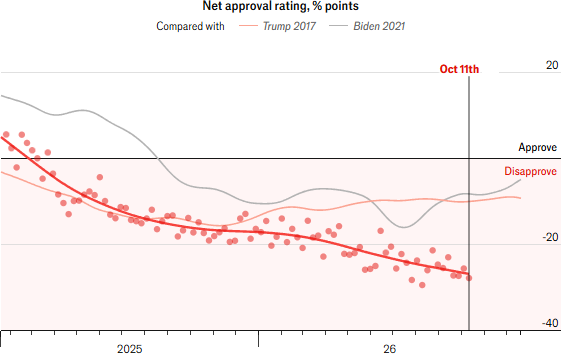
Source: The Economist 22 October 2026
5. The art of the cower
Trumpster likes to be thought of as a tough guy. He bullies Zelensky, berates Denmark and threatens Canada. But sit him across from a man with nuclear weapons and a Politburo, and the swagger evaporates.
With Tsar Vlad, it’s red carpets and sanctions relief. With Emperor Eleven, it’s a $14bn arms package for Taiwan frozen for months, with approval declared to be “up to China.” Weird, if not scary; outsourcing the decision on arm sales to the enemy of the buyer.
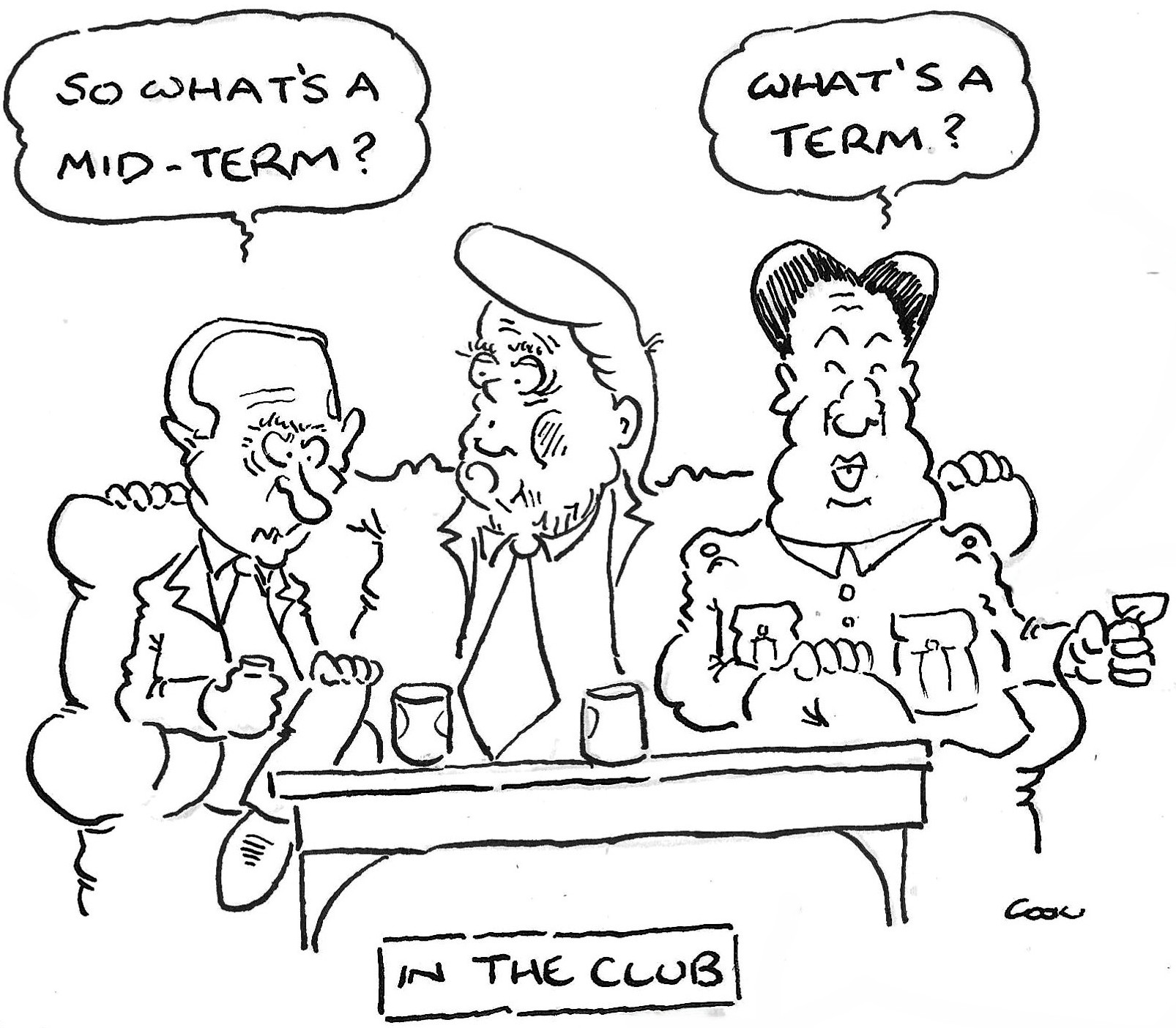
That isn’t strategy. It’s deference dressed up as dealmaking. Trumpster is fearless with allies and docile with dictators, which is obviously the wrong way round.
Emperor Eleven has noticed. He needn’t invade Taiwan. A slowly tightening ‘maritime quarantine’ will do, with a two-year tenure, timed for a president who flinches. Y’see, he believes the road to Taipei runs through an acquiescent Trumpster.
It does.
6. Liberté, Égalité, Overdraft
Half a million French citizens marched last weekend to demand more public spending from a state that already spends 57% of GDP, the second-highest share in the EU. One admires the optimism.
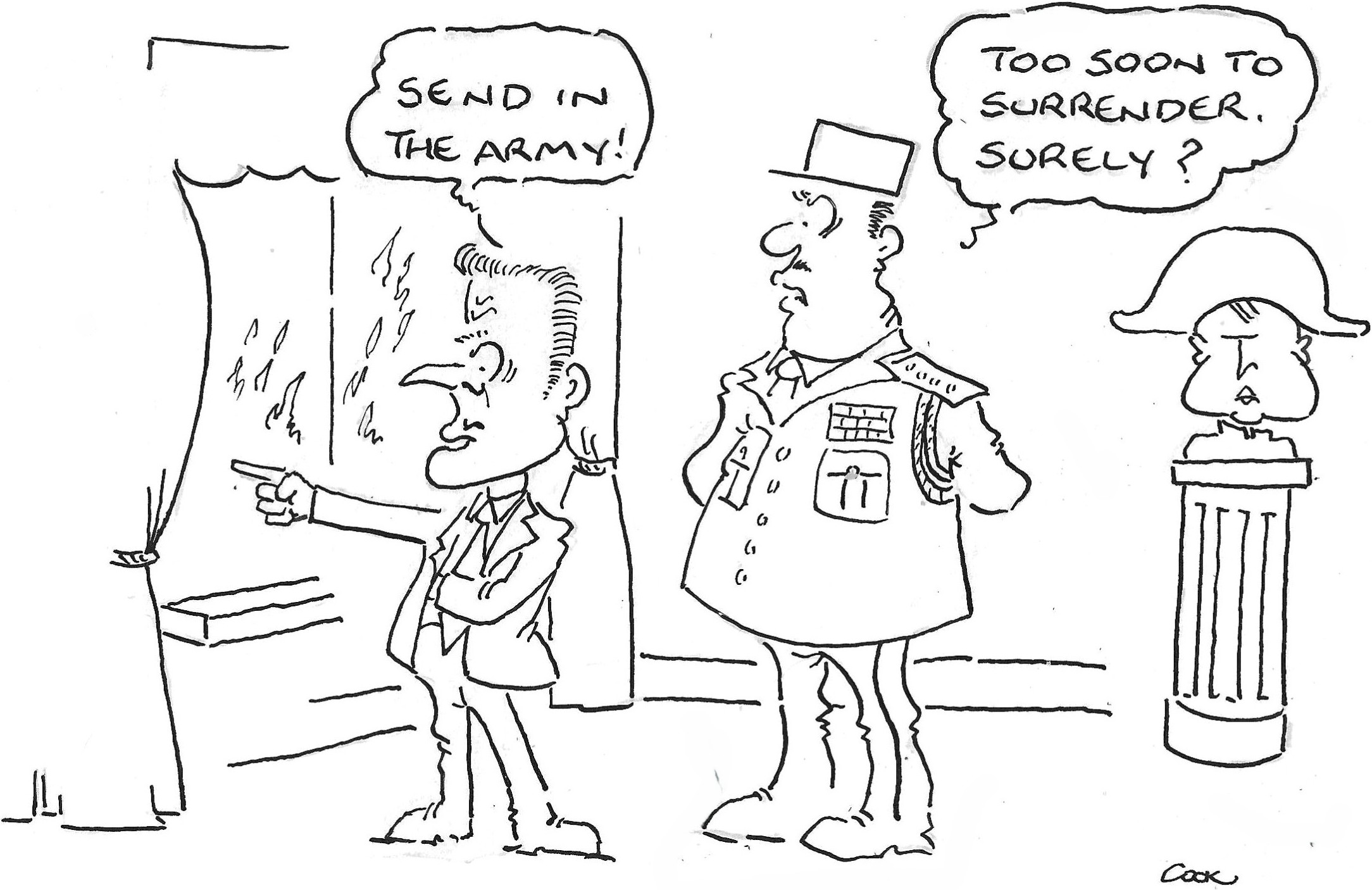
In Marseille, protesters stormed the town hall, presumably to check whether any money had been left behind the reception desk. There hadn’t.
France spends €100 for every €91 of receipts, which cannot be a successful way to run a fromagerie, much less a country. The single biggest budget line is pensions, at 14.1% of GDP, funding retirements that French men enjoy for 23 years, longer than anyone else in the OECD.
The irony is lost on the French. The young riot for better schools while the budget goes to their grandparents, financed by debt the young will repay. Wannabe president Marine Le Pen’s solution is to lower the retirement age.
Of course, this is France.
7. Canada builds pipelines
Canada has endured a lost decade: GDP per head up a feeble 4% against 23% in America, and private-sector productivity limping along at 0.8% per annum. Very ordinary.
Australia can hardly sneer. Its productivity growth over the past decade has run at about a quarter of its long-term average, while America’s tech-fuelled economy has left both Commonwealth cousins eating its dust.
The difference is the response. Canadian left-of-centre PM Mark Carney scrapped the consumer carbon tax, cancelled a capital-gains hike, cut income tax, let firms write off new equipment immediately, and posed beside a mining truck to bless a new oil pipeline. Investors, foreign and domestic, have been invited in.
Uncle Albo and Grim Jim have taken the scenic route: a 30% minimum tax on family trusts, heavier taxes on large super balances and capital gains, and federal spending at 26.9% of GDP, the highest in 40 years outside Covid. Australia ranks as the most restrictive for foreign investment among advanced economies and 16th-worst among 106 countries, according to the OECD annual index published this month.
Uncle Albo reluctantly approves coal and gas, 37 projects and counting, but does so apologetically and after exhausting every reason to say no.
Carney saw a crisis and reached for growth. Uncle Albo and Grim Jim also saw a crisis and reached for more tax.
.
8. “It’s at the back of the sofa, luv…”
Wannabe-elected-premier Ben Carroll has discovered the election-year magic of the $30 per week public transport cap: $206m per annum for many annums. State debt is cruising towards $200bn. At this rate, the cap will be the only thing in Victoria with a limit.
There is, naturally, an oops. Victorians spent about $2bn teaching commuters to ‘tap on’ with their credit cards, but the rebate of excess costs above the cap will only work if the old Myki card is used. The transport minister’s advice is to “check the back of the couch”.
This suits a government the budget strategy of which also relies on finding loose change down the sofa.
9. GST? Just add 5%
Australia’s tax debate has reached its natural conclusion. Grim Jim Chalmers has run out of trusts to raid and people to tax. So, it seems that he has asked, through the usual sympathetic back channels, someone to run an idea up the flagpole and see who salutes.
The idea is an old one. It’s about what everyone does: shopping. And a think-tank that hasn’t thought wants the GST lifted to 15% and extended to food. Thus raising $76bn a year for Canberra to redistribute with its customary wisdom.
Customary wisdom examples abound: wipe $16 billion of student debt, a 20% cut paid for by the 24 million Australians who don’t have any. Or the NDIS, a noble idea whose cost has ballooned to about $54bn per annum for many, many annums. With its growth now heroically “moderated” to a mere 8% per annum (somewhat higher than GDP growth, inflation, or population growth).
Harvard Business School should commission a case study on good intentions sunk by bureaucratic or botched implementation; NDIS is up there with Gallipoli and creating Canberra.
Readers know that the problem was never revenue. It was spending without discipline.
And spare a thought for the shopkeepers. For a quarter of a century, anyone could calculate GST by moving a decimal point. At 15%, Australians will need mathematics.
That alone may cost more than it raises.
10. Mummy did not consent
Finally this week, a clipping from The Times showing serious wokeness:

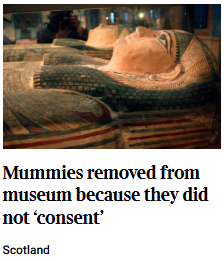
Source: The Times 23 October
Snippets from all over
Tourists to US fall
The number of overseas visitors to the US — which counts all non-citizens arriving from foreign countries excluding Mexico and Canada — was down 5.7 per cent year on year in the nine months to the end of September. (Financial Times 23 October)
Wry & Dry comments: The number of tourists from Western Europe fell 8.7%. Who will Trumpster blame?
M Macron on the back foot
Emmanuel Macron berated world leaders for making “unacceptable and even stupid comments” about France’s riots. (The Economist 22 October).
Wry & Dry comments: In a surprising intervention, Trumpster blamed migrants for the trouble.
US pending home sales fall to record low
Pending house sales (when a contract has been agreed on but not completed) in America dropped by 7.3% last month compared with August to a record low. (Wall Street Journal 21 October)
Wry & Dry comments: The average 30-year fixed rate is now 7.4%; the problem is that most home loans are fixed for 30 years, i.e. not variable.
Japan’s Mars mission
Japan is sending a spacecraft to Mars to investigate its moons, in the hope of shedding new light on the murky history of the Red Planet and its satellites. (Wall Street Journal 20 October).
Wry & Dry comments: Wait for the conspiracy stories…
Musk’s giveaway
Elon Musk pledged to give “every kid in America” one share in SpaceX, his rocketry and AI company, next year. (The Economist 20 October).
Wry & Dry comments: Cost: about $10.5bn. But imagine the contact data he’d get.
Apple pie
Apple… said its foldable iPhone Duo had seen “nothing short of extraordinary” demand, as the device sold out on the company’s website until next year within hours of going on sale.”. (Financial Times, 19 October).
Wry & Dry comments: Can’t wait for the upcoming Apple iPhone Rollo.
It figures
UK: 691,000; job vacancies, the lowest in five years.
China: 4.5%; GDP growth in 12 months to end September, up from 4.3% the previous quarter.
And to soothe your troubled mind…
“I can’t be on stage. I can’t do a play anymore. I can’t do a film anymore. I can’t read anymore.”
Dame Judi Dench, Oscar winning actress and ‘M’ in James Bond movies, aged 91, on having macular degeneration.
Wry & Dry comments: Dench won a Best Supporting Actress Oscar for eight minutes of being on film in Shakespeare In Love.
Disclaimer
The comments in Wry & Dry do not necessarily reflect those of First Samuel, its Directors or Associates.
Cheers!
Wry & Dry is Anthony Starkins’ personal publication. The views expressed are his own and do not necessarily represent the views of First Samuel Limited. It is not financial product advice.
Share this article