
First Samuel’s Investment Matters

This week’s perspective
UBS Australasia Conference — The great AI question
The entire First Samuel investment team headed to Sydney this week for the UBS Australasia Conference, a highlight of the Australian investment calendar.
The conference provides an extraordinary opportunity to meet with a broad range of companies, including those we already own, those we have owned in the past and those we might own in the future. This year, we heard from businesses including Life360, SGH, BlueScope Steel, Santos, and Wesfarmers, alongside companies on our current research radar such as Fletcher Building, Redox, Ridley, and Ampol.
These meetings are invaluable. They let us test our understanding of individual businesses, challenge management's assumptions, and identify opportunities that might otherwise escape our attention.
But the real attraction of the UBS conference is its breadth. Alongside the company presentations are discussions with economists, central bankers, business leaders and other thinkers covering defence, healthcare, China, geopolitics, monetary policy and investment trends. The opportunity to move between these different perspectives, often within the same day, is enormously valuable.
And, as usual, there was no shortage of competing opinions.
Yet across this extraordinary variety of discussions, one subject dominated: artificial intelligence.
For First Samuel clients who in recent weeks attended one of our CIO Dinners titled “Ambiguity, Hubris and AI”, the importance of AI to future economic growth, business profitability and investment portfolios will already be familiar. What made the UBS conference particularly interesting was not simply the enthusiasm for the technology, but the remarkable uncertainty about its eventual consequences.
Almost everyone agrees AI will be important. There is far less agreement about how, when and to whom the benefits will accrue.
There is also an intriguing connection to AI. Even as the world grapples with traditional inflationary pressures from energy, labour and geopolitics, the enormous investment required to develop AI is creating an additional source of demand for construction, electricity, equipment and capital.
The immediate consequences of AI could therefore be inflationary, even if the technology ultimately helps lower costs across the economy. This contradiction was a recurring theme throughout the conference.
The market
FYTD: ASX and Wall Street
Nov 2026 (MTD) · Australia +3.02% · US +1.24%
Source: IRESS · supplied workbook.
View chart data
| Period | Australia: ASX/S&P 300 | US: S&P 500 |
|---|---|---|
| Jun 2026 | 0.00% | 0.00% |
| Jul 2026 | +2.12% | -0.13% |
| Aug 2026 | +3.33% | +2.49% |
| Sep 2026 | +0.05% | +2.03% |
| Oct 2026 | +1.14% | +1.08% |
| Nov 2026 (MTD) | +3.02% | +1.24% |
The week: ASX and Wall Street
Week · Australia +0.63% · US +3.25%
Source: IRESS · supplied workbook.
View chart data
| Period | Australia: ASX/S&P 300 | US: S&P 500 |
|---|---|---|
| Mon | +0.13% | +0.31% |
| Tue | +1.13% | +2.35% |
| Wed | +0.26% | -0.38% |
| Thu | -0.10% | +1.31% |
| Fri* | -0.79% | -0.35% |
| Week | +0.63% | +3.25% |
Some welcome signs in a complicated economic environment
The conference also took place against an interesting backdrop for financial markets.
Over the past week, oil prices and interest-rate expectations have moved significantly, offering the possibility of some relief from the inflationary consequences of the Iran war.
The best-case scenario is becoming easier to imagine. If geopolitical tensions ease, energy supplies recover and oil prices fall sustainably, some of the inflationary pressures that have complicated economic policy could begin to dissipate. Central banks may then have the opportunity to pause their interest-rate increases.
This would be welcome news for households and businesses, particularly in Australia, where the combination of elevated interest rates and higher energy costs has been difficult.
Just this week we saw a snapshot of our concern in company announcements, which included:
- Commonwealth Bank (CBA) noting rising bad debts, and the highest level of 90-day past-due (in arrears) home loans since 2012.
- Accent Group (Athletes Foot, Platypus Shoes, Glue) noted like-for-like sales since August falling 5% on the previous year.
- PEXA Group noted Australian property transfer volumes fell 26% year-on-year in October 2026, while remortgage (refinancing) volumes remained broadly flat.
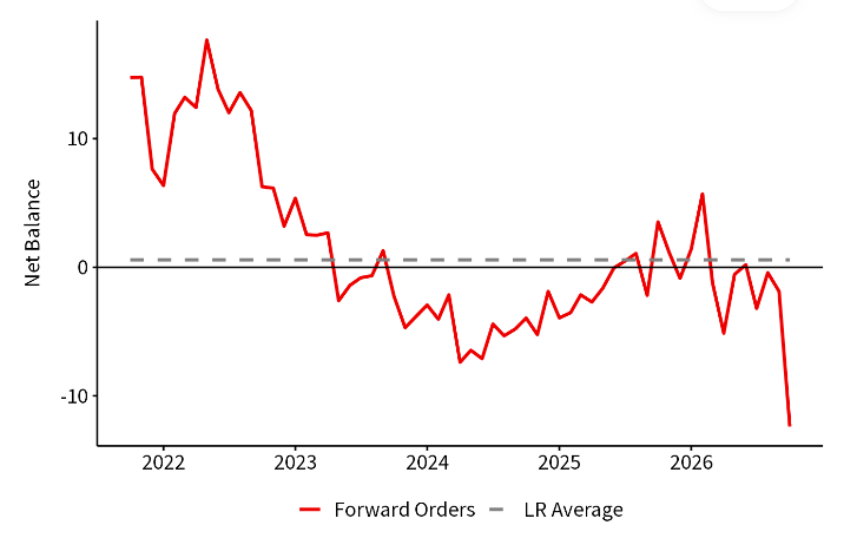
- NAB Business Survey reported significant slowing in business conditions, matching cratering business confidence. The forward order fall was notable, falling 11pts in October to -12 index points (negative indicating a net reduction amongst respondents). The decline in forward orders was broad-based but led by large falls in construction and manufacturing. Retail and wholesale forward orders remain the weakest in trend terms, reflecting the slowing in goods retailing.
Chart #1 – NAB Business Survey – Forward Orders
Sarah Hunter — A technology that could change everything
One of the most comprehensive presentations came from Sarah Hunter, Assistant Governor (Economic) of the RBA. Rather than attempting to predict exactly what AI will deliver, Hunter concentrated on how economists should think about a technology capable of transforming large parts of the economy. We took the following themes from the presentation.
- AI is what economists call a general-purpose technology. Like electricity or the internet, its eventual significance may come less from its initial applications and more from the extraordinary range of activities it makes possible.
- History suggests that these technologies create new industries, new occupations and entirely new forms of economic activity. But history also suggests the transformation takes time. The current impacts on employment and productivity are minor, based on RBA business liaison surveys shown in the chart below.
Chart #2 – RBA Liaison Survey Results: Productivity Gains from AI
Share of firms (%)
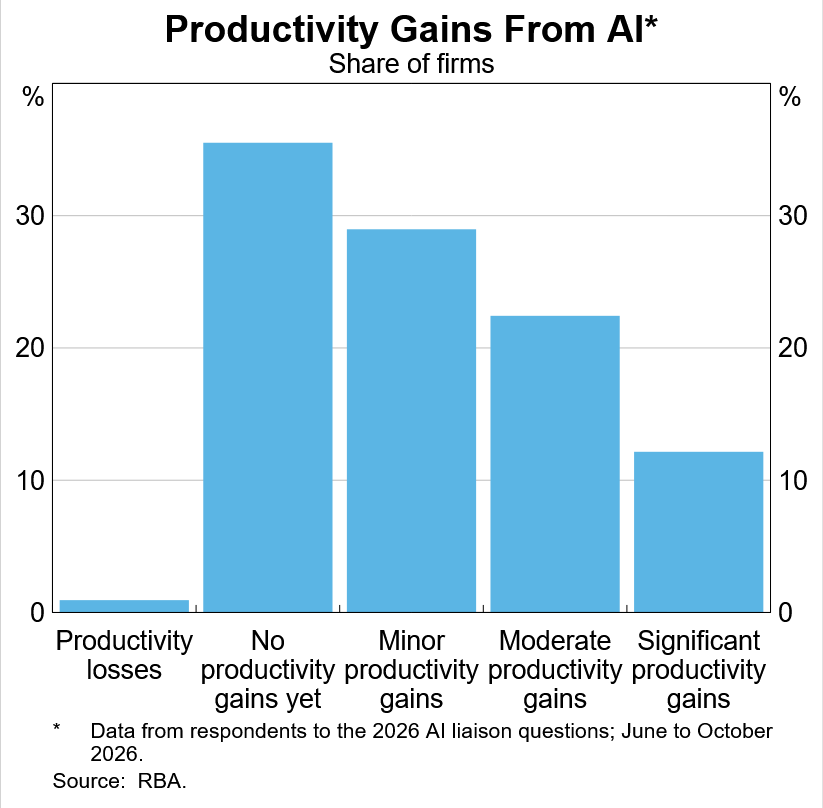
Data from respondents to the 2026 AI liaison questions; June to October 2026.
- Hunter was not yet particularly concerned about widespread AI-driven unemployment, although she recognised that the distribution of the benefits would be important. That distributional question deserves considerable attention.
- Higher national productivity does not necessarily mean higher incomes for everyone. The benefits might accrue disproportionately to business owners, shareholders or a small group of highly skilled workers.
In economies such as Australia, where household consumption, debt and population growth are so important, the distribution of additional income may matter almost as much as the productivity improvement itself. For the moment, however, we are seeing enormous investment in AI infrastructure without much convincing evidence of a corresponding economy-wide productivity dividend.
China — Perhaps the more practical approach to AI
Often your author finds a particular aspect or discussion from such a conference packs more medium-term punch than others. The fascinating discussion involving China specialists Tao Wang (formerly of UBS), Andy Rothman (a Sinologist), and Edward Tse (formerly of Boston Consulting Group) was one such moment.
China has serious economic problems. After approximately six years of falling property prices, consumer confidence remains depressed, and household savings have accumulated at an extraordinary rate.
Tao Wang made the important observation that China's growing industries are simply not large enough to replace the economic activity lost from residential construction. There is no easy solution to this imbalance. The promise of balancing economic growth through higher household consumption remains a goal that China is yet to deliver.
Yet the discussion of AI was surprisingly optimistic, and a challenge to the Western model, especially in a week when Anthropic (Claude) is expected to IPO for US$1.3 to $1.4tn. While much of the American debate concerns developing ever more powerful models, eventually capable of superintelligence, China appears much more interested in what existing AI can actually do.
China has an enormous industrial base, highly competitive businesses and access to increasingly capable, relatively inexpensive AI models. These businesses are often those the West was pleased to see head to China. But now, with a Chinese government actively encouraging the application of AI throughout the economy, the next leg of innovation may transform these businesses in a manner the West was neither able to foresee nor execute.
Rothman suggested that China may have a better perspective on the technology: the objective should be productivity, not simply technological supremacy.
The country that develops the world's most powerful AI model need not be the country that benefits most from using AI. There is, however, an important catch for investors.
China's intense internal competition, sometimes described as involution, frequently drives businesses to lower prices and sacrifice profitability to maintain or increase market share. AI may make Chinese industry extraordinarily productive while delivering much of the benefit to customers rather than shareholders.
Edward Tse introduced another dimension, arguing that China's growing industrial strength needs to be understood alongside its long historical experience and its relationship with the rest of the world. China increasingly has companies that can compete with global leaders, but its prosperity remains intimately connected to the prosperity of its trading partners.
The broader point was that China does not necessarily see its technological future through the same lens as the United States. And that raises a question which should be central to investors everywhere: who actually receives the economic benefits of AI?
Who captures the productivity dividend?
An unexpected contribution to this discussion came from UBS chief executive Sergio Ermotti.
Asked whether AI would improve the profitability of global banks, Ermotti suggested that competition would ultimately ensure that much of the benefit went to clients. It was an important observation.
If every bank adopts similar technology, reduces its operating costs and becomes more productive, competitive pressure may eventually force those savings into lower prices and better services. The banks become more efficient, but not necessarily more profitable.
This is hardly a new economic principle. Competition has always played an important role in determining who benefits from technological progress. But it is particularly relevant to AI, where the scale of investment and the expectations being placed on future corporate profitability are enormous.
A company can implement AI successfully and still fail to generate attractive returns on that investment. The China discussion and Ermotti's comments pointed towards the same conclusion. Productivity growth is not the same thing as profit growth.
For investors, identifying the eventual beneficiaries may prove considerably more difficult than identifying the technology itself.
The politics of artificial intelligence
Geopolitical strategist and Stratfor (a US strategic intelligence publishing company) founder George Friedman introduced another dimension: the political consequences of AI. Your author particularly enjoyed his 2009 book The Next 100 Years: A Forecast for the 21st Century and was excited to hear his perspectives.
He noted AI's role in the recent US midterms and the resistance it is already generating, particularly around the construction of data centres. The enormous demand for electricity, water and infrastructure can affect local communities long before the promised economic benefits become visible. Add fears about unemployment and the extraordinary concentration of wealth and political influence among technology companies, and the potential for political opposition becomes obvious.
Friedman compared the power accumulating around AI to the influence once enjoyed by America's railway barons. It is a useful historical parallel.
Railways transformed the American economy, connected markets and created extraordinary wealth. They also generated monopolies, political controversy and considerable resentment towards the individuals who controlled them.
AI may follow a similarly complicated path.
The development of a profoundly beneficial technology does not guarantee that society will accept how it is developed, owned, or controlled. Indeed, one striking feature of the conference was the contrast between the long-term optimism surrounding AI and the immediate economic and political problems associated with building it.
Building on last week's Investment Matters, Friedman also offered important insights into the evolving political circumstances in the US, noting that the Republicans, despite soon to be in opposition, may play an outsized role over the next two years in how the US evolves in coming decades. He argued the choices they make both in terms of policy direction, leadership style and global focus may be more important than what the Democrats achieved under a belligerent lame-duck President.
We agree and argue the scope of possible positions the Republicans could take is as broad as we have ever encountered. This could be tumultuous for portfolios that rely too heavily on the narrow range of expensive US equities.
Life360 — AI moves into everyday life
One of the most interesting examples of AI's practical potential came from a company we already own: Life360.
Life360 also released its September-quarter results this week, providing a useful reminder of the scale the business has already achieved. Revenue increased 40% to US$174.1m, while global monthly active users increased 17% to 107.7m. Paying family circles grew 26% to 3.4m, and adjusted EBITDA increased 41% to US$34.6m.
Chart #3 – Ongoing growth in Life360 Core Monthly Active Users across the globe
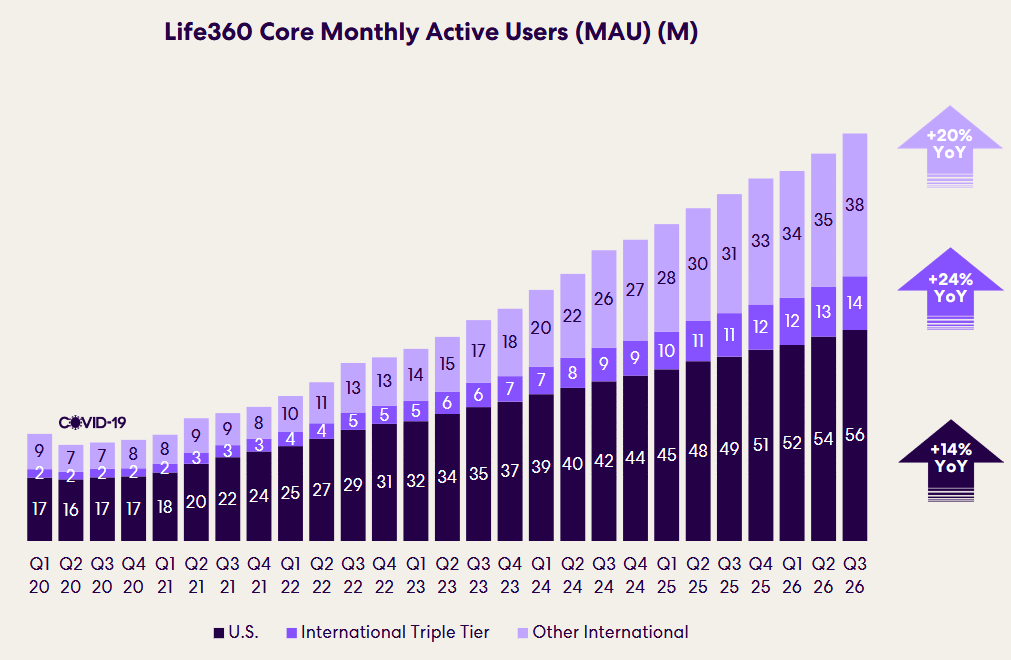
As is often with dual-listed stocks (NASDAQ and ASX), there was significant price volatility, yet despite the moves, the stock is up 1% in November.
The company continues to expand its enormous network of families using its location-sharing and safety services. Its advertising business is also developing, although the investment case still depends on successfully monetising this large audience while maintaining user trust.
But the most interesting part of the company's update was not its excellent quarterly financial performance. It was the potential for AI agents to transform what Life360 actually does.
Today, Life360 allows family members to see where other members of their family are located. That is useful, but it is fundamentally a map of the present. What happens when AI agents can begin assembling information about where people intend to be in the future?
Consider something as mundane as children's sport. Information about sporting fixtures, school activities, weekend commitments and family arrangements is scattered across emails, calendars, messages and different applications. Most people would never bother entering all those arrangements into a separate social network or group calendar. The effort required to maintain the information outweighs the likely benefit.
Consequently, a potentially valuable network of future intentions simply does not exist.
AI agents could change that. An agent might identify a child's upcoming sporting fixture from an email, establish its location and time, and make that information available to the family's Life360 map.
With appropriate permission, another family's agent might discover that both families will be attending activities in the same area and suggest an opportunity to meet. Or it might identify a convenient restaurant for several friends based on where they will already be.
None of this requires people to sit down and construct elaborate shared calendars or continuously update their plans.
The AI agent removes the work required to contribute information to the network, potentially making the network itself enormously more useful.
Life360 has begun opening its family-information services to external AI agents, rather than relying exclusively on developing its own AI capabilities. This is an interesting strategic decision.
Life360 does not need to build the world's most powerful AI model. Its advantage may instead come from its existing relationships with more than 100 million users and its position within the daily organisation of family life. This data is unique to Life360, especially where groups span multiple phone operating systems.
We see something similar in another portfolio investment, Block (XYZ), where AI can potentially be incorporated into existing merchant, payments and financial relationships. Both companies are attempting to use AI to make established services more valuable, rather than simply investing in the infrastructure required to develop the technology.
Of course, the Life360 opportunity also raises some unsettling questions, especially if you're like your author and see much of this discussion as a dystopian hell to be avoided. An AI agent capable of assembling our future activities may know an extraordinary amount about our intentions, relationships and daily behaviour.
This raises an entirely new set of questions about privacy, trust, and the extent to which we want technology involved in our personal relationships. Are we outsourcing the inconvenience of coordination, or outsourcing elements of human relationships?
We don't know. But that is precisely what makes the opportunity so fascinating.
Life360's proposed agent-enabled services remain an emerging possibility rather than an established new earnings stream. Yet they provide a tangible illustration of how AI may change the usefulness of products and services we already know.
Much more than a technology conference
We came away from Sydney with a great deal to think about, and plenty of additional research to undertake. The UBS conference was an excellent reminder of why we spend so much time meeting companies, listening to competing views and challenging our own assumptions.
We left Sydney better informed, with new ideas to investigate and considerable enthusiasm for the opportunities ahead.
Past performance is not a reliable indicator of future performance.
No assurance or guarantee is given that any forecast, target or projection will be achieved. Forward-looking statements are based on assumptions and information available as at 13 November 2026 and are subject to risks, uncertainties and factors beyond First Samuel’s control. Actual outcomes may differ materially.
Any advice contained on this website is of a general nature only and has been prepared without taking into account your personal objectives, financial situation or needs. Because of that, before acting on any advice on this website, you should consider whether the advice is appropriate for you having regard to your objectives, financial situation and needs.