
First Samuel’s Investment Matters

This week’s perspective
Blue tsunami – Teddy or turmoil?
America’s blue wave, the return of economic populism and the growing strains in Australia’s economy.
The market
FYTD: ASX and Wall Street
Nov 2026 (MTD) · Australia +2.38% · US -1.95%
Source: IRESS · 6 November 2026. View original chart ↗
View chart data
| Period | Australia: ASX/S&P 300 | US: S&P 500 |
|---|---|---|
| Jun 2026 | 0.00% | 0.00% |
| Jul 2026 | +2.12% | -0.13% |
| Aug 2026 | +3.33% | +2.49% |
| Sep 2026 | +0.05% | +2.03% |
| Oct 2026 | +1.14% | +1.08% |
| Nov 2026 (MTD) | +2.38% | -1.95% |
The week: ASX and Wall Street
Week · Australia +1.30% · US -4.75%
Source: IRESS · 6 November 2026. View original chart ↗
View chart data
| Period | Australia: ASX/S&P 300 | US: S&P 500 |
|---|---|---|
| Mon | -0.58% | -1.82% |
| Tue | +0.33% | -0.51% |
| Wed | -0.57% | +0.36% |
| Thu | +2.65% | +1.58% |
| Fri* | -0.51% | -4.36% |
| Week | +1.30% | -4.75% |
The blue tsunami that swept through the United States this week delivered one of the clearest political verdicts in recent American history. The Democrats seized control of both houses of Congress, rejecting much of Donald Trump’s political agenda and reminding everyone that, even in an age of extraordinary executive power, the electorate can still impose change.
We were pleased with our portfolios’ performance over the past week. Strong quarterly results from Block (XYZ, +12% in November) supported the return. Relative performance was assisted by ongoing weakness in Iron Ore and Financials. We outline Block’s results at the end of the article and cover what is driving Iron Ore pricing in the coming weeks in Investment Matters.
Financial markets responded chaotically to the mid-term results. The Dow rose more than 1,500 points on Wednesday, while oil prices fell sharply. Then last night the Dow gave it all back, and then some. There was relief that the election result was so decisive, optimism that divided government might reduce the frequency of disruptive policy decisions and, perhaps most importantly, renewed hope that the political pressure created by the election might accelerate a resolution of the Iran war.
Lower oil prices would provide immediate relief to consumers and businesses worldwide.
We cannot ignore last night’s market falls, driven by the Nasdaq (-6.4%), with large Nasdaq-listed S&P 500 stocks (e.g., Nvidia) pushing the major index down 4.4%. Fears of AI regulation (limits on data centre-building and forced slowing of model training) took hold. But a nervous market may need time to digest the broader implications of the Democrats’ success.
More generally, we suspect the election represents something more complicated than a straightforward rejection of Trump. It was also a rejection of high petrol prices, persistent inflation and declining affordability. But deeper forces were at work: concerns about the erosion of institutions, frustration with prolonged American military aggression, and renewed attention to fundamental economic questions about education, opportunity, and access to the benefits of economic growth.
Cartoon: Patrick Cook

Florida Governor Ron DeSantis, a Republican, and likely participant in the 2028 presidential campaign, offered one of the week’s more revealing observations. Discussing the Iran war and rising petrol prices, he argued that Republicans could not dismiss the financial pain being experienced by working-class voters with “gaslighting them”. He went further, questioning the party’s relationship with large corporations and arguing for a return to small-business interests.
Perhaps the epitome of complicated economic impacts, the data centre has become a symbol of the consolidation of power and economic benefits in the hands of tech oligarchs, while costs are spread across a wide community. At the same time, data centre investment has driven much of the US economic demand growth over the past year. Curbing their growth will affect not only the over-hyped AI investment trade but also pockets of growth.
The significance is not simply that Democrats have won. It is that the economic pressures behind the result are beginning to reshape arguments within both political parties.
A reflection: history offers two competing interpretations
The first takes us back to the reform movements of the 1890s and early 1900s. This era saw rapid industrialisation, enormous concentrations of wealth, and growing corporate power, which prompted a political response.
In the United States, “Teddy” Roosevelt (president 1901-1909) emerged as a symbol of progressive reform, challenging trusts (which then hid monopolistic company structures, e.g. those of Rockefeller) and seeking to restore a balance between private economic power and public institutions. In Australia, figures including Alfred Deakin, building upon the nation-building efforts of Henry Parkes and others, helped establish the political foundations of a new nation, with stronger institutions and an increasingly egalitarian ambition.
These reformers were not seeking to overthrow the economic system. Rather, they recognised that capitalism required institutions capable of maintaining competition, broadening opportunity and limiting the concentration of power.
We could be approaching a similar period in the US today. Rising inequality, economic insecurity, the extraordinary concentration of corporate power and the disruption threatened by artificial intelligence all provide fertile ground for a new generation of reformers. The American midterms, and the political progress made before the next presidential election in 2028, may represent the early innings of that process.
The alternative interpretation is considerably more turbulent.
Proponents of the so-called Fourth Turning argue that societies periodically reach a crisis in which their institutions have become fundamentally weakened, public confidence collapses and the political rules that previously sustained stability no longer command widespread support.
Under this interpretation, Trump is not simply an aberration to be corrected by the next election. He represents one stage of a much longer breakdown in institutional authority. The rejection of established rules and conventions is followed not necessarily by immediate renewal, but by a prolonged struggle over which values, institutions and economic arrangements should replace them.
That process could take another decade, with younger generations playing an increasingly important role in determining the outcome, which is completely obscured from us in 2026.
As a student of history, I find elements of both interpretations persuasive. The progressive reforms of the early twentieth century emerged from decades of political conflict, institutional weakness and economic upheaval. Renewal and crisis are not necessarily opposing explanations. One can follow from the other.
Nor should we underestimate the extraordinary powers that remain with the American presidency. A Democratic Congress can constrain legislation, exercise oversight, and challenge executive decisions. It cannot simply reverse the accumulation of presidential authority over recent decades.
For investors, the encouraging observation is that equity markets can perform well under either historical scenario. What changes is who the winners are.
Cartoon: Patrick Cook

An era of institutional rebuilding may favour investment, competition, infrastructure and businesses that benefit from a broader distribution of economic opportunity. A more turbulent era may instead reward companies with strong balance sheets, essential assets, pricing power and the ability to navigate greater political intervention.
What seems unlikely to disappear under either scenario is populism — particularly economic populism. Historically, change has been driven by hero-type figures, or those who can demonstrate leadership in crisis. External threats, whether China, artificial intelligence or geopolitical conflict, may become increasingly important in shaping the political response. For Australia as a whole, and consistent with the basket approach to our mining exposures, these scenarios are often positive for minerals and metals that support technology and investment.
The election may mark the beginning of a new reform era. Equally, it may mark the start of a much longer institutional crisis. In Australia, facing an election in Victoria and the rise of One Nation, which followed from the rise of the Teals, the historic twist is somewhat delayed but equally important.
Does Australia give power to the emergent angst, or does the Liberal Party return to its small-l Liberal roots, and the Labour Party to its progressive version of economic strength with deep social equity?
Australia: NAB and Retail Sales show the conditions are biting
While American markets celebrated the election, developments in Australia offered a rather less comfortable picture of the economic cycle. I suspect Australian policymakers (who have barely begun) have hard work to do before Keating’s vision of a “first-rate country with a powerful economic engine and a soul to match” becomes reality.
The growing pressure on households and businesses is becoming increasingly visible in company announcements. Profit downgrades and deteriorating trading conditions are appearing across more sectors, while falling housing prices are beginning to challenge assumptions that have underpinned much of Australia’s credit and consumption growth.
This week’s result from National Australia Bank was particularly revealing.
The most important development was NAB’s decision to increase its forward-looking credit provisions by $403 million, reflecting a more challenging economic outlook. This was not simply recognition of losses already experienced. It acknowledged that future credit losses may be greater than previously anticipated. We welcome that recognition of risk. For years, Australia’s banking system has benefited from rising property prices, remarkably benign credit losses and borrowers conditioned to believe that interest rates would remain manageable and housing values would continue to increase.
That combination is now being tested.
The banks entered this period with exceptionally demanding valuations. Their relative underperformance may represent an important change in market leadership, particularly as investors begin to distinguish between the apparent stability of bank earnings and the underlying deterioration in parts of the economy.
The pressure extends well beyond the banks. An increasing number of companies updating the market are discovering that consumer resilience, previously taken for granted, is becoming less reliable.
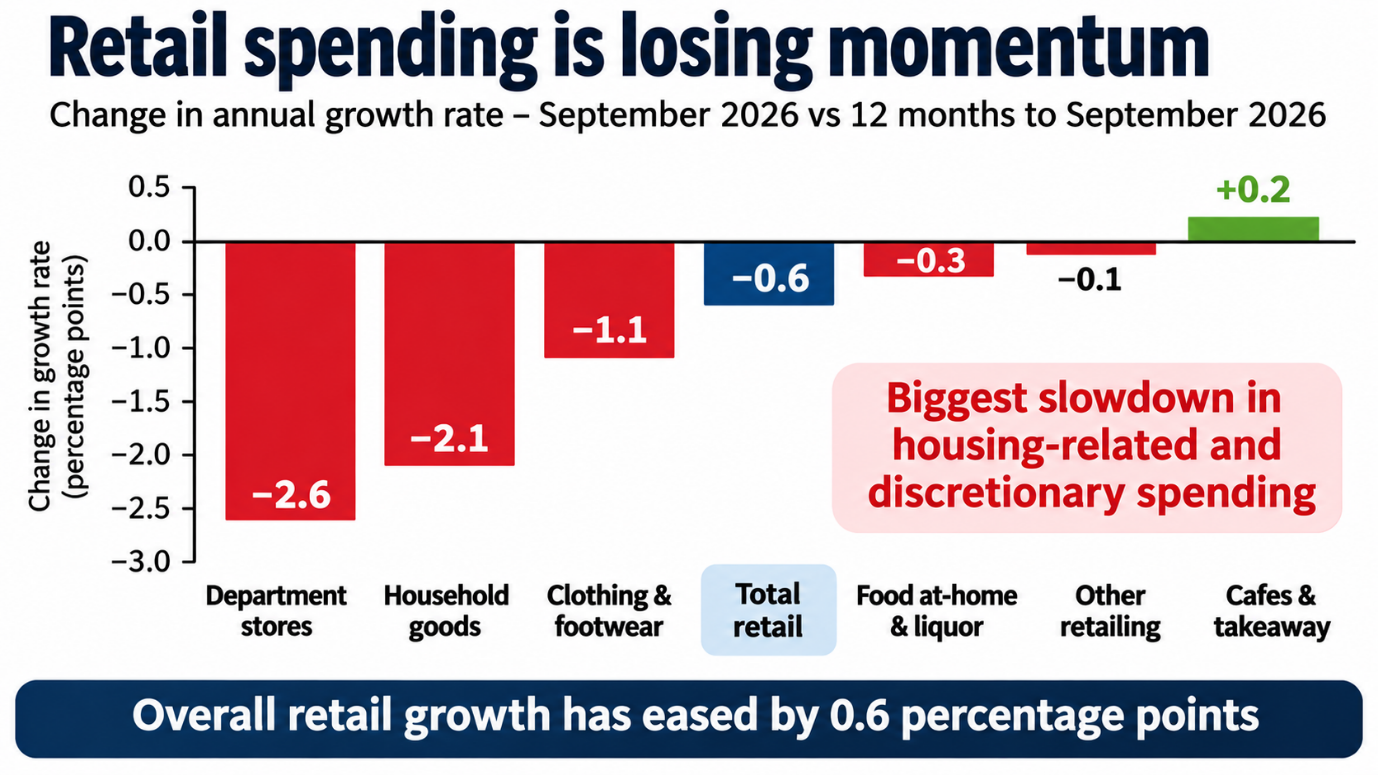
The latest retail spending analysis from MST Marquee provides a particularly useful illustration. Overall year-on-year retail growth in September was 0.6 percentage points below the growth recorded across the full preceding year. But the slowdown was much more pronounced in household goods, department stores and clothing.
Retail spending is losing momentum
Change in annual growth rate – September 2026 vs 12 months to September 2026
Yet the deterioration in economic conditions has not delivered a corresponding decline in inflation.
Government expenditure, the enormous investment associated with data-centre construction and continued high migration are contributing to demand pressures, while weak productivity remains an important underlying constraint.
This combination is especially uncomfortable. Parts of the private economy are weakening, but inflation remains sufficiently persistent to prevent the Reserve Bank from providing relief.
On Melbourne Cup Day, the RBA increased the cash rate by another 25 basis points to 4.85%, its fifth increase this year. However, three of the nine board members voted against the increase. For the first time in this tightening cycle, there are meaningful signs that the willingness to impose further economic pain is weakening.
Inflation remains a problem. But the appetite to keep bludgeoning the economy appears to be diminishing.
That distinction matters.
Historically, the end of an RBA tightening cycle has often been good news for retailers, housing prices and other interest-rate-sensitive investments. It is hardly surprising that some investors have begun retrieving their old notebooks to remind themselves what happened the last time the central bank stopped raising rates.
We are less convinced that the historical playbook will work quite so neatly this time.
Housing is considerably less affordable relative to household incomes. Debt burdens remain substantial, and mortgage repayments absorb an unusually large share of income. Negative equity is becoming a more serious consideration for some borrowers, while changing demographics and the intergenerational distribution of housing wealth present problems that lower interest rates alone cannot resolve.
Nor does the end of rate increases immediately reverse the consequences of those already delivered. Higher debt-servicing costs, weaker collateral values, falling real purchasing power and growing financial pressure take time to work their way through household and corporate balance sheets.
Our expectation remains that interest rates, particularly the cash rate, will fall over the medium term.
But the end of monetary tightening is not the same thing as the end of economic stress.
We suspect the Australian economy has several more quarters of adjustment ahead. The challenge for investors will be distinguishing businesses that merely benefit from the prospect of lower rates from those that can emerge stronger once the adjustment has run its course.
It may be a useful parallel with the political developments in America. In both cases, the pressure for change is becoming unmistakable. What replaces the old arrangements, and how much disruption occurs along the way, remains far less certain.
Block (XYZ): AI and innovation driving strong growth
A 15% share-price rise, another strong quarterly result and a compelling contrast with Australia’s major banks.
In recent CIO client dinners, I have discussed two important opportunities emerging from artificial intelligence. The first is the enormous advantage enjoyed by companies with scale, proprietary information and a genuine understanding of how AI can improve their businesses. The second is the fertile ground that financial services provides for better products, lower costs and helping customers understand and access the financial options available to them.
These themes have been central to our decision to concentrate the portfolio’s banking and financial-services exposure in Macquarie Group and Block (XYZ), rather than Australia’s major banks.
Block operates two major financial ecosystems: Square, providing payments, software and financial services to businesses, and Cash App, providing payments, banking-related services and financial products to consumers. The former Afterpay business is now integrated into these platforms as part of Block’s broader lending and commerce offering.
Block’s September-quarter result, which saw its share price rise more than 15% this week, provides powerful evidence of why we believe this approach makes sense.
Growth that is becoming increasingly profitable
The headline numbers were impressive:
- Gross profit increased 22% to US$3.24bn.
- Adjusted operating income increased 92% to US$923m.
- Adjusted operating margin reached a record 29%, compared with 18% a year earlier.
- Cash App gross profit grew 27%, while Square gross profit increased 14%.
Perhaps most importantly, management increased its full-year expectations and provided an initial outlook for 2027 that includes at least 15% gross profit growth, 30% adjusted operating income growth and a 32% operating margin.
The consistency of growth in the figure below indicates the strength of the developing ecosystem.
Block Adjusted EBITDA – Consistent growth / higher margins
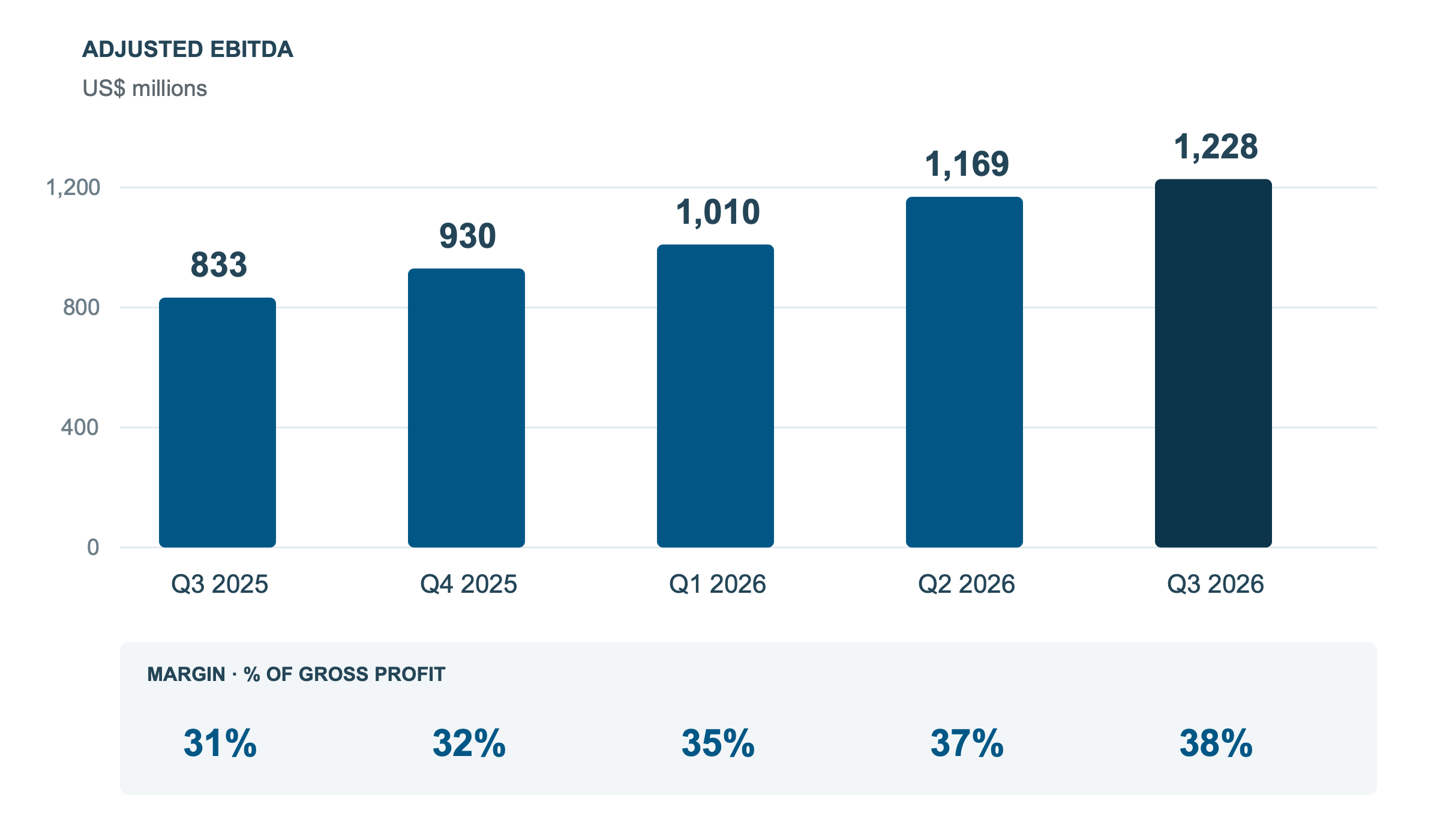
This is the financial arithmetic we like: strong underlying growth, substantial operating leverage and profits growing considerably faster than the business itself.
The extraordinary economic opportunity in product development
Block’s shareholder letter, which your author really looks forward to each quarter, devotes enormous attention to new products, distribution and the integration of AI into its operations.
For us, this is not a distraction from the financial results. It is central to the investment thesis.
Square processed US$76.4bn of payments during the quarter, an increase of 14%, its fastest growth since early 2023. International volumes increased 26%.
Yet only 16% of Square’s US sellers currently use its monetised software products. That leaves an enormous opportunity to sell additional services to businesses already connected to its payments’ infrastructure.
The pace of innovation is accelerating. Square released more than 180 new features in the first nine months of 2026, exceeding the combined number released in 2024 and 2025. These include Squaremates, an AI-powered business assistant that can analyse staffing, prepare marketing campaigns and assist with purchasing and inventory management.
Block is also developing its own AI infrastructure and tools, initially to improve internal productivity but increasingly as products that can be sold to other businesses.
The important advantage is not simply access to AI. It is Block’s combination of distribution, transaction information, established customer relationships and the capacity to turn intelligence into useful financial and commercial products.
Sixty million customers, and considerable room to grow
Cash App now has 60 million monthly transacting customers and generates more than US$8bn in annualised gross profit.
Its consumer lending originations increased 40% to US$19bn in the quarter, while the integration of Cash App with Square through its Neighborhoods initiative is creating new opportunities to connect consumers with local businesses.
Cash App has 28 million active card users, but another 32 million monthly transacting customers who do not yet use the card. Even among existing customers, Block’s share of everyday spending remains relatively modest.
These are relatively simple measures of the opportunity: more customers, more products per customer and a greater share of their financial activity.
Importantly, the company is particularly well positioned among younger consumers, modern earners and small businesses — groups whose financial requirements are not always well served by traditional banking arrangements.
This aligns closely with the structural and demographic changes we have been discussing.
A remarkable contrast in valuation
The contrast with Australia’s major banks is becoming increasingly difficult to ignore.
This week NAB increased its forward-looking credit provisions by A$403m, recognising the possibility of deteriorating credit conditions. At the same time, the major banks continue to trade on elevated earnings multiples, despite prospective earnings growth of only 2–5% at best, before allowing for further deterioration in credit conditions.
Block, meanwhile, has delivered sustained strong growth and is forecasting another substantial increase in profitability.
Before this week’s sharp share-price rise, Block was approaching a lower prospective P/E than the Australian major banks, despite its vastly superior growth outlook. Clients already own Block (XYZ), having purchased shares at prices approximately 30% below current levels.
An important distinction is that Block’s earnings come from a combination of transaction processing, value-added financial and software services, and credit. Much of its growth opportunity comes from increasing the value of services provided across its existing customer networks, rather than simply expanding lending. Nevertheless, credit represents a genuine source of risk. Transaction, loan and consumer receivable losses increased 66% this quarter, substantially faster than gross profit, reflecting growing loan volumes and changes in product mix. Although management reports that lending returns remain attractive, underwriting quality and credit losses will become increasingly important as the portfolio grows, particularly in a weaker economy.
Nevertheless, the difference in prospective growth is striking.
Macquarie Group (MQG), another important portfolio holding, is also investing continually in new capabilities, markets and financial products. We draw a sharp distinction between the financial services companies we choose to invest in and those we choose to avoid.
Block remains a top-ten portfolio position because we believe it is building the right products, for the right customers, using capabilities that should become more valuable with scale.
For the first time in a considerable period, we believe the valuation offers a reasonable price for this combination of growth, innovation and expanding profitability. The investment opportunity is no longer simply about what Block might become. Increasingly, it is about what the company is already delivering.
Past performance is not a reliable indicator of future performance.
No assurance or guarantee is given that any forecast, target or projection will be achieved. Forward-looking statements are based on assumptions and information available as at 6 November 2026 and are subject to risks, uncertainties and factors beyond First Samuel’s control. Actual outcomes may differ materially.
Any advice contained on this website is of a general nature only and has been prepared without taking into account your personal objectives, financial situation or needs. Because of that, before acting on any advice on this website, you should consider whether the advice is appropriate for you having regard to your objectives, financial situation and needs.