
Singapore · The future of money
Singapore: innovation, fugazi and the future of money

Copyright 2026 First Samuel Limited
The market
FYTD: ASX and Wall Street
Oct 2026 (MTD) · Australia +0.0596% · US +3.2599%
Source: IRESS. View original chart ↗
View chart data
| Period | Australia: ASX/S&P 300 | US: S&P 500 |
|---|---|---|
| Jun 2026 | 0.0000% | 0.0000% |
| Jul 2026 | +2.1200% | -0.1300% |
| Aug 2026 | +3.3250% | +2.4866% |
| Sep 2026 | +0.0496% | +2.0254% |
| Oct 2026 (MTD) | +0.0596% | +3.2599% |
The week: ASX and Wall Street
Week · Australia +0.9244% · US -0.2742%
Source: IRESS. View original chart ↗
View chart data
| Period | Australia: ASX/S&P 300 | US: S&P 500 |
|---|---|---|
| Mon | +0.7260% | +0.5947% |
| Tue | -0.0676% | -0.0550% |
| Wed | -0.6359% | -0.0229% |
| Thu | -0.1717% | -1.1083% |
| Fri* | +1.0800% | +0.3254% |
| Week | +0.9244% | -0.2742% |
A tale of two economies
Having travelled through Southeast Asia for decades, it is impossible not to be struck by the ongoing transformation of Singapore. The quality of its infrastructure, sophistication of its economy and youthful energy of its technology and business communities are remarkable.
Singapore has almost none of Australia’s natural advantages. It has little land, virtually no natural resources and operates within a political system that significantly constrains civil and political freedom. Yet it has built one of the world’s most prosperous and technologically sophisticated economies.
There is an uncomfortable trade-off here. Singapore’s capacity to establish long-term priorities, invest strategically and build institutions capable of executing those priorities comes with political compromises Australians should not be eager to make. But the results cannot be dismissed.
Singapore ranked fifth globally in the 2025 Global Innovation Index, compared with Australia’s 22nd. With research and development spending around 2% of GDP, world-class universities, sophisticated infrastructure and an extraordinary capacity to attract international talent, Singapore has developed an innovation ecosystem extending well beyond its physical limitations.
The comparison with Australia in 2026 is almost dystopian. And not in a good way.
Australia enjoys extraordinary natural wealth, political freedoms and a vast endowment of land, minerals and energy. We have been considerably less successful at financing businesses and investments that might make the country wealthier.
Singapore, with almost nothing, has systematically manufactured competitive advantages. Australia, with almost everything, seems content to capitalise the advantages it inherited.
The Big Short meets the future of money
Against this backdrop, we spent last week in Singapore to better understand how advances in artificial intelligence, financial technology and digital assets are reshaping financial markets, economic activity and public policy. Our research program included more than 15 independently arranged meetings with academics, economists, business leaders, technology innovators and public policy experts. We also attended Token2049, one of the world’s largest digital asset and cryptocurrency conferences.
Token2049, attracting approximately 25,000 participants, hundreds of speakers and 500 exhibitors, was extraordinary. Propulsive vision meets high-octane digital circus. Genuine technological breakthroughs, enormous fortunes (has anyone heard of TRON) extravagant promises and plenty that might politely be described as fugazi.
I couldn’t help recalling the scene in The Big Short where investors arrive at the American Securitization Forum in Las Vegas. The entire financial industry is celebrating a spectacular boom in financial engineering, seemingly oblivious to the possibility that much of the wealth being created is an illusion.
Among the personalities at Token2049 was Eric Trump, not the smartest Trump, but an appropriate reminder of the extraordinary intersection of money, politics and speculative enthusiasm.
Yet dismissing the conference as another cryptocurrency circus would be a serious mistake.
In July 2025, the United States passed the GENIUS Act, establishing a regulatory framework for privately issued US dollar stablecoins. Beneath the speculative excess, an important technological and geopolitical contest is emerging over the future infrastructure of money.
And unlike much of the cryptocurrency industry’s original promise, this one has considerable economic substance.
Stablecoins: crypto’s useful offspring
The cryptocurrency industry originally promised an alternative to conventional money. Ironically, one of its most useful inventions may instead be a better way to distribute conventional US dollars.
A stablecoin is a digital token designed to maintain a fixed value, generally one US dollar. Unlike Bitcoin, its purpose is not price appreciation. Its value comes from being transferable, widely accepted and readily redeemable.
The mechanism is straightforward. An issuer receives dollars, creates digital tokens and invests the backing funds in reserves, typically cash and short-term US Treasury securities. The tokens move between digital wallets across blockchain networks, with transfers recorded on a shared digital ledger. The issuer generally earns the interest on reserves, while the holder receives a transferable digital dollar.
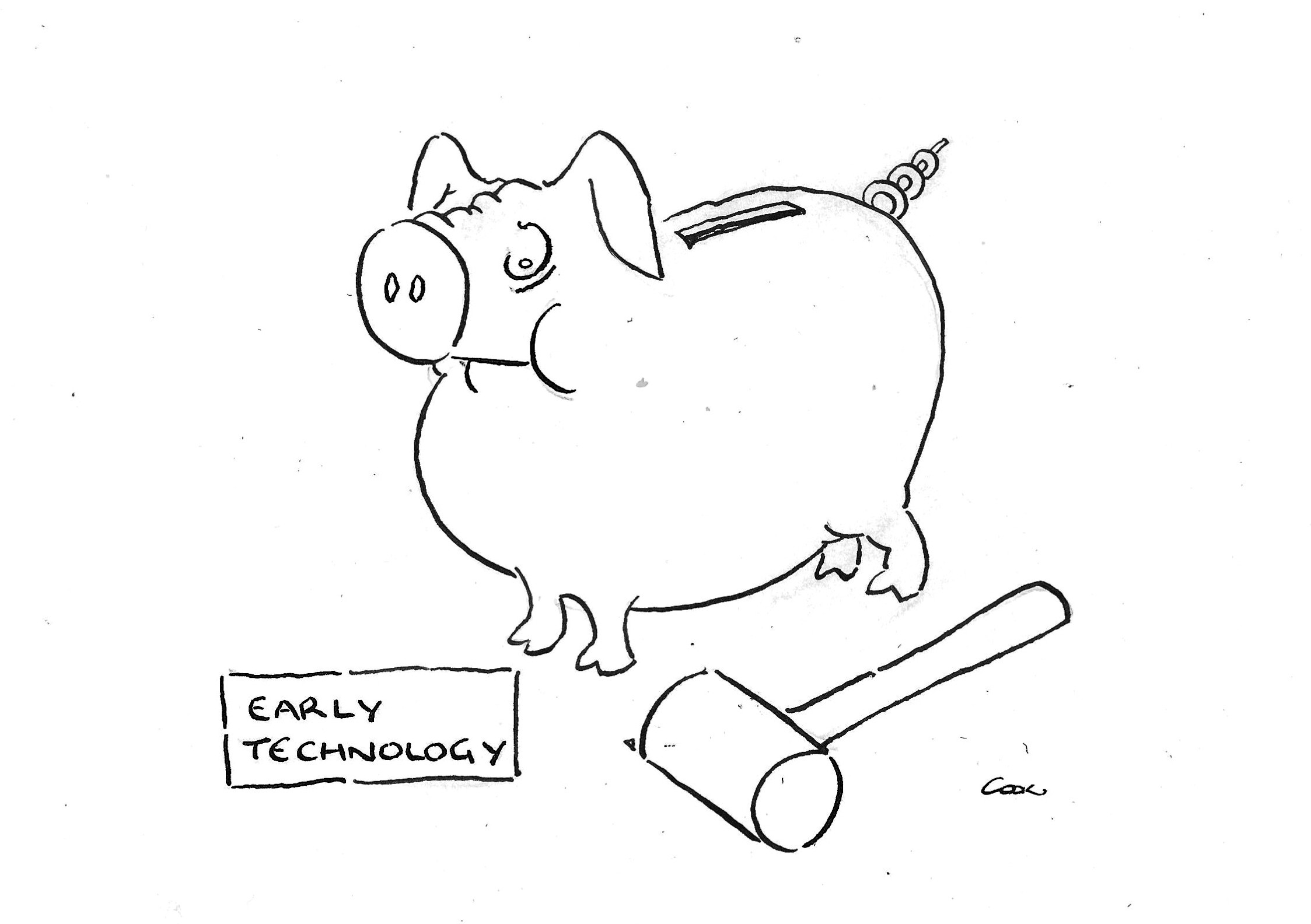
Stablecoins emerged because cryptocurrency traders needed something resembling conventional money to move between speculative investments without returning constantly to the banking system.
But the infrastructure could have applications far beyond cryptocurrency.
International payments, corporate treasury, collateral management and securities settlement remain burdened by delays, fragmented institutions and expensive intermediaries. Enormous amounts of capital sit idle or are trapped across different institutions, currencies and jurisdictions.
Programmable payments, tokenised assets and continuously accessible financial markets could reduce these inefficiencies. Even TD’s and savings and company transaction accounts could become transferable digital assets, allowing businesses to earn a return on liquidity until the moment it is required.
The potential is not the creation of wealth through financial engineering, but the release of existing capital from inefficient financial arrangements.
The geopolitics of digital dollars
The GENIUS Act is not simply an endorsement of financial innovation. It is also an attempt to extend the international dominance of the US dollar.
US Treasury Secretary Scott Bessent has explicitly linked stablecoin growth to increased demand for US government debt and the preservation of dollar supremacy. There is now more than $200bn of stablecoins minted.
An industry established partly to escape the conventional monetary system is becoming a potentially important financier of American government borrowing.
For China and other Asian countries, the implications are very different.
Widespread circulation of privately issued digital US dollars presents a challenge to monetary sovereignty, potentially weakening domestic currency demand, complicating capital controls and extending American financial influence.
What appears to Western technology enthusiasts as the democratisation of money can appear to Asian governments as the erosion of national sovereignty.
The cryptocurrency industry’s original ambition was to escape the established monetary order. Its most commercially useful invention may instead extend the reach of that order.
AI agents: goodbye to banking hours
Perhaps the most interesting development emerging from our meetings was the convergence of artificial intelligence, digital wallets and programmable money.
People are not particularly captivated by banking. They are captivated by technology that makes their lives easier.
AI is already providing inexpensive, accessible and non-judgmental assistance with information, research and everyday decisions. Why should financial services be different?
The recent launch of Meta’s Muse provides a glimpse of what might follow. Released in September, Muse is a personal AI agent designed to do more than answer questions. It can organise activities, book travel, send emails, navigate websites and make purchases on behalf of users. Integrated with Stripe’s payment infrastructure, it can already complete approved transactions using digital payment credentials. It has attracted millions of downloads in little more than a month.
The prospect of agents continuously monitoring savings rates, borrowing arrangements, investment alternatives and foreign exchange costs is compelling. But allowing an AI agent to move money, select investments and execute transactions autonomously is another matter altogether. Reliability, security, accountability and liability remain formidable problems. Hallucination and incorrectly executed financial transaction don’t go together.
Yet the enthusiasm for Muse suggests plenty of consumers will jump headfirst into these technologies long before their risks are understood. Adoption is unlikely to follow an orderly path, and innovation may race well ahead of regulation.
Combined with digital wallets and stablecoins, such agents could eventually transact directly with businesses and other agents, bypassing much of the existing financial distribution system.
Bank customers may ultimately have little reason to open a banking app, contact a call centre or visit a branch.
Banks: the extraordinary value of inertia
This presents an interesting problem for banks.
One of the banking industry’s most valuable assets is customer inertia.
Banks earn substantial profits because customers leave money in accounts paying considerably less than alternative available rates. Switching is inconvenient, comparisons are difficult and the existing arrangements are familiar.

AI agents that continuously optimise returns and costs could challenge these profits. Digital financial infrastructure could undermine the value of controlling payment systems and customer relationships.
We were impressed by the willingness of several Asian financial institutions to acknowledge these threats, discuss their ageing technology and explore partnerships with competitors. DBS, who we met and Partior are among the organisations developing alternative approaches to payments and settlement.
But tokenising an existing bank deposit does not necessarily create greater competition. It can simply reproduce existing financial relationships on newer technology.
The Financial Times recently captured the scale of the challenge:
“This sector needs an AI initiative capable of bringing banks, regulators and companies such as OpenAI and Anthropic to the same table. Making banking better is no longer the story. The battle for what form banking will take in the future has already begun.”
We agree. The challenge extends well beyond making banks more efficient. It concerns who will control the financial infrastructure, who will own the customer relationship and whether the enormous profits generated by financial intermediation will continue to accrue to the same institutions.
This is not an argument that banks will disappear. Their roles in credit creation, maturity transformation and risk management remain fundamental. But their dominance of payments, deposits and customer distribution is considerably less assured.
And this raises an uncomfortable question about the valuations investors are currently prepared to pay for Australian banks.
Australian banks: expensive at a point of change
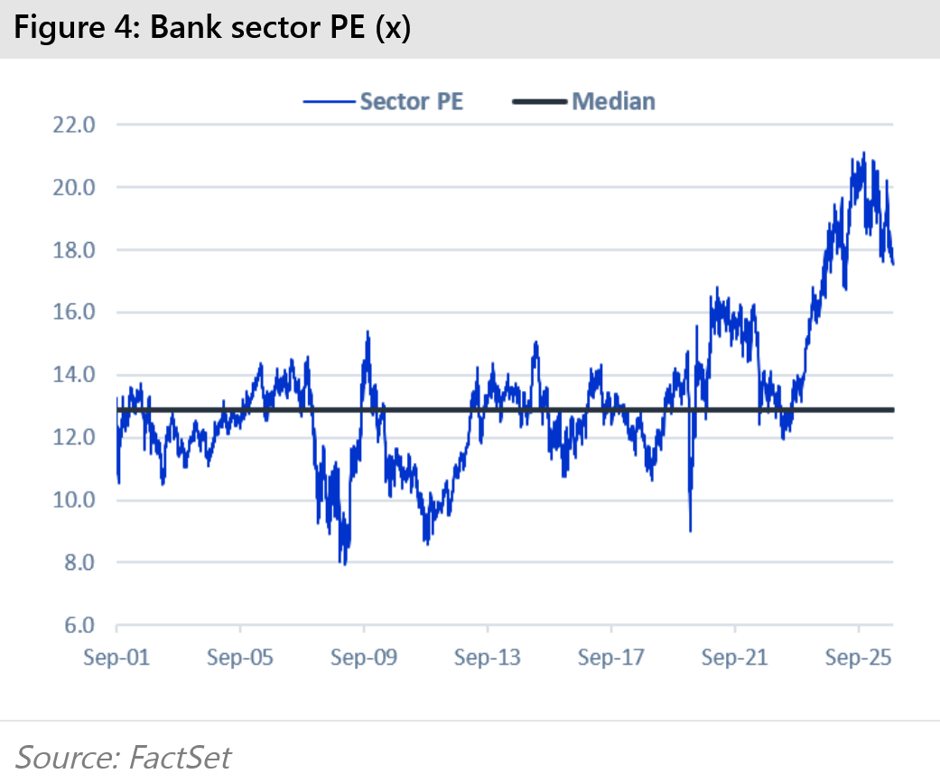
As the accompanying chart shows, Australian bank P/E ratios have retreated from their extraordinary recent highs but remain around 17.5–18 times earnings, compared with a long-term median of approximately 13 times.
Investors are still paying roughly 35% above the historical median for an industry confronting both cyclical deterioration and the possibility of structural disruption.
Australian bank sector P/E
The risks are not confined to technological change.
Australia’s credit environment is becoming more difficult. Housing prices have softened, debt servicing remains demanding and pressures on business cash flows are increasing. The availability of private credit as an escape valve for more troubled borrowers has also diminished.
Meanwhile, business lending is becoming more important relative to housing credit. We welcome this development. Financing productive businesses should contribute more to national wealth than continually increasing the price of existing houses.
But business lending generally requires more regulatory capital than prime residential mortgages. The same dollar of lending can therefore generate a lower return on equity, other things being equal. A meaningful change in credit composition could put pressure on the exceptional profitability and capital distributions investors have come to expect.
Add to this the possibility that technology increasingly challenges the banks’ extraordinarily valuable deposit franchises.
The sector’s elevated valuations seem to anticipate the continuation of yesterday’s profitability, despite mounting evidence that tomorrow’s financial system may look rather different.
The RBA: protecting the system or protecting the banks?
The Reserve Bank faces a difficult challenge.
Assistant Governor Brad Jones has been actively advancing work on tokenisation, programmable settlement and digital money. Project Acacia has explored opportunities to improve liquidity, reduce costs and increase efficiency across wholesale financial markets.
We welcome this work and believe he really gets it.
But the distinction between protecting the stability of the financial system and protecting the profitability of its incumbent institutions can become dangerously blurred.
Australia needs safe deposits, reliable settlement arrangements and a resilient financial system. None of these objectives necessarily requires preserving the extraordinary market power of four dominant banks.
At points of fundamental technological change, established institutions possess the resources, regulatory relationships and influence to shape the rules governing emerging competitors.
Will Australia’s regulatory framework encourage genuinely interoperable money, competition and new financial services? Or will it recreate the existing banking oligopoly using more modern technology?
We believe we are approaching precisely such a point of change.
Innovation, investment and the next financial system
The speculative excesses of Token2049 may eventually look remarkably similar to the securitisation boom portrayed in The Big Short. Many fortunes will disappear. Some financial structures will prove to be little more than fugazi.
But the underlying infrastructure may prove considerably more enduring than the fortunes currently being made from it.
As investors, we must distinguish technological value creation from the returns ultimately captured by shareholders. Customers may be the largest beneficiaries, while many technology providers disappear and established financial institutions lose their economic rents.
And that brings us back to Singapore.
A country that has spent decades investing deliberately in its future seems an appropriate place to contemplate the next reinvention of money.
Australia has repeatedly demonstrated a preference for preserving the value of existing assets and institutions rather than encouraging the creation of new productive capacity.
At a time when the infrastructure of finance itself may be changing, that preference could become considerably more expensive.
Past performance is not a reliable indicator of future performance.
No assurance or guarantee is given that any forecast, target or projection will be achieved. Forward-looking statements are based on assumptions and information available as at 15 October 2026 and are subject to risks, uncertainties and factors beyond First Samuel’s control. Actual outcomes may differ materially.
Any advice contained on this website is of a general nature only and has been prepared without taking into account your personal objectives, financial situation or needs. Because of that, before acting on any advice on this website, you should consider whether the advice is appropriate for you having regard to your objectives, financial situation and needs.