Copyright 2026 First Samuel Limited
The final week of company profit reporting season reinforced many of the themes that have been building through August. The clearest area of weakness remained domestic spending. Consumers are still under pressure, trading down where they can and becoming increasingly selective about discretionary purchases. Even Chemist Warehouse, one of the strongest structural growth stories in Australian retail, and the perennial darling Bunnings disappointed the market on sales. There was little in the week to suggest that the domestic consumer is about to become dramatically more generous.
Against that backdrop, the strongest results in our portfolios came not from companies relying on a booming economy, but from businesses improving their own execution. This was particularly evident among some of our cheapest value-oriented holdings. EarlyPay, Bapcorp, Integral Diagnostics and Paragon Care all demonstrated that when expectations are low, relatively modest improvements in operating performance, cash generation and management discipline can create substantial value. We have spent much of the past year arguing that a weak share price and a weak business are not necessarily the same thing. Reporting season provided several useful reminders of that distinction.
The miners also delivered something investors have waited some time to see: dividends returning alongside stronger balance sheets. After several years in which capital was directed toward acquisitions, new mines and debt reduction, companies including Sandfire and Aurelia are now in a position to return cash while still funding future growth. That transition matters.
Perhaps the most striking portfolio outcome during August, however, came from property. Our contrarian positioning has dramatically outperformed the listed property index during the month. The market has been reminded, sometimes painfully, that property is not a single asset class and that leverage, funding costs, development exposure and asset quality matter enormously at this point in the cycle. Avoiding the obvious winners of the previous cycle has proved just as important as finding the next ones.
Read the previous Investment Matters here
The market
Final week of reporting season
| Company | Event & Market Reaction since Result | Commentary |
| Woolworths Ltd (WOW) POSITIVE | FY26 Result 26th August Movement since June 30 2026: -3% Movement post result: +2 | See detailed report |
| Nanosonics Ltd (NAN) NEGATIVE | FY26 Results 25th August Movement since June 30 2026: +11% Movement post result: -27% | The numbers printed ok. The core business (Trophon) is operating ahead of expectations and providing strong cash flow. However, the market is concerned this cash is being heavily invested into the commercialisation of CORIS, the new product, which will take time to reach scale. The $40m drag to fund CORIS is real, but ignoring the optionality of this growth project is harsh, in our view. Meeting management in the coming week to assess the opportunity the sell-off provides. |
| EarlyPay Ltd (EPY) POSITIVE | FY26 Results 27th August Movement since June 30 2026: +0% Movement post result: +17% | Today’s financial results outperformed the market’s subdued expectations, highlighting significant fundamental value. Trading at a highly compressed multiple, the stock remains fundamentally cheap. If this positive earnings trajectory persists, we expect a powerful upward re-rating of the share price and the business remains an attractive acquisition target. |
| Aurelia Metals (AMI) NEUTRAL | FY26 Results 27th August Movement since June 30 2026: +50% Movement post result: +5% | See detailed report |
| Bapcor (BAP) POSITIVE | FY26 Results 25th August Movement since June 30 2026: +5% Movement post result: +45% | Bapcor delivered slightly above guidance EBITDA for FY26 of $153 million, down 34% year on year. Initiatives at Bapcor are showing early signs of a changing fortune. With improvements in debt and stabilisation in the core business, balance sheet risks are now declining, prompting the dramatic share price rise +45%. After a terrible FY26, some value remains in Bapcor as we expected. |
| Paragon Care (PGC) POSITIVE | FY26 Results 25th August Movement since June 30 2026: +4.0% Movement post result: -4% | Results were modestly ahead of expectations. Paragon Care’s FY26 result reflected a disappointing year, but many of the negatives were well flagged. Earnings were weighed down by the Infinity bad debt, transformation costs and the work required to bed down a series of acquisitions. Beneath those issues, however, there were encouraging signs of structural improvement across several businesses, including strong growth in Asia and better execution through the enlarged group. With many of the one-off costs now absorbed and the operating platform improving, Paragon enters FY27 from a considerably stronger base. |
| Integral Diagnostics Ltd (IDX) POSITIVE | FY26 Results 25th August Movement since June 30 2026: +14% Movement post result: +2% | Pre-released the result on August 10 (discussed in this publication Aug 14), and so thankfully there were no surprises this week. The presentation highlighted the opportunity ahead of IDX if management can convert the favourable industry backdrop into sustainable organic growth. Success will deliver a step change in scale and margins, a de-geared balance sheet, higher dividends and an appropriately higher share price. |
| Worley Ltd (WOR) NEUTRAL | FY26 Results 26th August Movement since June 30 2026: +0% Movement post result: -4% | In line with the FY26 EBITA result, the prolonged Middle East conflict is set to see ongoing related project deferrals, which will drag on the growth outlook and backlog. FY27 EBITA guidance was c.3% below cons, with a 2H skew expected. But trust is low with a management team full of excuses for many years. Given work backlog declined -17% and project deferrals could continue, the market simply lost patience. Ostensibly cheap at 12x P/E around prior cyclical lows, any Middle East resolution or recovery in project activity would unlock a positive re-rate. |
| Inghams Group Ltd (ING) NEUTRAL | FY26 Results 21st August Movement since June 30 2026: +8% Movement post result: -7% | FY26 EBITDA hit guidance levels with some sense of stabilisation and predictability returning to the business. Despite input cost pressures and a soft wholesale environment, margins should start to recover in FY27. Execution was improved, and our valuation increased 2-3%. Given the lingering market pessimism about bird flu despite overseas experience, we are not rushing to increase our position. Volatility will remain in this stock price, but the value proposition continues to improve. |
| Independence Group Ltd (IGO) POSITIVE | FY26 Results 27th August Movement since June 30 2026: +11% Movement post result: +1% | Progress at its world-class hard-rock Greenbushes lithium mine pleased the market. Experience of the past two years, however, highlights the risks: fire, ongoing failure of the Kwinana chemical plant, and a problematic relationship with its Chinese partner, all of which threaten IGO’s 25% of cash flows from the world’s best lithium hard rock orebody. Kwinana continues to leak value, and IGO delivers little value from its expensive corporate overheads (FY26 ~$50m) and exploration (FY27 $35-40m). Upside from better execution, and the value of the underlying asset remains the core investment thesis, with value still to be unlocked. We are, however, conscious of locking in some recent profits. |
| Sandfire Resources Ltd (SFR) POSITIVE | FY26 Results 26th August Movement since June 30 2026: +19% Movement post result: +2% | See detailed report |
| Santos Ltd (STO) POSITIVE | FY26 Results 19h August Movement since June 30 2026: +12% Movement post result: -4% | We were pleased with Santos’ first-half result – underlying profit of US$397m ahead of expectations, and the market gained more confidence in the second half: Barossa and Pikka (new projects) are ramping strongly, production should rise 20–30%, and cash flow should improve materially. Cash flow and project upside are core investment themes for Santos. |
Sandfire Metals – Full year F26 Results
Cash today: optionality tomorrow
Sandfire’s FY26 result completed a remarkable multi-year transformation of the business. Record revenue of US$1.7bn and underlying EBITDA of US$867mn were supported by strong copper prices, record processing rates at MATSA (Spain) and Motheo (Botswana) and continued operating discipline. More importantly, Sandfire finished the year with US$353mn of net cash, having added around US$750mn to its balance sheet over the past two years.
Figure #1: Sandfire assets, note the geographical diversity
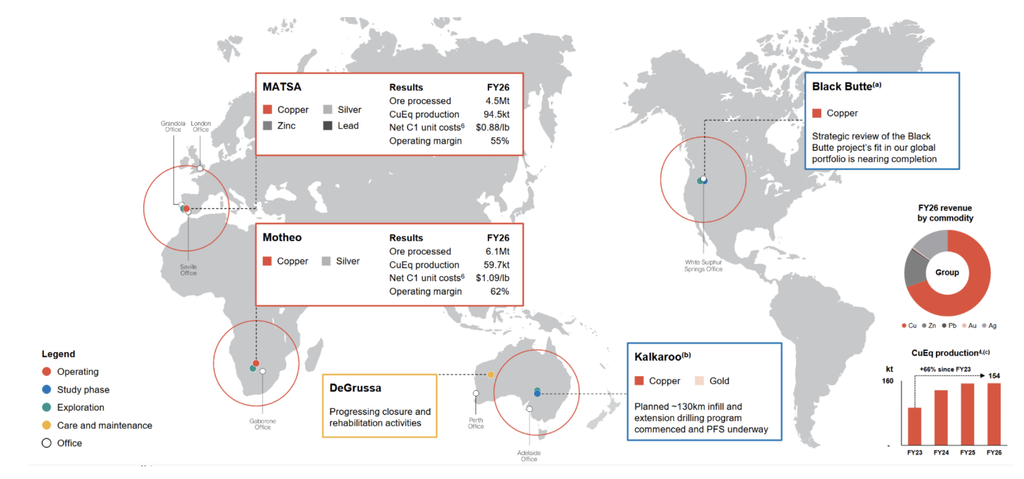
Source: Sandfire FY26 Company Presentation
The scale of the transformation is worth remembering. As of June 2023, following the acquisition of MATSA and while Sandfire was still funding the development of Motheo, the company carried net debt of US$430mn, generated Group EBITDA of just US$246mn, and its shares traded at $5.90. Three years later, EBITDA has risen to US$867mn, net debt has disappeared and been replaced by US$353mn of net cash, and the shares are around $23. That is a substantial reward for several years during which shareholders had to fund and tolerate the risks of building a very different company.
Investors were also rewarded directly with cash in FY26. Sandfire declared a 35-cent fully franked final dividend, the first meaningful return of capital under the balance-sheet and capital-management strategy that management has spent several years constructing. We loved it. The dividend is more than simply a welcome cheque: it marks the point at which the acquisition of MATSA, the construction of Motheo, and the subsequent balance-sheet repair have begun to return cash directly to shareholders.
Increasingly, however, the investment case is about what comes next. Sandfire now owns an unusually broad range of organic growth options around two existing operating hubs. At MATSA in Spain, drilling at Magdalena West extended mineralisation beyond the existing resource boundary, while La Juliana produced encouraging high-grade polymetallic massive-sulphide intersections. At Motheo in Botswana, drilling north of the existing A1 resource continued to intersect copper mineralisation, while results from A4 West point to potentially valuable underground extensions.
These tonnes are particularly attractive because much of the processing infrastructure already exists. The maiden A1 reserve has already added roughly another year of mine life at Motheo, while Sandfire’s longer-term ambition remains a minimum 15-year reserve life across its operating hubs. FY27 will see another substantial exploration program across both the Iberian Pyrite Belt and Kalahari Copper Belt.
Then there is Kalkaroo. The recently acquired South Australian copper-gold project provides Sandfire with another potentially large development option. Sandfire plans an extensive drilling program across the deposit and surrounding Curnamona Province to better define its scale and economics before committing significant capital.
This combination is what continues to attract us to Sandfire. MATSA and Motheo now generate substantial cash; the balance sheet has been repaired; shareholders are receiving dividends again; and the company has several avenues for reinvestment at attractive rates of return. Exploration around existing infrastructure, extensions at A1 and A4, Kalkaroo and longer-dated projects mean Sandfire no longer needs one large new mine to work. It has built a portfolio of copper growth options increasingly funded from its own cash flow.
The only real problem with Sandfire today is the price. We remain conscious of maintaining meaningful copper exposure across portfolios — generally 4% or more — but equally conscious that paying too much for that exposure simply replaces commodity risk with valuation risk. Rio Limited (RIO) is now expensive, Aurelia (AMI) has risen around 50% since 30 June, and Sandfire’s extraordinary share-price appreciation has made the copper basket considerably less cheap.
This is a good problem to have, but strong portfolios are maintained by occasionally realising profits. Sandfire remains attractive because of the optionality in Kalkaroo, Black Butte and around its existing operations, while strong zinc and other by-product prices should help fund that growth. However, this week’s reserves and resources update was not especially strong, and we are reluctant to assume materially longer mine lives than roughly 16 years at MATSA and 10 years at Motheo without better drilling results. With the shares now trading above our valuation, some caution is warranted. The balance sheet is pristine, the dividend has returned and free cash flow could exceed US$550 million across FY27–28 on current estimates, implying a yield above 7%. We like the company enormously; at current prices, we simply like it a little less.
Woolworths Limited FY26 Results
Sales first, profits follow
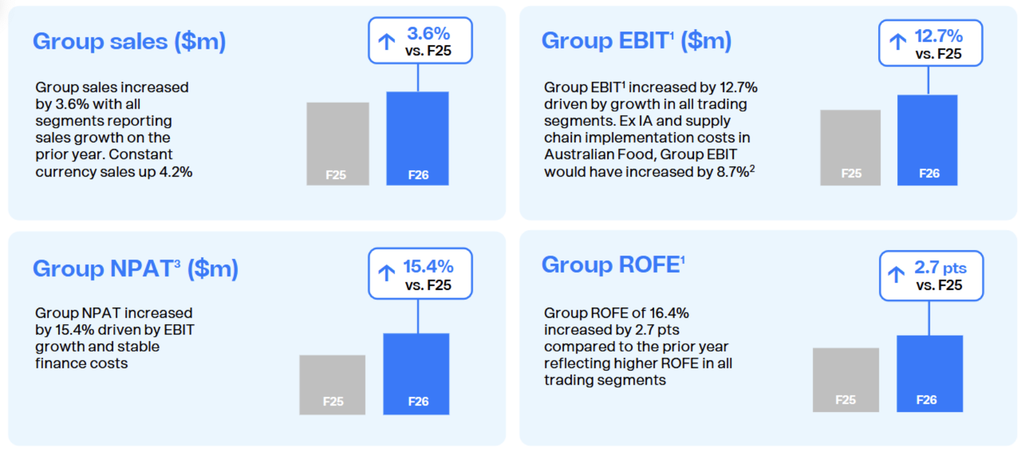
FY26 was the clearest evidence yet that CEO Bardwell’s repair of Woolworths is working. There was a time when we weren’t sure the turnaround had traction. The headline numbers were strong: group sales rose 3.6%, EBIT 12.7% and underlying NPAT 15.4%, while ROFE (return on funds employed) increased 2.7 points to 16.4%.
Some of the EBIT growth was the reversal of last year’s industrial action and supply-chain disruption; excluding those effects, group EBIT still rose 8.7%. More important than the precise number was the shape of the result. Woolworths is rebuilding the business in the right order: first create the conditions for sales growth, then use scale, productivity and better capital utilisation to turn that growth into faster profit growth.
Build the sales environment first
For a supermarket, the first task is not margin extraction. It is to give customers enough reasons to come back more often and add more items to their baskets. Woolworths has been investing in price, Everyday Rewards, fresh food, own-brand, availability, and promotion while simultaneously making online shopping and delivery easier. Australian Food sales rose 4.6% for the year and accelerated to 5.7% in H2, driven predominantly by item growth rather than inflation. Average shelf-edge availability improved 58 basis points, Fresh sales grew 7.7% in H2 and Value for Money scores improved. These are mundane retail measures, but they are the building blocks of a durable recovery.
Figure 2: FY26 results in four charts
Source: Woolworths FY26 Company Presentation
Ooshies helped – but the underlying momentum matters more
The first eight weeks of FY27 provided the strongest evidence yet of improved momentum. Australian Food sales rose 7.6%. About 1.5-2 percentage points came from Disney Ooshies – small Disney, Pixar, Marvel and Star Wars collectibles given to customers with each qualifying $30 shop. The promotion plainly worked: it encouraged existing customers to add a few more items and brought some new customers into Woolworths. Strip out the estimated Ooshies benefit and sales were still growing around 5.5-6%, a very strong starting point. The crucial issue is retention. A collectible can create the visit; Woolworths must earn the next one through price, fresh quality, availability, loyalty and convenience. Management says momentum has remained strong since the promotion ended, which is the more important observation.

From supermarket chain to multi-channel retailer
This is where Bardwell’s background in e-commerce matters. The shift from a traditional supermarket chain to a multi-channel retailer has been expensive and operationally difficult, but FY26 showed signs that Woolworths is learning how to make convenience profitable rather than simply subsidising it. EComX sales grew 18.6%; average weekly visits to Woolworths’ digital platforms reached 14 million, up 22.9%; and more than 70% of e-commerce orders were placed through the app in Q4. Delivery in under two hours reached 47% of delivery orders, more than 850 stores now offer On Demand, and Direct to Boot more than doubled sales. Olive, Woolworths’ agentic AI shopping assistant, and Smart Basket are designed to reduce the friction of building the weekly shop. Connected customers spent 2.4 times as much as store-only customers in Q4. Critically, e-commerce profit improved substantially as scale, productivity and a greater mix of pickup and higher-margin convenience propositions began to work in Woolworths’ favour.
Then convert sales growth into profit growth
Sales growth only creates value if Woolworths can convert it. Here the result was encouraging. Australian Food gross margin was slightly lower as the company reinvested in price and promotions, but cost of doing business fell 22 basis points as a percentage of sales. At group level, 3.6% sales growth became 12.7% EBIT growth. The cleanest underlying numbers are less dramatic – Australian Food EBIT growth was 4.8% excluding industrial action and supply-chain implementation costs – and analyst Craig Woolford correctly notes that unusually subdued depreciation growth also helped reported earnings. Management expects depreciation to grow modestly again. Even so, the direction is right: Woolworths’ stated medium-term ambition is for Food EBIT to grow faster than sales, and FY26 provided evidence that this is achievable without asking the customer to fund it through higher prices.
Working capital completes the picture
The second half of the story is capital. We were very disappointed with this aspect of the Woolworths business in FY25.
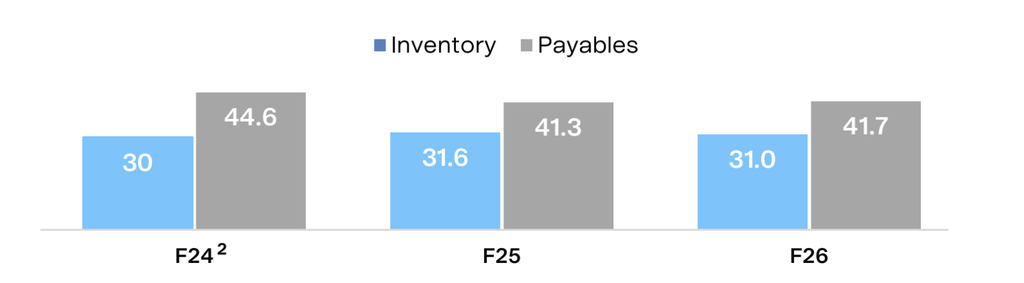
Average inventory days fell from 31.6 to 31.0 despite Woolworths deliberately carrying higher dollar inventory to protect the supply chain, while average payable days increased from 41.3 to 41.7. In other words, better sales and stock management improved working capital while on-shelf availability improved. ROFE rose from 13.7% to 16.4%, with Australian Food at 29.2%. This is precisely the combination we want: higher sales, stronger profits and better use of the capital tied up in the business.
Figure #3: Working capital improvement – average inventory and payables days
Source: Woolworths FY26 Company Presentation
Working capital improved alongside availability, while Group ROFE recovered to 16.4%. Source: Woolworths Group FY26 Results Presentation, page 27.
A core holding – but price still matters
Woolworths remains a core holding in client portfolios because the strategic problem it is solving is both difficult and valuable. A bricks-and-mortar grocery network must now compete simultaneously on price, fresh food, promotion, loyalty, delivery speed, pickup convenience and digital experience – and do so profitably.
FY26 was a meaningful step toward proving Woolworths can. But the share price also matters. The shares jumped 3.4% on results day after a rise of more than 50% from last October’s lows, and the subsequent giveback the following day was unsurprising.
We have made a few changes to our forecasts and continue to value Woolworths in the low $40s. It remains a core position, but near the top of our valuation range we will lighten rather than chase it, and look to buy again when cheaper. The next test is how this improved operating model performs as household conditions weaken and the Ooshies comparison rolls off. For now, the sales engine is working; the task is to keep converting it into profit and returns.
Aurelia Metals FY26 Results
Execution catches up with the geology
Aurelia Metals’ FY26 result was one of the strongest results of reporting season for a company we have written about for many years. The attraction remains unusual: a high-quality, long-duration position in the Cobar Basin with exposure across several of our minerals’ baskets. Copper mineralisation at Great Cobar was discovered in 1870; today’s Aurelia combines that remarkable mineral endowment with modern underground production of gold, copper, zinc, lead and silver. FY26 was the year when the quality of the geology was finally matched by consistently better execution.
The headline result was excellent. Revenue increased 40% to $480.2 million, statutory EBITDA rose 55% to $189.2 million and net profit increased 69% to $82.7 million. On the broker numbers, EBITDA was around 6% ahead of our expectations and 23% ahead of consensus, mainly due to better-than-expected costs. Operating cash flow reached $142.8 million, exceeding our forecasts for the past 2 years. June cash was $143.9 million, with no debt drawn.
The Board also resumed dividends with a fully franked 1 cent final dividend – the first in six years. We anticipate strong cash flow will support more expansive dividends in the coming years.
Federation has moved from promise to production
Federation was the key operational test of the previous CEO, and it passed. The mine ramped successfully, delivering 360kt of ore in FY26, around 30kt ahead of plan, while Peak improved and group ore processed rose 28% to 806kt. Aurelia also kept investing: Great Cobar development advanced, and the Peak plant expansion moved closer to lifting capacity from 800ktpa to 1.1-1.2Mtpa. High gold prices helped, but this was not simply a commodity-price result. More tonnes, better recoveries and better cost control all mattered.
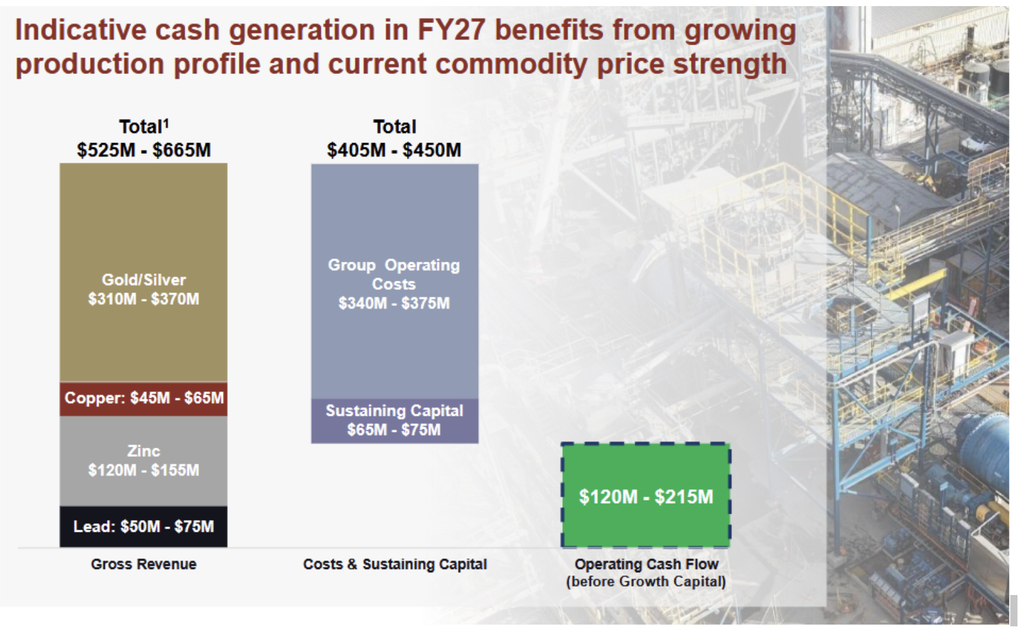
The most interesting chart is the cash-flow chart
The chart below is the part of the result we like most.
At current commodity prices and FY27 guidance, Aurelia illustrates $120-$215 million of operating cash flow before growth capital. Against a market capitalisation of about $737 million at Thursday’s close, that is a pre-growth-capital cash-flow yield of roughly 16-29%. It is not free cash flow – Aurelia still plans $50-$70 million of growth capital plus exploration – but it shows how much cash-generating capacity is now embedded in the existing asset base.
Figure #4: Position for cash generation in FY27
Source: Aurelia Metals FY26 Company Presentation
For several years, the company needed cash to build Federation and prepare the next projects. It can now plausibly fund $50-$70 million in growth capital, maintain exploration, maintain a conservative balance sheet, and still return capital to shareholders. The 1 cent fully franked dividend is modest in isolation; its importance is that it marks the transition from financing growth to financing growth and shareholder returns simultaneously.
FY27: more ore through the same system
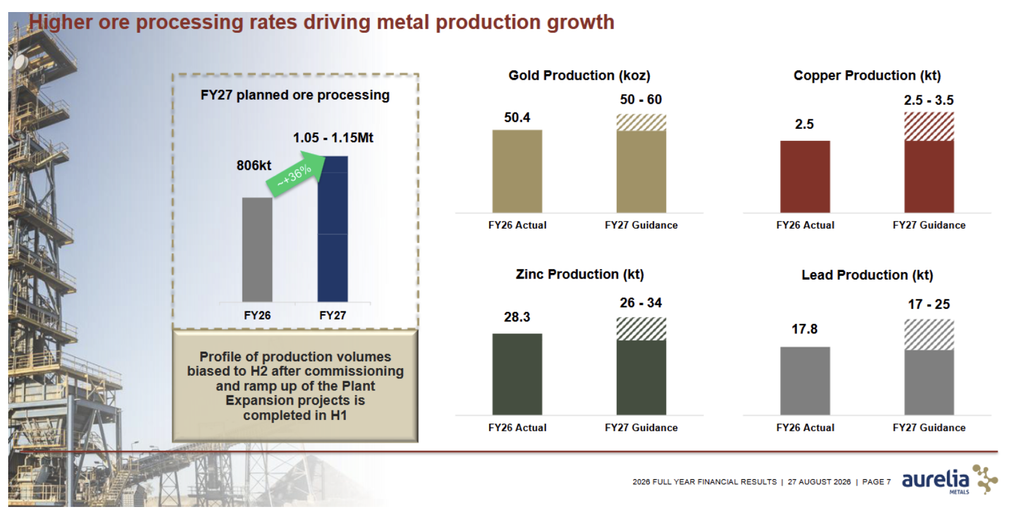
FY27 guidance is constructive as shown in the figure below. Aurelia expects to process 1.05-1.15Mt of ore, around 30-40% more than FY26, with production weighted to H2 as the plant expansion ramps up. Gold is guided to 50-60koz versus 50.4koz in FY26; copper to 2.5-3.5kt; zinc to 26-34kt; and lead to 17-25kt. On balance, this is close to our forecasts, with stronger gold offset by softer copper and slightly higher sustaining operating cost and capital spend. The more important point is higher throughput through the same processing system – precisely the setup required for operating leverage.
Figure 5: FY27 Production Guidance
Source: Aurelia Metals FY26 Company Presentation
Long duration is becoming more visible
Aurelia also remains a long-duration asset rather than a short-lived beneficiary of high gold prices. Group Ore Reserves increased 49% to 8.2Mt despite mining depletion. Great Cobar is now under development with first ore targeted for FY28, while Federation supplies zinc, lead, gold, copper and silver. Peak South is benefiting from stronger gold economics. Together, these assets give Aurelia unusual flexibility to change its production mix while retaining exposure to several commodities we want in portfolios.
A hard-rock operator for the next phase
We also appreciated the Board’s work on succession. Bryan Quinn’s three-year tenure helped move Aurelia from heavy investment and operational uncertainty to improving production, a debt-free balance sheet and restored dividends. After meeting the new Chair, Graeme Hunt, earlier this year, we were confident the Board would find a strong replacement. Steve Badenhorst, who starts on 6 October, fits the bill on paper: more than 35 years of operating experience, most recently as Rio Tinto’s Group Head of Asset Management, plus leadership of Glencore’s deep Kidd underground zinc-copper mine in Canada and earlier roles at Vale, BHP, De Beers and Anglo American. For Aurelia’s next phase, that hard-rock operating background is highly relevant.
The market has noticed
The market has noticed. Aurelia closed Thursday at 43.5 cents, up 4.8% on the result and around 55% since 30 June. The easy re-rating from proving it can execute has begun, but the investment case is now stronger for a different reason: Aurelia can increasingly fund growth from its own cash while retaining a strong balance sheet and returning capital to shareholders. Commodity prices and execution still matter, but FY26 materially increased our confidence in the long-term value of this unusual polymetallic portfolio.