
As company profit reporting season approaches, the headline indices are becoming a poor description of what is happening in markets. Beneath the surface, prices are moving sharply.
Movements across sectors and markets appear less consistent with either improving growth or falling risk, as we would normally expect. The contradiction is not confined to Australia. In this context, our investment team has recently focused on long-term questions that are now moving market prices.
Investment Matters will scratch the surface on a few this week.
- Inconsistent market moves in July as risks rise and war resumes
- The normalisation of long-term interest rates
- Coming to terms with lower Chinese growth
- Creating value from AI innovation: who wins and who loses
It is a little dry but potentially therapeutic.
Copyright 2026 First Samuel Limited
Read the previous Investment Matters here:
The market
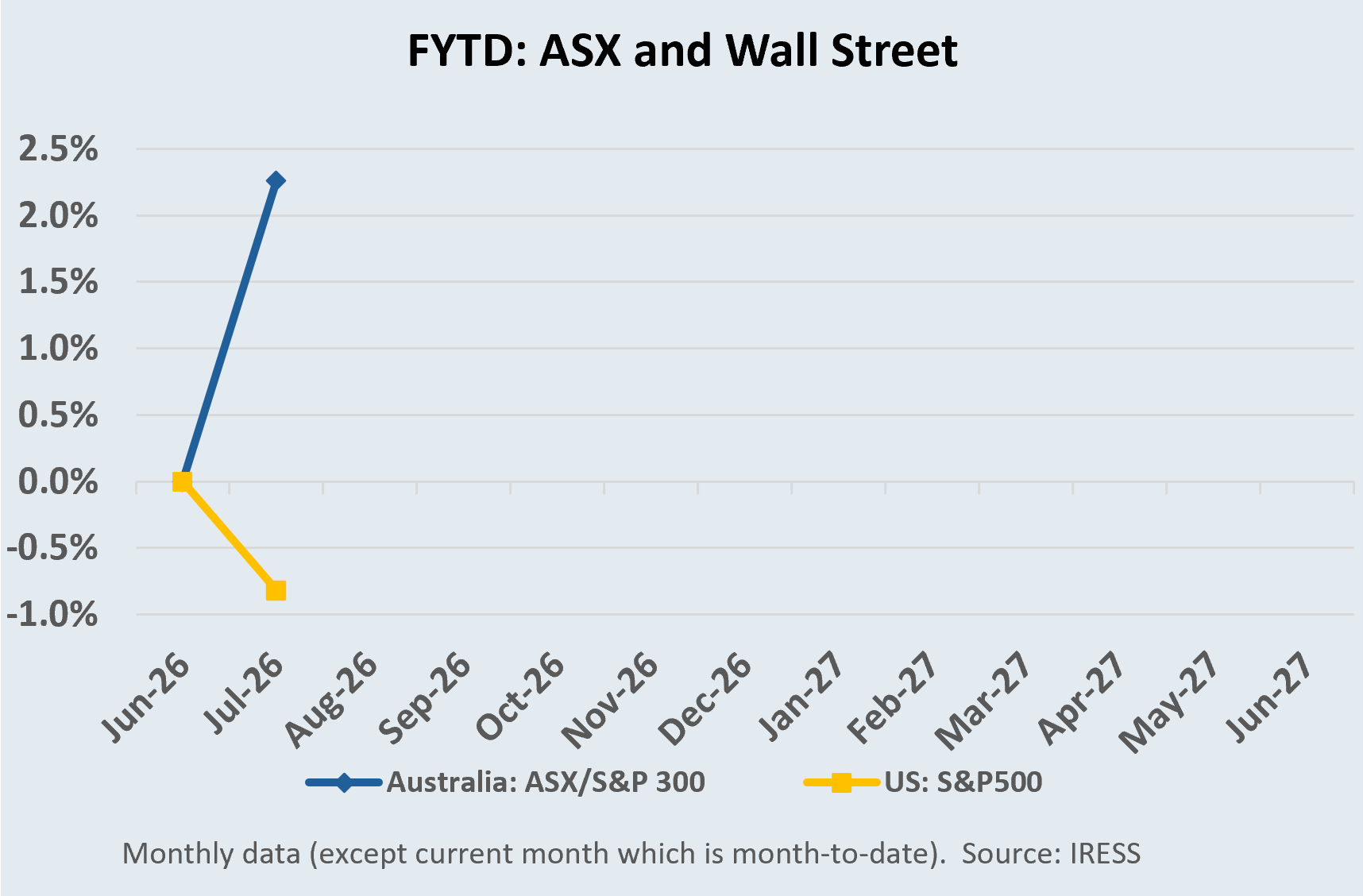
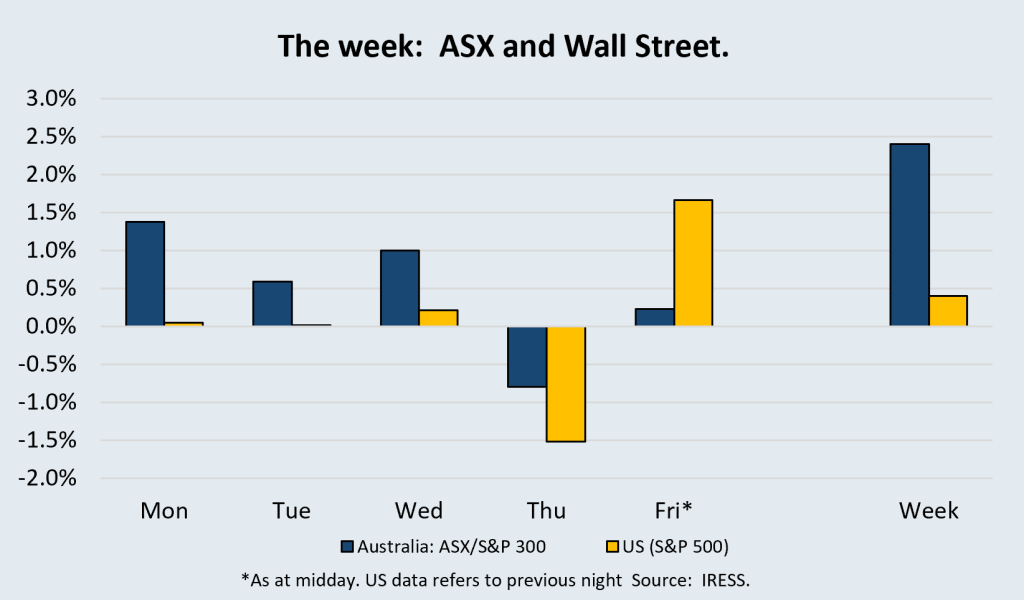
July – Inconsistent moves
Australian banks have surged. Small companies, materials and technology have weakened. In the United States, the Nasdaq has fallen sharply. The market is not calm. It is rotating.
Since the end of June, the big four Australian banks have risen by an extraordinary 8.2%; the rest of the market is down 0.3%. Over the same period, the Small Ordinaries index has fallen 4.5%, the entire Materials sector is down 2.3%, and Australian technology has declined 3.5%.
The Nasdaq, the US market dominated by large technology companies, is down 6.7%. The broad Australian index has therefore been flattened by the size and strength of the banks.
Figure 1: Aussie stocks closer to average PE, without the banks
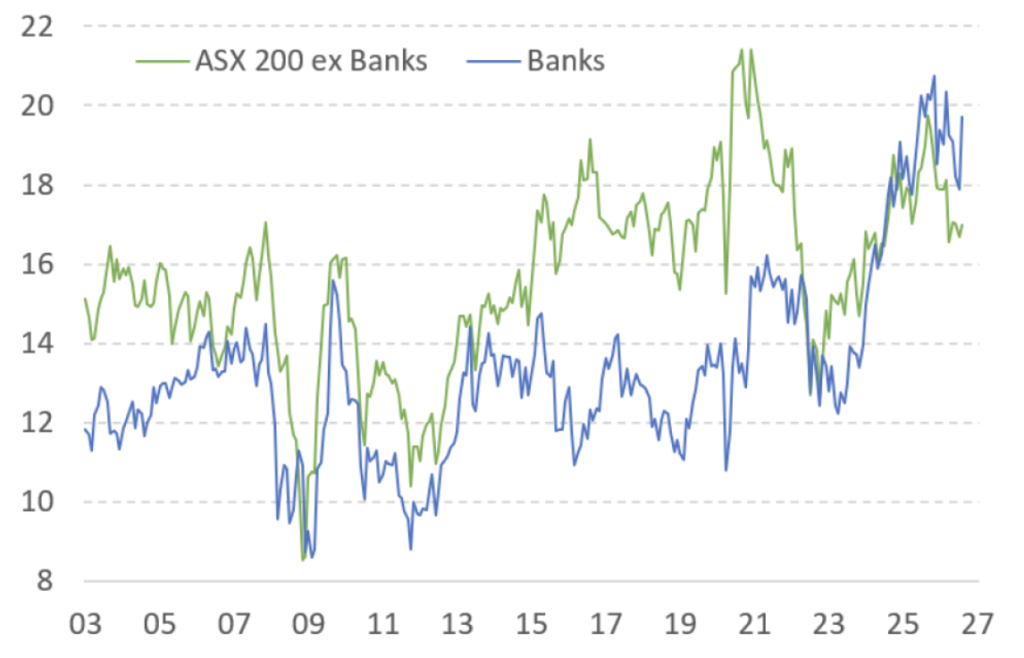
Source: LSEG, MST Marquee
The banks are being treated as defensive yield investments. They are large, liquid, pay franked dividends and performed poorly during the previous year, leaving room for a rebound. But the scale of the July move is difficult to reconcile with the operating backdrop. Housing prices are weakening from elevated levels. Home-loan applications have fallen sharply. Credit demand is slowing. The economy is softening, and the cost of credit remains high.
This does not resemble the beginning of a powerful bank earnings cycle. It looks more like short-term capital flows, relief after earlier weakness, and a rush towards familiar income before dividends are declared. The positioning is even more fraught in our view considering movements in global interest rates.
Interest rate normalisation
The second issue the normalisation of long-term interest rates. The US 30-year Treasury yield finished 30 July at 5.21%, around levels associated with the early 2000s. For almost fifteen years, investors were trained to see low rates as normal. Near-zero cash rates, quantitative easing and compressed term premia supported the value of distant cash flows. Technology companies, property, infrastructure and private assets all benefited. Cheap rates in the West and directed financing in China provided the easy credit conditions that supported innovation and investment.
Figure #2: U.S. 30-year Bond rates
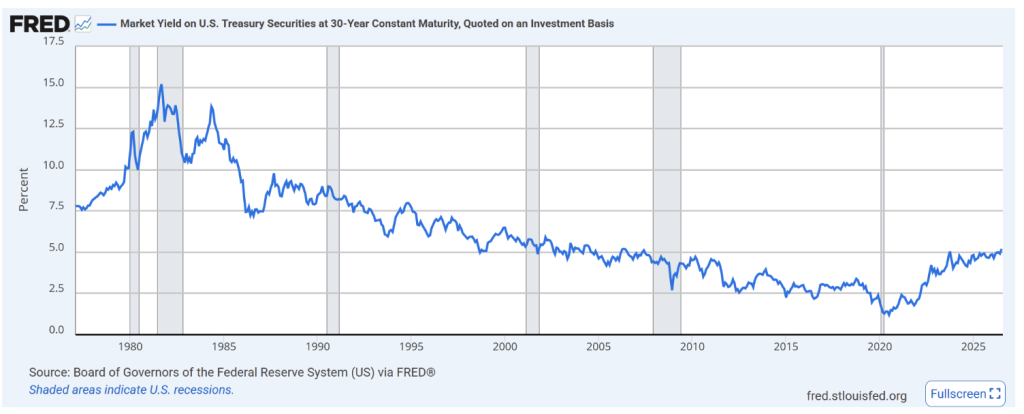
Source: US Federal Reserve
A 5% long bond changes that arithmetic. It does not simply represent the expected path of the Federal Reserve’s overnight rate. It also incorporates inflation uncertainty, fiscal supply, duration risk and the possibility that the long-run neutral real rate is higher than markets assumed during the 2010s. The price of time has risen.
This matters when US equity valuations remain exceptional. High valuations can persist, but they require strong earnings growth, stable margins and confidence that future cash flows deserve a low-risk premium. When government bonds provide a substantial nominal and real return, investors have a credible alternative. Equity prices can no longer rely on falling discount rates to repair disappointing earnings.
China – driving a different version of global growth
The third issue is China. Its second-quarter growth slowed to 4.3%, below the lower end of the official annual target. Beijing has promised faster use of budgeted fiscal resources, but not another large stimulus package. China’s old response to weakness was a powerful credit impulse transmitted through property, infrastructure and commodity demand. That mechanism is now constrained by local-government debt, property losses, overcapacity and weak household confidence.
Just as Japan begins to emerge from the peculiarly Japanese problems of the past 35 years, China is increasingly likely to repeat the path of Japan’s lost decades
Because of China’s scale, these shifts rarely stay contained domestically. A rising credit impulse has historically coincided with stronger demand for metals like copper and iron ore. A falling impulse has often preceded slowdowns in global manufacturing.
Figure #3: China Credit Impulse – % of GDP in new credit
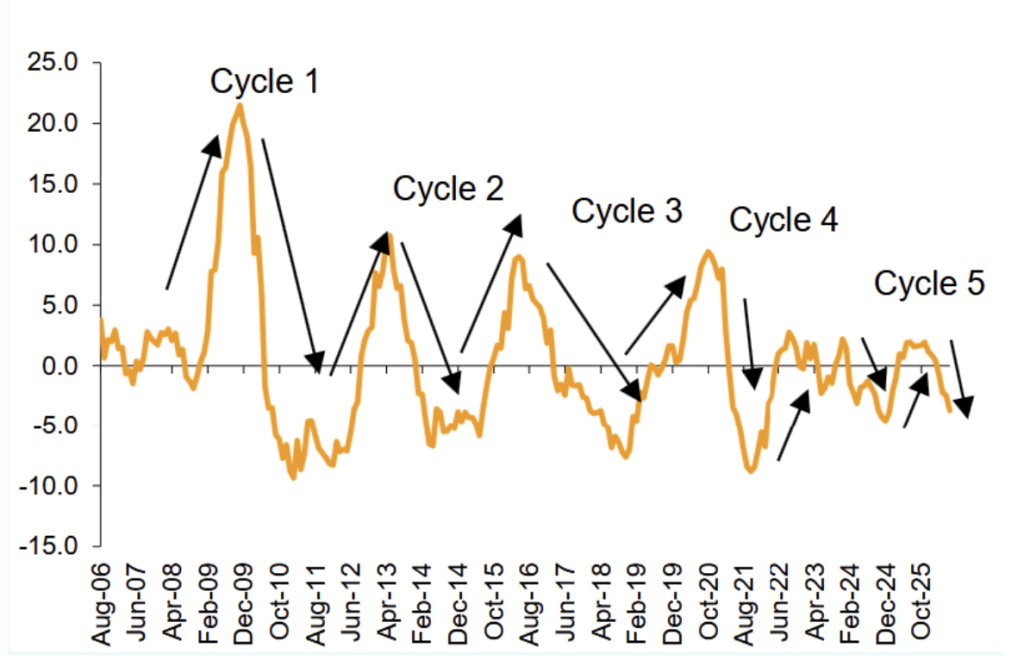
Source: Bloomberg; Macquarie Global Strategy
China is not collapsing, per se, but its energies appear directed towards an alternative growth model. One future option for growth may lie in China finding new sources of industrial power.
Its emerging dominance in electric vehicles, batteries and related supply chains shows how quickly scale, manufacturing depth and state-supported investment can shift global competition. The same pattern is now appearing in AI.
Whilst layoffs at Volkswagen made headlines, and the rest of the world pondered domination in EVs, a likely more powerful issue is emerging. Chinese developers are releasing capable open-weight models at very low cost, encouraging adoption well beyond China and challenging the economics of expensive proprietary systems.
This creates a different kind of influence: not stronger domestic credit demand, but control over technologies, standards and supply chains used by the rest of the world. For investors, the implications are mixed; Western democracies need the innovation and productivity that open-weight models and their installation can provide, but at what price, and after investing what costs.
Creating value from innovation in Artificial Intelligence
The fourth issue is artificial intelligence. The debate over open and proprietary models appears technical, but it goes directly to the assumptions supporting market valuations. The range of outcomes is unusually wide.
Whether AI’s gains will be controlled by a small number of private US companies or spread through cheaper, open ecosystems increasingly shaped by China.
Bullish AI innovation scenarios require more than impressive AI models. AI must produce high productivity, fall rapidly in cost, diffuse widely through the economy and generate strong returns on the capital being invested. We believe they need to be deployed locally, controlled by firms and households and customised for the diversity of firms.
Open access would accelerate experimentation, specialisation and adoption. Smaller models could reduce inference costs and energy use. Competition could allow productivity gains to spread beyond a handful of platform owners.
Recent comments from Satya Nadella (Microsoft CEO) and Jensen Huang (Nvidia CEO) were important for this reason. Both argue that the United States needs a strong open-model ecosystem alongside closed frontier models. Elon Musk has also attacked excessive concentration and the conversion of supposedly open research into private control. Their interests differ, but they identify the same strategic risk: if American open models are restricted too heavily, Chinese open-weight models could become the infrastructure for global AI.
The opposing forces are powerful. Leading proprietary US laboratories have invested extraordinary sums and possess significant political influence. They may argue their models are better at managing social and security risks. But at what price?
For investors, this is not philosophical. If AI remains costly, energy-intensive and concentrated, its economic benefits may accrue narrowly while the capital burden remains enormous. If productivity gains arrive slowly, the earnings required to justify current valuations move further into the future. At today’s prices, high productivity, low costs, broad access and strong returns are increasingly embedded in the base case. Most other outcomes are less bullish.
Australia has additional constraints
Australia faces these global uncertainties while struggling with its own supply constraints. Michele Bullock’s speech this week emphasised repeated supply shocks, weak productivity and the need for more business investment. She made the uncomfortable point that an economy with poor productivity cannot grow quickly without creating inflation.
The later inflation result reduced the immediate pressure. Annual CPI eased to 3.8%, while trimmed-mean inflation remained at 3.6%. Markets almost eliminated the probability of an August rate increase. That was sensible, but it did not resolve the problem. Services inflation rose to 4.0%, housing inflation remained elevated, and the RBA still needs demand to grow more slowly than the economy’s constrained productive capacity.
Australia is therefore left on tenterhooks between monthly inflation releases and irregular central-bank commentary. A softer number produces relief. A stronger number can quickly revive expectations of another increase. Meanwhile, companies are describing a weak consumer without yet reporting obvious financial stress. That is a narrow path, not a stable equilibrium.
Company news is already widening the gap between execution and narrative. Rio Tinto delivered stronger cash generation and a higher interim dividend, helped by copper and aluminium. James Hardie’s preliminary first-quarter result exceeded guidance, led by stronger Siding & Trim sales. Operating delivery can still overcome a weak macro backdrop.
Elsewhere, strategic importance did not remove execution risk. Lynas reported strong sales but disclosed a large increase in the estimated cost of its Malaysian heavy-rare-earth expansion. Origin Energy’s cyberattack exposed information relating to around 900,000 current and former customers, adding remediation, regulatory and reputational risks. Macquarie’s appointment of Greg Ward to succeed Shemara Wikramanayake reduced succession uncertainty, while SGH’s proposed $500 million buyback signalled confidence in capital discipline.
The common feature is dispersion. Strong balance sheets and execution are being rewarded, but cost overruns, security failures and strategic uncertainty are harder to ignore. Reporting season should widen that divide.
These conditions support our defensive positioning. Higher cash levels across portfolios are not a prediction of an imminent market collapse. They recognise that the range of outcomes has widened while prices still assume a favourable destination. Cash now provides a respectable return and, more importantly, the ability to act when reporting season exposes a gap between price and operating reality.
The same logic supports our international tilt away from the largest US companies. We are not dismissing AI, American innovation or those businesses. We are questioning how much success is already priced in and how little compensation investors receive if the outcome is merely good rather than exceptional.
The themes are eclectic, but connected. Long rates determine what future earnings are worth. China influences global demand. AI shapes the productivity assumptions embedded in US valuations. Australian productivity and inflation determine how much pressure households and companies must absorb. Current prices require many of these questions to resolve favourably at once.
The information in this article is of a general nature and does not take into consideration your personal objectives, financial situation or needs. Before acting on any of this information, you should consider whether it is appropriate for your personal circumstances and seek personal financial advice.
Estimated reading time: 9 minutes