
This week in investment matters:
- Company profit reporting season begins next week, where Analysts and investors alike drill companies on their business model, along with the pressures and opportunities they face
- Australian reporting seasons have become volatile, influenced by increased interest rates, high inflation, and changing economic conditions
- A recent RBA survey highlights economic illiteracy among Australians, particularly regarding the impact of higher interest rates on inflation and asset prices.
- The Federal Budget introduced changes to negative gearing and capital gains tax, affecting property investment dynamics.
- The upcoming reporting season will reveal how the economic picture from the Budget aligns with real market conditions, especially regarding credit and housing trends.
Copyright 2026 First Samuel Limited
Read the previous Investment Matters here:
The market
Company Profit Reporting season
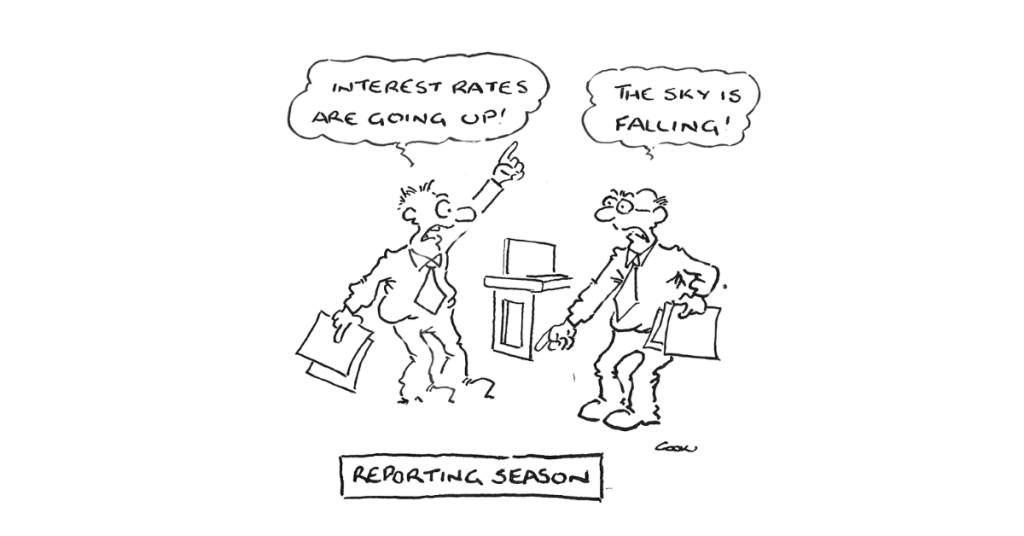
We are a week away from the majority of listed companies providing a detailed update to the market for the most recent financial period. Companies will provide detailed financial accounts, an opportunity to access management teams, along with commentary on current and expected conditions. Analysts and investors alike drill companies on their business model, along with the pressures and opportunities they face. August is known as “reporting season”.
Australian reporting seasons have become increasingly unforgiving. In February, companies’ share prices moved by an average of about 5% on the day of their results, only slightly below August 2025, then the most volatile reporting season in at least a decade.
That volatility reflects more than nervous investors. Markets are attempting to price companies precisely while the economy may be changing faster than forecasts can be updated. The financial result will describe the year, or six months just completed, and sometimes this alone creates surprises. But often the share price reaction is determined more by what management says about July, August and the year ahead.
That makes the coming reporting season unusually important. The Federal Budget was delivered only in May, but much has changed since then. Interest rates have risen, inflation has remained stubbornly high, the external environment has become less predictable, and the first signs of a sharp contraction in housing credit and prices have appeared.
Among the results we will be watching most closely are Commonwealth Bank and Woolworths, together with portfolio companies including SGH, Cleanaway, Origin Energy and Reliance Worldwide.
The accounts themselves will matter. But mortgage applications, arrears, transaction volumes, selling prices, customer behaviour, credit losses and updated guidance will matter more. Reporting season should tell us how much of the economic picture embedded in the Budget remains valid. Inflation and economic literacy
An Australian Financial Review article this week drew attention to a new Reserve Bank survey of 9,000 Australians. Inflation was comfortably the public’s greatest economic concern. Yet only around one-quarter of respondents correctly answered that higher interest rates should ultimately reduce inflation. More than half believed higher rates would increase it.
But are they wrong? And what does wrong mean?
The conventional economic answer is clear enough. Higher interest rates encourage saving, discourage borrowing, lower spending and weaken aggregate demand. As demand slows, businesses find it harder to increase prices, and inflation eventually falls.
The public experiences the other side of the process first. Mortgage repayments increase immediately. Developers and landlords face higher financing costs. Businesses pay more for working capital and investment. Companies then try to recover those costs through higher prices.
The RBA paper acknowledges this cost-push reasoning is common but largely treats it as an incomplete mental model that better communication should correct. That conclusion is too easy in an economy containing concentrated markets and businesses with significant pricing power. It is easy in an economy without a reform agenda, and one that rarely supports new business formation or duopoly-busting behaviour.
Kelty’s warning
Former ACTU secretary Bill Kelty’s warning this week belongs in this debate, regardless of your political persuasion. He argues that economic policy has become a series of ad hoc changes that fail to improve the lived experience of Australians. Railing against falling real wages despite high terms of trade, Kelty he also gave a common-sense example: the proposed $400 million “crisis powers” contingency to cover the cost of propping up the use of cash in our economy was effectively a subsidy for the big banks and retailers. He said it was a “totally entirely inappropriate public policy” and “a policy of lunacy and stupidity”.
According to the AFR, Kelty said, “We have a bureaucracy that is too interested in looking at the symptoms and ignoring the cause”. Ouch.
Woolworths and Coles dominate Australian supermarket sales. Similar issues arise across banking, insurance, energy, telecommunications and other essential services. Banks continue to pay zero interest to poor households’ savings accounts despite earning the RBA rate for their own funds. In recent years, new concentration has emerged in Chemist Warehouse, and the dominance of Bunnings only broadens in scope.
Market concentration increases the risk that price increases aren’t legitimate; coordinated price growth only accentuates our scepticism. It does mean that companies may have greater capacity to pass increased labour, financing, insurance and compliance costs to customers than a simple competitive model assumes.
Reporting season may show the consequences before policymakers acknowledge them.
I would suggest that many Australians already understand this. Higher rates can therefore do two things simultaneously. They can lower future inflation by destroying demand, while adding to selected prices through financing costs and cost pass-through. Economists believe the first effect eventually dominates. Households see the second effect immediately.
Economic illiteracy?
That distinction matters when describing the result as economic illiteracy.
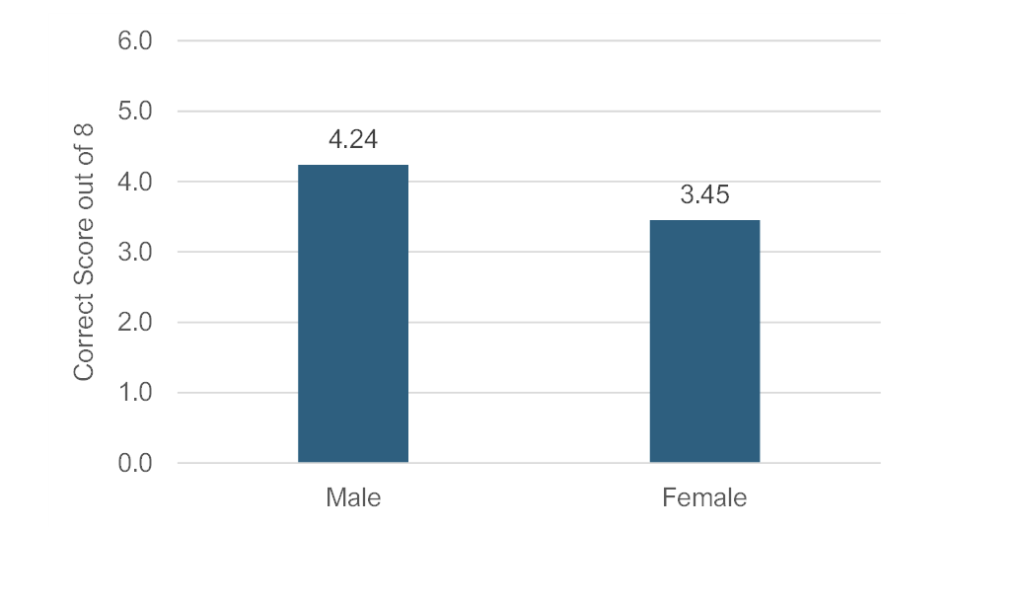
It matters even more because the RBA, in a recently released survey, found a substantial difference between male and female economic-literacy scores. Women, younger Australians and lower-income respondents scored less well on average across eight questions that were designed to gauge fundamental economic concepts and how well the public understands the central bank’s core responsibilities.
Perhaps that reflects differences in formal economics education. But when a model concludes that women are disproportionately wrong, my experience suggests that the appropriate first response is to examine the model again.
Those more closely involved in recurring household expenditure may place greater weight on what they observe at supermarkets, insurers, utilities and banks. Their answer may not correspond with the textbook long-run aggregate-demand model, but it is not necessarily irrational, or even wrong in my view.
Figure #1: RBA Bulletin: Average Economic Literacy Score by Group – Score out of 8
Source: RBA Bulletin July 2026, JWS Research
Why inflation expectations matter
This is not merely an academic disagreement. Inflation expectations can become self-reinforcing.
When households expect prices to keep rising, workers seek larger wage increases and businesses become more willing to increase prices. Each decision may be individually rational, but together they make inflation more persistent.
That makes poor understanding of monetary policy a practical problem for the RBA. If more than half the public believes rate rises increase inflation, another increase may be interpreted not as the cure but as an additional source of the disease.
It does not automatically mean rates must rise again. But poorly anchored expectations increase that risk. The less credible the path back to target appears, the greater the amount of demand destruction that may eventually be required to prove it.
The policy problem is made harder because interest rates are being asked to compensate for forces they cannot repair. Monetary policy cannot reform planning systems, increase housing supply, improve competition, reduce unnecessary regulation or determine government expenditure and migration settings. It can only make credit more expensive and suppress private demand.
The result nobody discussed
After dealing with inflation, the RBA survey contains an even more remarkable finding.
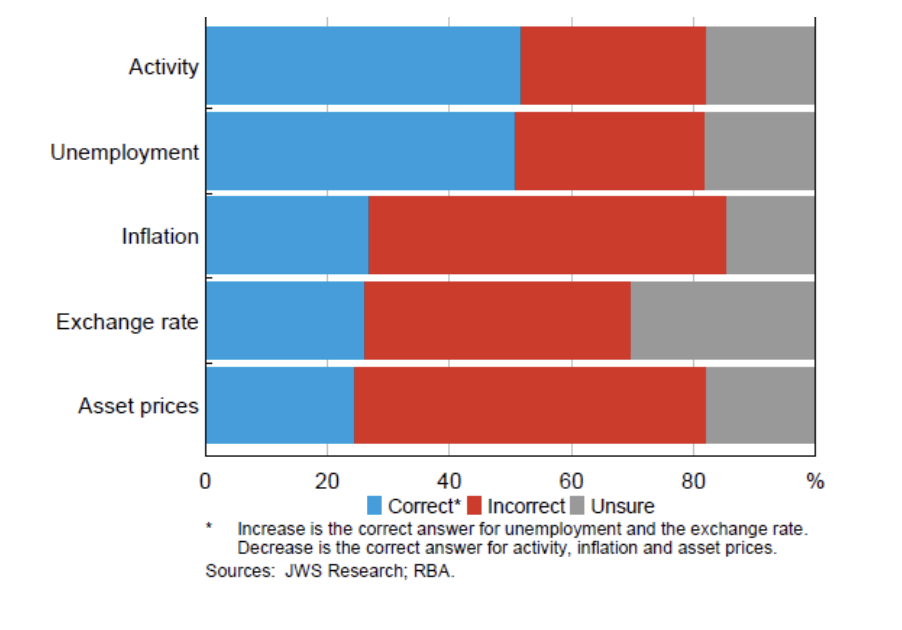
The following five questions asked respondents to give their opinion of whether higher rates increased or decreased key economic factors. More than half correctly answered the higher rates impact on Activity (reduced) and Unemployment (increased) factors.
Figure #2: RBA Bulletin: Impact of Higher Interest Rates – Share of Responses
Source: RBA Bulletin July 2026, JWS Research
Only around one-quarter of respondents correctly answered that higher rates reduce asset prices. Almost 60% gave the answer classified as incorrect.
60% of respondents said that higher interest rates would cause asset prices to rise!!! How is this possible?
Remember this is a well-constructed representative sample of 9000 Australians (commenced in February 2025 and was repeated in September 2025 and again in late February/early March 2026)
Yet neither the RBA’s substantive discussion in the RBA July Bulletin nor the Australian Financial Review article explored this result. The data is there but not discussed.
The inflation question has a defensible orthodox answer, even if the path is complicated. The asset-price question is much harder. Higher discount rates should reduce the present value of future income. Higher mortgage rates should reduce borrowing capacity. All else being equal, both should lower asset prices.
But all else is rarely equal.
Asset prices are also determined by population growth, housing supply, rents, wages, tax policy, government subsidies, availability of credit and expectations about where interest rates go next.
Australians have spent much of the past two years observing housing prices remain firm or rise despite restrictive rates, and of course asset prices have been almost a one-way bet since 1997. Through 2025, Perth, Brisbane and Adelaide recorded particularly strong momentum as population growth and inadequate supply overwhelmed the impact of higher borrowing costs.
Answering from observed experience rather than theory therefore produces a different response.
So, what happens when these mechanisms, already poorly understood, start breaking? What does it do to the housing market and broader economic activity?
House prices are now changing
The recent housing data suggest that the traditional interest-rate channel may finally be overwhelming the other forces.
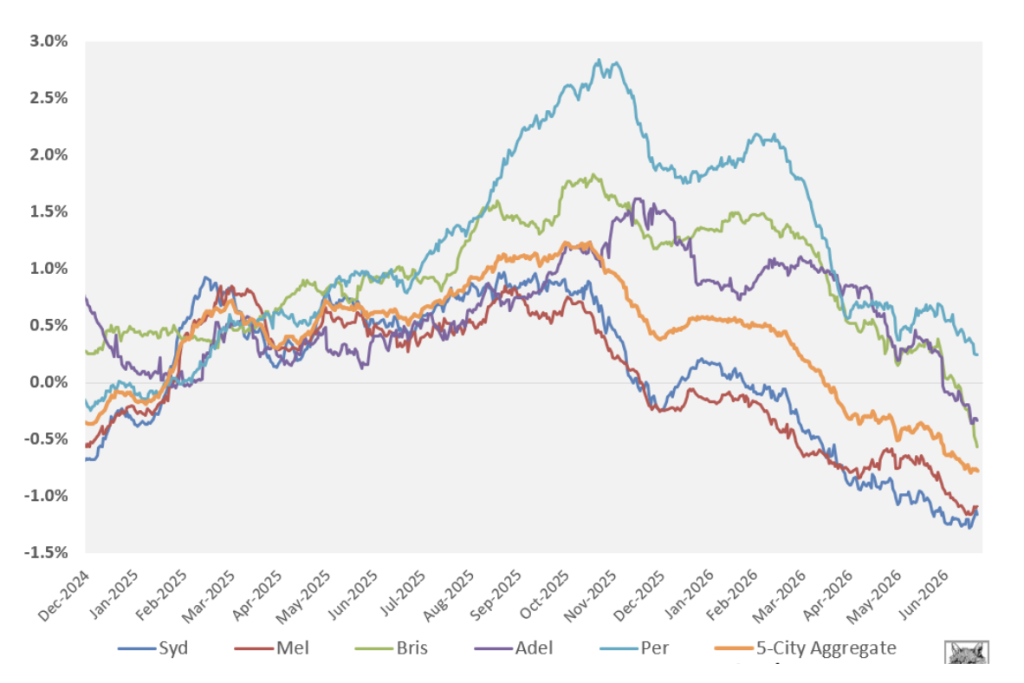
The five-city Cotality measure accelerated through much of 2025, even with interest rates already restrictive. By late last year, Perth’s 28-day price change was approaching 3%, while Brisbane and Adelaide were also recording strong growth.
The direction has since reversed. By June, the five-city measure was falling at around 0.8% over 28 days. Sydney and Melbourne were declining by more than 1%, Brisbane and Adelaide had turned negative, and Perth’s previously exceptional growth had slowed sharply.
Figure #3: Cotality Daily House Price Index by city – 28-day change
Source: Cotality, macrobusiness.com.au
The lending data we are now seeing are potentially more important because credit provided generally turns; we see prices accelerate downwards or economic activity slows.
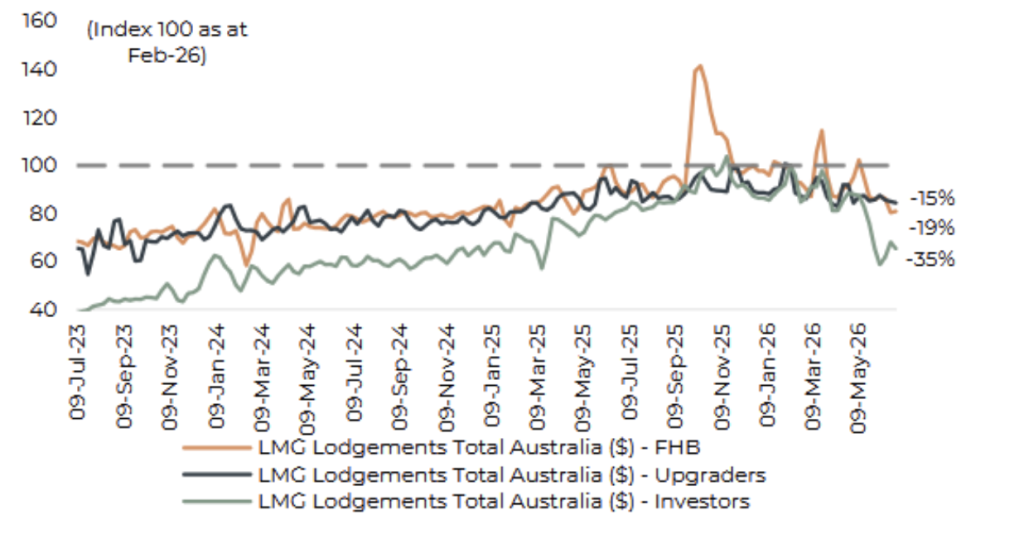
The following charts were reported this week by Barrenjoey Research and are derived from the Loan Market Group, which represents up to 15% of the supply of new loan lodgements. We expect these results to be indicative of the movements across all loan supply channels including the major banks.
Figure #4: Loan Market Group – Total Lodgements by Category (index to 100 in Feb 2026)
Source: Loan Market Group, Barrenjoey Research
Since the beginning of February, Loan Market Group lodgements are down by roughly 15% for first-home buyers, 19% for upgraders and 35% for investors. This is one large mortgage aggregation group rather than the whole market, but the scale of the change makes it an important leading indicator.
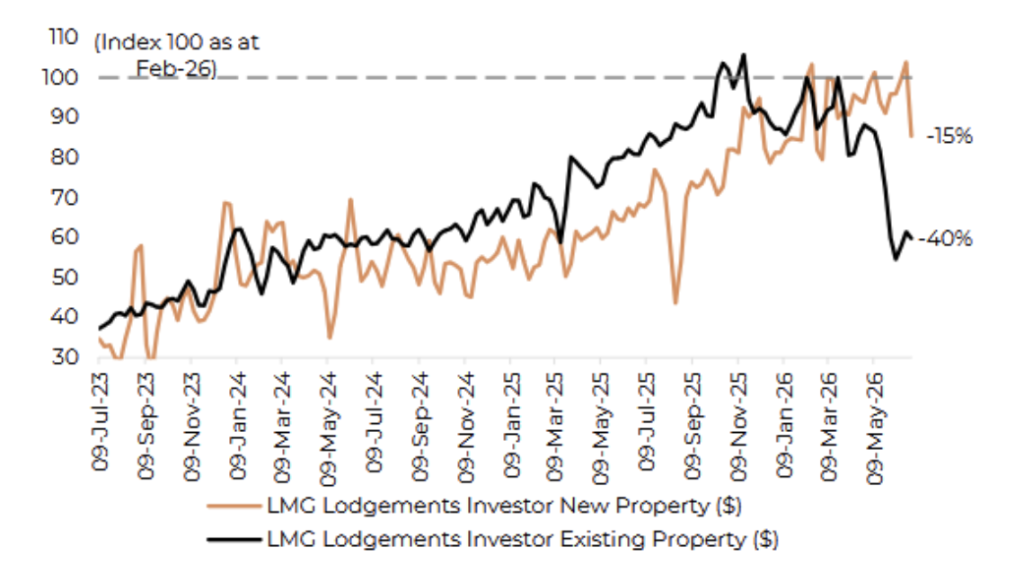
Within investor finance, the difference between established and newly constructed property is particularly striking.
Figure #5: Loan Market Group – Total Lodgements – Investors (index to 100 in Feb 2026)
Source: Loan Market Group, Barrenjoey Research
Investor lodgements for established housing are down about 40%, compared with around 15% for new property.
Interest rates are part of the explanation, but they are no longer the only shock.
The Budget
The Budget changed the future treatment of negative gearing for established investment property while retaining support for new construction. It also altered the future capital gains tax treatment of property investment.
The announcement immediately changed the expected after-tax return from buying established investment property. It landed while rates were rising, prices were beginning to fall, and credit demand was already weakening. The divergence between new and established investor lending is consistent with the intended policy shift.
Combining a tax-policy shock, higher mortgage rates, falling collateral values and sharply weaker credit growth creates a risk of overshooting. New housing supply takes years to respond. Credit demand and asset prices can adjust in weeks.
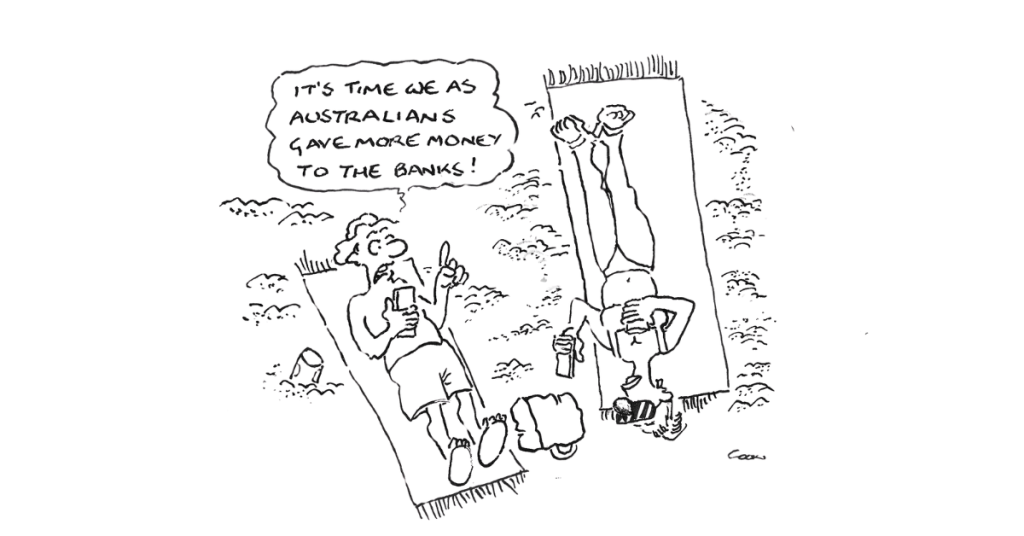
This is not the environment in which bank share prices should be approaching record levels given their weak profit outlook. Regular readers would understand we are avoiding this sector for our clients. But every day those investing in broad ETFs or industry funds are continuing to plough additional funds into this sector.
Back to reporting season
This brings us back to why the coming company results matter so much.
Commonwealth Bank should provide the clearest reading on mortgage applications, approval rates, refinancing, repayment behaviour, arrears and credit quality.
Woolworths will provide a different test. Its result should help separate inflation caused by supplier and operating costs from inflation sustained by market power.
Judo (former portfolio position) and others in smaller financials will show whether credit deterioration is spreading through small and medium-sized businesses. SGH will reveal the difference between private construction activity and government-supported infrastructure and mining demand. Cleanaway’s commercial and industrial waste volumes provide a physical measure of economic activity, while its pricing shows how effectively a scaled operator can recover costs. Origin will help explain the interaction between wholesale energy, regulation and retail pricing – note we previously discussed rising delinquencies in energy bills. Reliance Worldwide offers a direct reading on housing turnover, repairs and renovation activity.
There is much more to learn than whether reported earnings beat or missed consensus by 2%.
The danger is that reporting season confirms two apparently contradictory developments at once: inflation remains embedded in essential services and businesses with pricing power, while mortgage credit, property prices and private demand are deteriorating rapidly.
That would leave the RBA with an exceptionally difficult choice. Further tightening may be required to break inflation expectations, particularly when the public does not understand or trust the mechanism. Yet more tightening would arrive alongside a major tax-policy change, falling house prices and collapsing investor credit.
This asymmetry is also relevant to portfolio construction. We currently have very limited exposure to the major banks. That does not reflect an expectation of systemic failure. It reflects the view that slowing credit growth, weaker housing momentum and the possibility of rising arrears and credit losses are not obviously compensated for in bank valuations.
The Budget gave us an economic forecast. Reporting season will show us how much of that forecast has already been overtaken by events.
The information in this article is of a general nature and does not take into consideration your personal objectives, financial situation or needs. Before acting on any of this information, you should consider whether it is appropriate for your personal circumstances and seek personal financial advice.