
Copyright 2026 First Samuel Limited
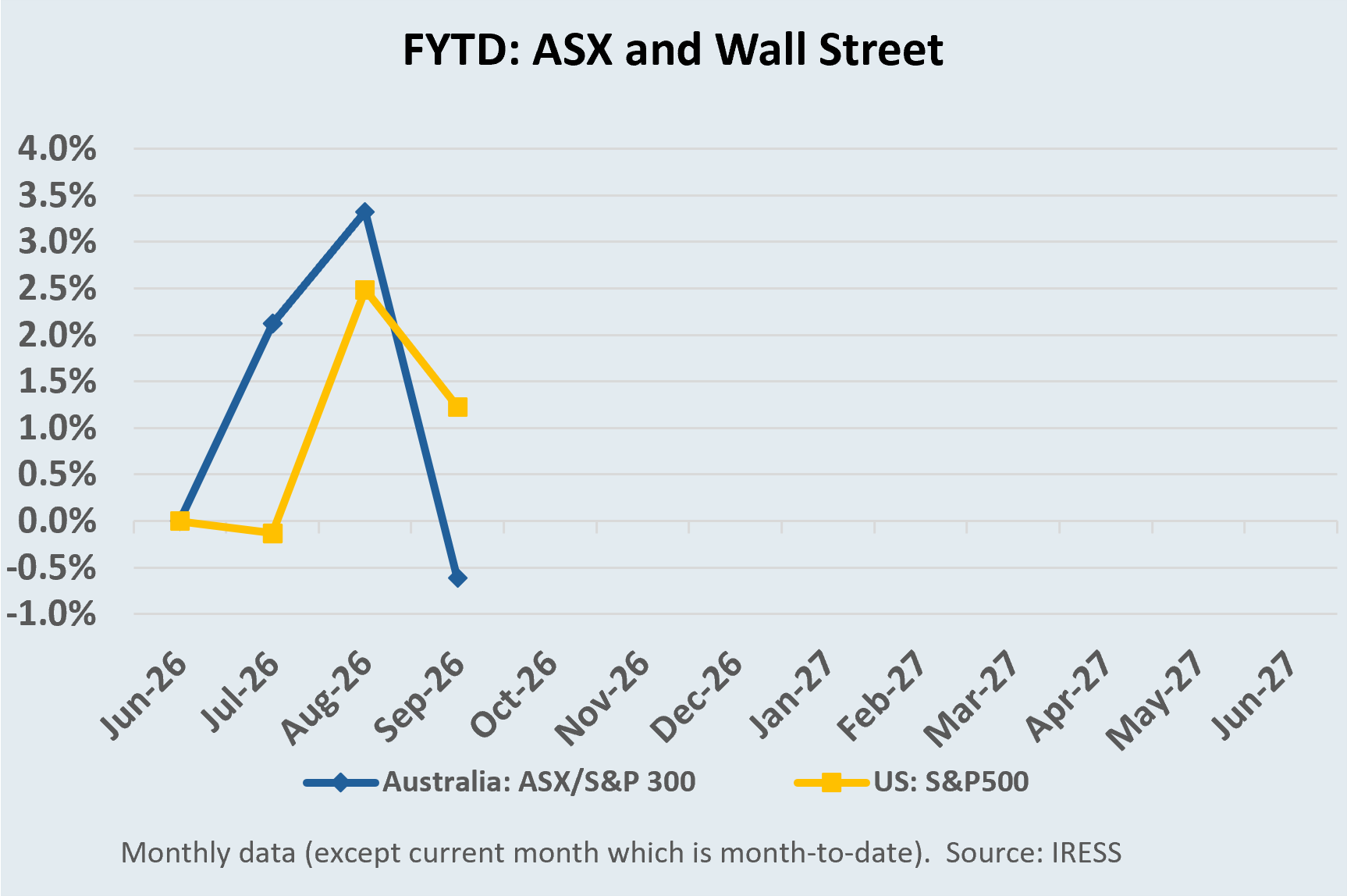
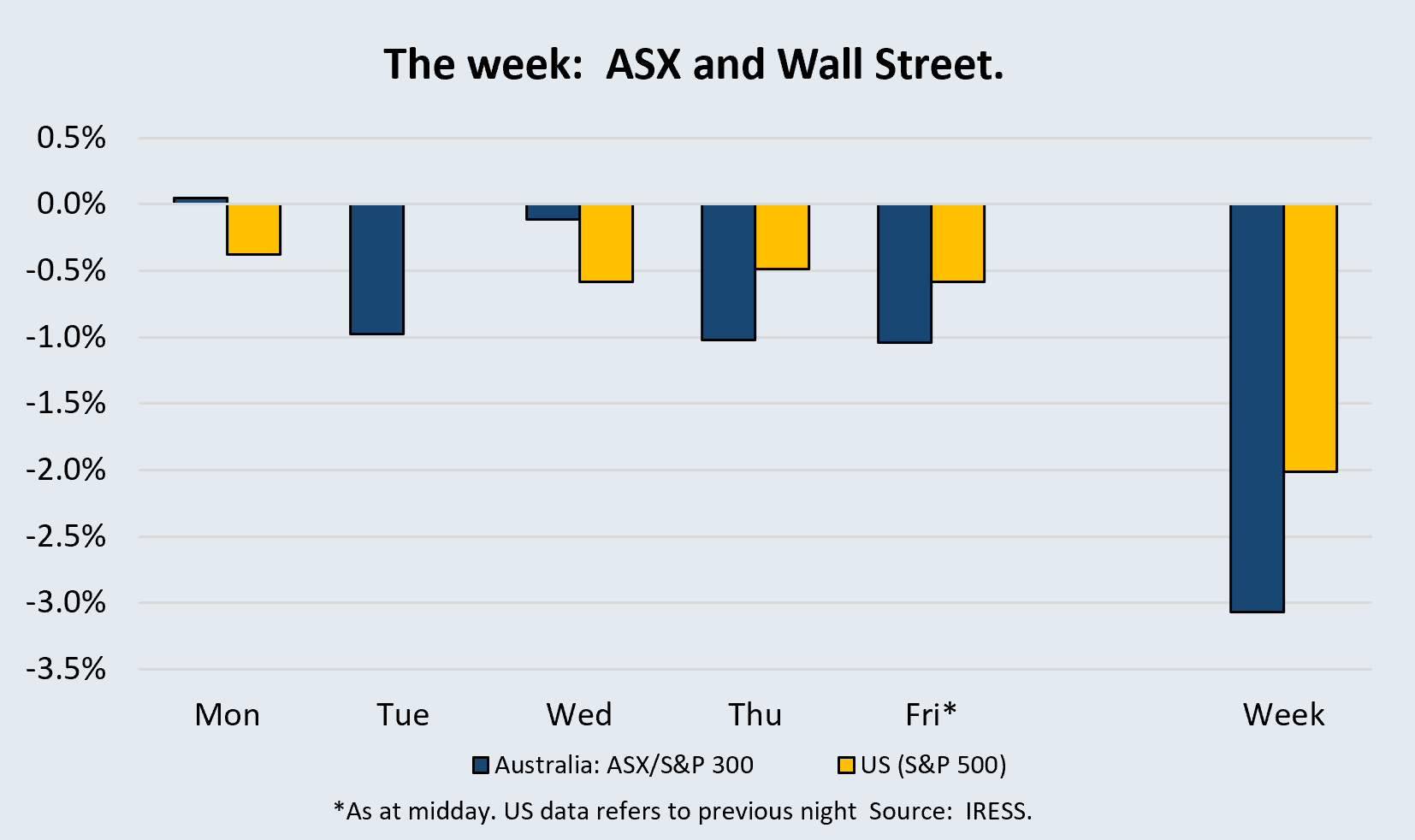
Markets have again become noticeably choppier. That is not especially surprising after a strong run in a number of markets and sectors. Investors are being asked to absorb a still-uncertain growth outlook, elevated inflation and, overnight, another increase in US interest rates.
The Federal Reserve raised rates by 0.25 percentage points, reinforcing that the hurdle rate for risk assets remains meaningful. Higher rates do not automatically mean weaker equity markets, but they do increase the price investors should demand for taking risk and reduce the attraction of stretching for marginal returns.
In this environment, we remain comfortable holding a moderate amount of cash. Cash earns a reasonable return, reduces the need to force marginal investments, and, most importantly, gives us flexibility when volatility creates opportunities. We do not regard cash as a long-term investment, but we also do not regard it as a problem that must always be solved.
On the portfolio front, Reliance Worldwide returned to the market with a finalised bid for the company. Subject to additional higher offers in the next few weeks, shareholders will likely vote on the sale of the business in the coming months at circa $4.75 per share. We continue to believe it is worth more than that and will miss the opportunity to invest in such a high-quality business on the ASX should the takeover be completed.
This week we revisit three important portfolio companies. Santos and Healius combine a review of their recent results with developments since. James Hardie combines its strong first-quarter FY27 result with the investor day held this week, the first since the acquisition of AZEK.
Similar to last week’s Investment Matters outline of our position in Amcor, James Hardie is also a strong example of how Australian share portfolios can provide exposure to much more than the domestic Australian economy.
Read the previous Investment Matters here
The market
Santos (STO): The transition year is beginning to turn
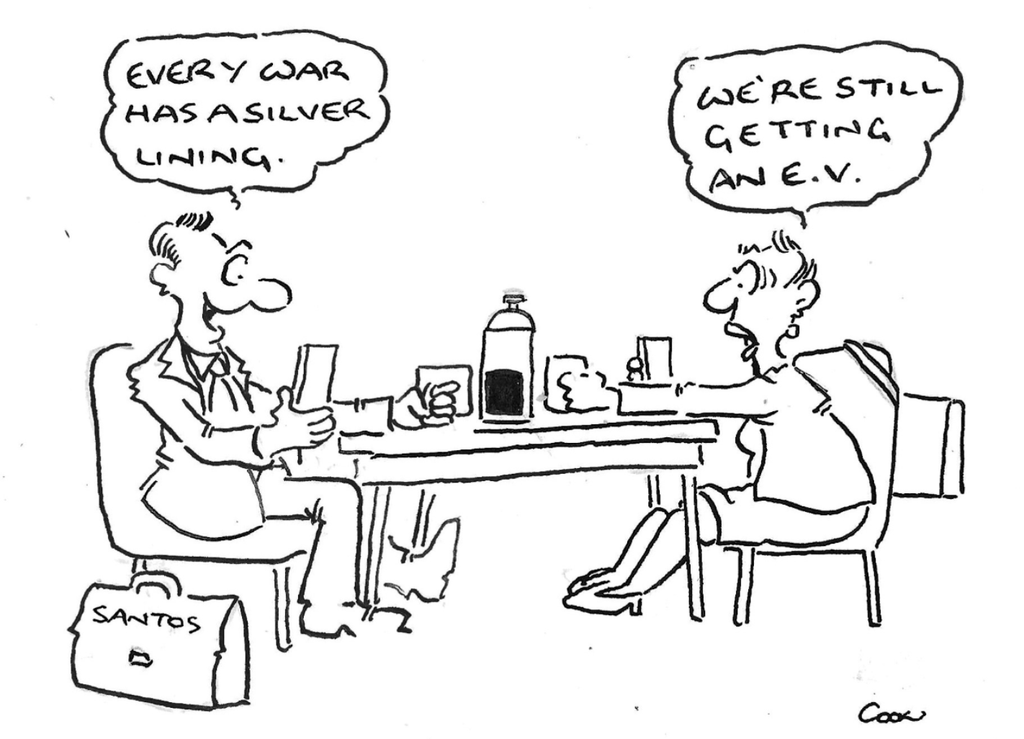
Santos remains a core energy holding. The share price has rallied strongly this year, unsurprisingly given the stronger oil price environment, but we do not see that as a reason to step back. The thesis is unchanged: a low-cost operating model that protects cash flow through the cycle, genuine oil price exposure, and a queue of high-quality growth options — Barossa, Pikka, Papua LNG and Beetaloo — that we still do not believe the share price fully reflects.
While we have been rewarded by a rising share price due to the Iran War, the underlying business remains undervalued based on rising free cash flows, excluding the impact of the oil price.
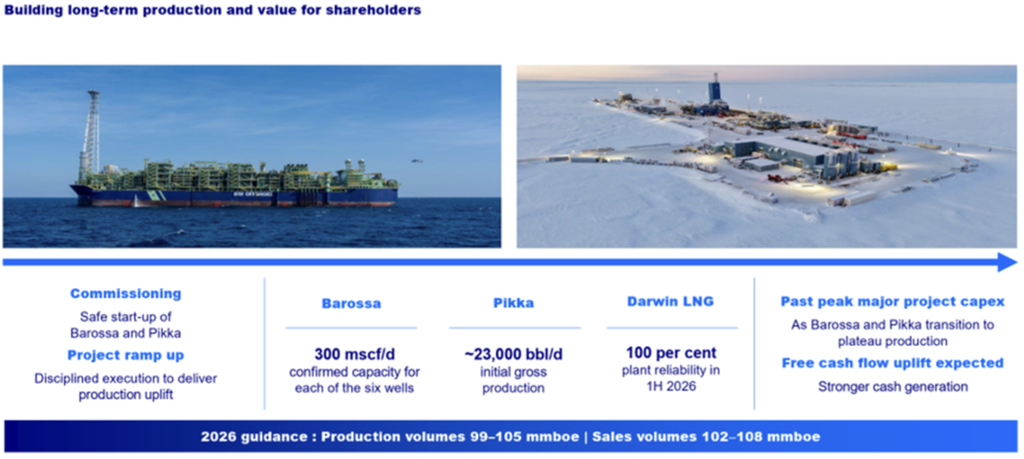
Figure #1: Santos – 2026: A year of transition
Source: STO 1H26 Results Presentation
The first half of 2026 was, as flagged, a transition period. First-half free cash flow from operations of US$378m was well below the prior corresponding period of US$1,086m, reflecting commissioning costs at Barossa and Pikka, cargo timing around 30 June, and a roughly 1.3 mmboe PNG under-lift.
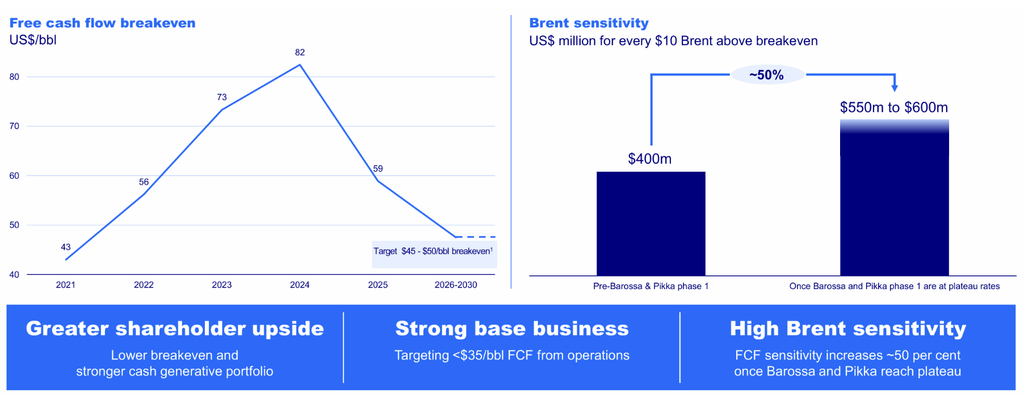
None of these changes the underlying story. Management guides second-half production to rise 20–30 per cent on the first half as Barossa moves to steady state at around 550–600 mmscf/d and Pikka ramps toward its 80,000 bbl/d gross plateau. Unit production costs of US$7.53/boe and the US$45–50/bbl free-cash-flow breakeven target to 2030 confirm the low-cost positioning that underpins our conviction.
The most important development since the result has been Papua LNG. TotalEnergies is selling down its stake and handing operatorship to ExxonMobil, lifting Santos’ interest to 21% after the PNG government backed in. We see this as de-risking, rather than diluting, the optionality thesis. A single, experienced PNG operator across both LNG projects should improve execution and unlock synergies, while the probability of a final investment decision has continued to rise.
Santos also provides the oil and LNG price exposure we want in the portfolio. Roughly 80 per cent of its contracted LNG position is linked to the Japan Crude Cocktail, with a three-month lag, meaning stronger oil prices flow through with a delay. Brent sensitivity will increase materially as Barossa and Pikka reach plateau: Santos estimates around US$550–600m of additional free cash flow for every US$10/bbl move above breakeven, up from roughly US$400m previously.
Figure #2: Santos – Our core thesis remains growing free cash flow
Source: STO 1H26 Results Presentation
That operating leverage is valuable in a supply-constrained LNG and oil market. Domestic gas remains a smaller, steadier contributor, generating US$85m of first-half free cash flow.
With gearing at 23.2% excluding leases, US$3.8bn of liquidity and no debt maturities before September 2027, the balance sheet provides room to complete the current growth program. A strong run in the shares has reduced some of the obvious valuation gap, but it has not, in our view, closed off the quality of the exposure on offer.
Healius (HLS): operating improvement hidden by financing noise
FY26 showed that Healius’s underlying turnaround is progressing, even if the market chose to focus elsewhere. Underlying EBITDA rose 8.1% to $258.6 million and underlying EBIT jumped 76.6% to $30.2m, with real structural improvement in the revenue mix. Genomics revenue increased 16.9%, and Clinical Trials/B2B rose 92.9%. This was a pleasing mix of revenue growth even as GP attendances softened by roughly 1%.
Operationally, the result was broadly in line with expectations. The headline miss on underlying NPAT came almost entirely from interest costs, not the core business. Net debt of $32.8m also reflected one-off ATO and Lumus lease settlements working through the balance sheet rather than a deterioration in trading. The shares rallied as much as 20% on the result before giving it back within weeks — more a reflection of thin, catalyst-driven positioning than a verdict on the business itself.

Three issues sit underneath the current share price weakness.
- First is financing. Underlying EBITDA was in line with expectations; the shortfall was lease interest, up 17 per cent despite around 100 collection-centre closures, together with one-off settlement costs. None of this speaks directly to the health of the pathology franchise, and the potential sale of Agilex provides a natural mechanism to simplify the balance sheet.
- Second is rising labour costs. Cost pressure is real. The Fair Work Commission wage decision lands in three tranches through January 2027, with further Health Professional Award increases expected through FY31. Management has already pushed out its T27 margin target from FY27 to December 2028. We regard that as a sensible recalibration given the scale of the cost step-change, rather than evidence that the plan is failing. Labour as a share of revenue has continued to fall, which is the more important operating measure.
- Third is the sale of Agilex. Optionality remains intact. A sale could crystallise value of around $125–150 million, materially delever the balance sheet and allow the remaining pathology business to be judged on its own improving fundamentals. Even without a transaction, Agilex continues to perform strongly. We expect the next meaningful update around the 22 October AGM.
The valuation remains unusual. Healius generates around $1.3bn of revenue and trades at roughly half book value. At current prices, the market appears to be ascribing little value to either of the two obvious sources of upside: a confirmed Agilex transaction at an attractive price, or an eventual change in Medicare indexation. Neither needs to be our base case for the current valuation to look conservative.
The near-term markers are straightforward. The next two wage steps arrive in October and January, so we will see whether the cost base continues to absorb them without derailing the margin recovery. The Agilex process should become clearer around the AGM. Medicare indexation remains upside, not an assumption.

For now, we remain patient. Cost discipline, a better-quality revenue mix and a national market-leading pathology footprint are moving in the right direction. The near-term noise around interest costs and wage timing should not obscure that.
In the medium term, we believe numerous levers related to labour, and critically rents and the physical operating model, could unlock multiples of the current value. In a short-term-oriented market, however, Helius may join the long list of takeover targets for investors with a long-term focus and more patience.
James Hardie (JHX): More than a US housing stock
James Hardie is increasingly being valued through the wrong lens. The market still tends to treat it principally as a US housing stock: mortgage rates rise, housing activity weakens, and James Hardie is marked down accordingly. That understates what the company has become and, more importantly, where its growth can come from.
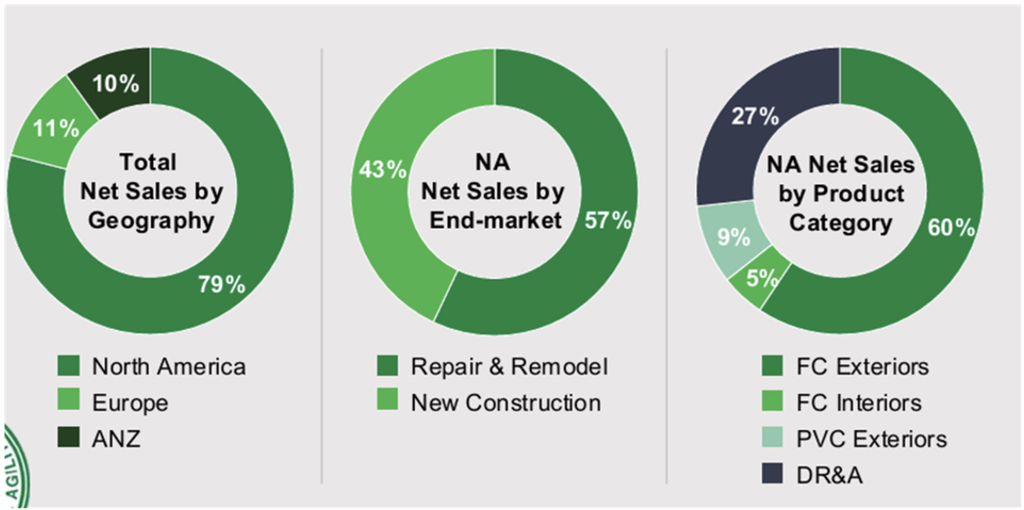
From a portfolio perspective, it is an international company that happens to be listed on the ASX. Less than 10 per cent of demand now comes from Australia and New Zealand.
Not only is it predominantly US-focused; the figure below shows 57 per cent of demand is related to Repair and Remodel (R&R).
Figure #3: James Hardie – Sales by geographic region, activity type and product line
Source: JHX Investor Day Presentation, September 2026
Following the acquisition of AZEK, James Hardie is predominantly a North American and global exterior building-products company, with substantial repair and remodel exposure and a much broader range of products than the fibre-cement (FC) siding business many Australians still associate with the name.
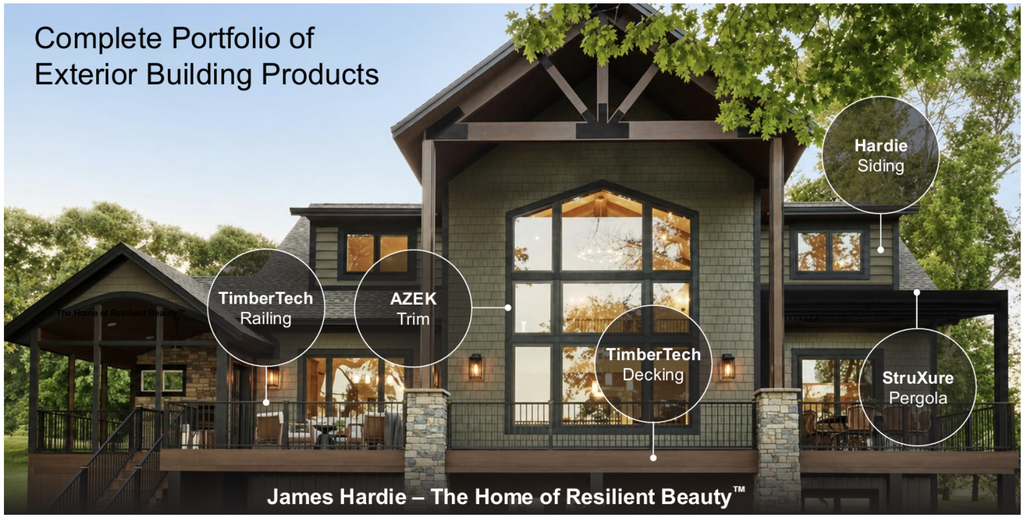
Visually we were drawn to the following picture that we have duplicated from the Investor Day slides.
Figure #4: James Hardie Investor Day – Breadth of product offer
Source: JHX Investor Day Presentation, September 2026
The breadth shown above is important. James Hardie now sells across siding, trim, decking, railing and outdoor-living applications. That creates a substantially broader relationship with builders, contractors, distributors and homeowners, while increasing the opportunity to sell several products into the same project.
Strong recent results
The first-quarter FY27 result, announced August 7th, showed the underlying business is already performing well despite weak housing conditions. Group sales were US$1.475bn, up 64% including AZEK and 12% on a pro-forma basis. Adjusted EBITDA reached US$422m, ahead of previous guidance, while North American fibre-cement sales grew 20% organically. Free cash flow was US$254m, more than double the prior year.
This week’s investor day provided the more important message: James Hardie does not need a US housing recovery to grow strongly.
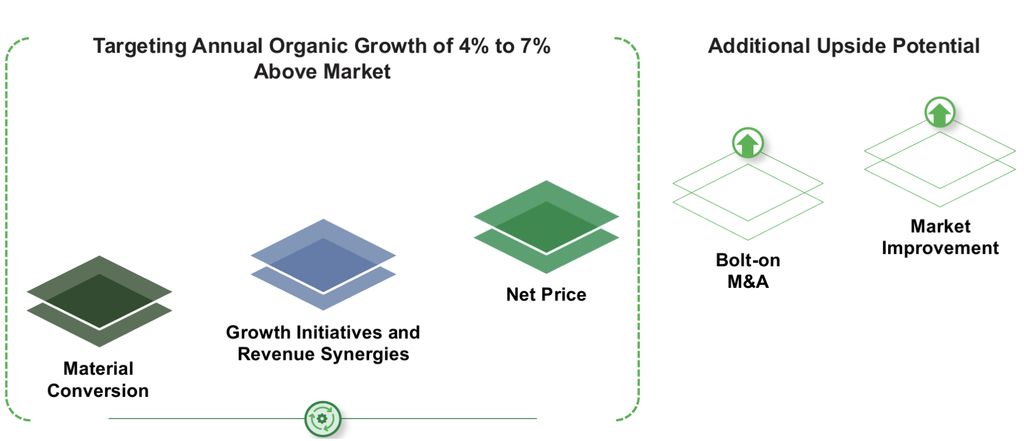
Management is targeting annual North American organic growth of 4–7% above the underlying market. That is an important distinction. If housing remains weak, James Hardie expects to grow. If housing eventually recovers, market growth comes on top.
The three drivers are material conversion, company-specific growth initiatives and commercial synergies, and pricing.
The largest is material conversion. James Hardie estimates a roughly US$23bn opportunity as fibre cement, composite decking and related products continue taking share from traditional building materials. A one-percentage-point change in material conversion translates to roughly 4 per cent growth in the siding and decking category. Following James Hardie as a company for more than 20 years the consistency of this forecast has remained not only firmly held, but substantially delivered through a vast range of previously economic conditions.
That is not a macro forecast. It is a market-share opportunity.
Figure #5: James Hardie North America Growth Algorithm – driving a combined 35% growth rate opportunity
Source: JHX Investor Day Presentation, September 2026
The acquisition of AZEK adds a second layer. James Hardie can now place Hardie siding alongside TimberTech decking, AZEK trim and the broader outdoor-living portfolio through the same distribution channels and into the same customers. The economic opportunity from the acquisition therefore extends well beyond removing duplicated costs.
Management continues to target more than US$500m of revenue synergies and now expects to achieve its original US$125 million cost-synergy target one year ahead of schedule. FY27 free-cash-flow guidance has also been increased from more than US$500 million to more than US$600m. Faster cash generation means faster deleveraging and ultimately greater capital-allocation flexibility.
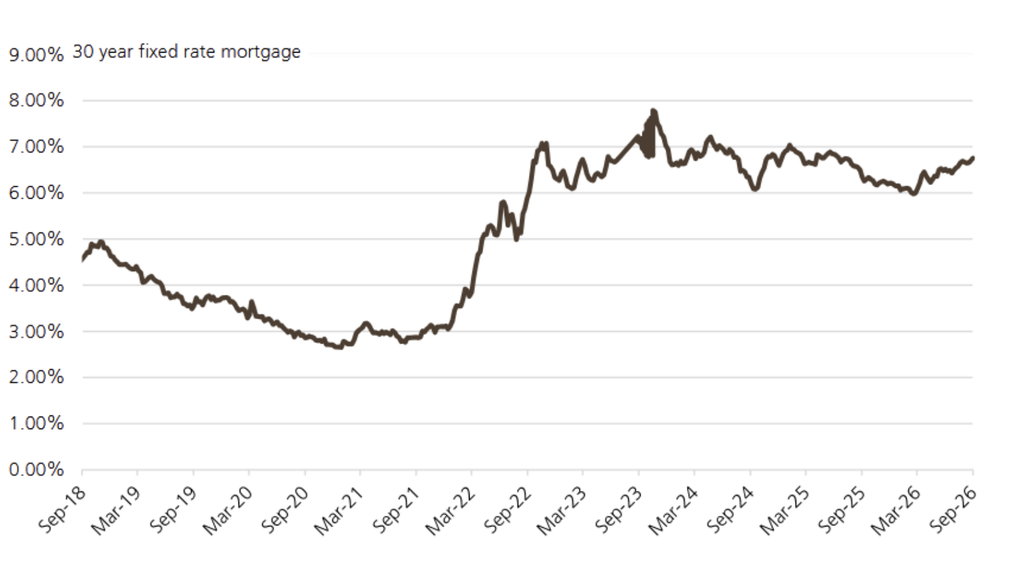
The facts on the grounds in the New Homes sector is on the other hand terrible. Mortgage rates remain high and rising since the outbreak of the Iran War, affordability is poor and consumer confidence is subdued. But that is increasingly the attraction. James Hardie is producing strong margins and cash flow in an ordinary end market while building a business capable of materially outgrowing that market.
Figure #6: US Macro conditions – US 30-year mortgage costs remain elevated and rising
Source: Freddie Mac, UBS
The steep rise in mortgage rates has effectively locked many homeowners into their existing 30-year mortgages, written when rates were very low post-COVID. Despite recent attempts (MOVE Act, August 2026) to change regulations to allow certain homeowners to take their existing mortgage rate and terms with them when they move to their next home, reform in this area will be slow.
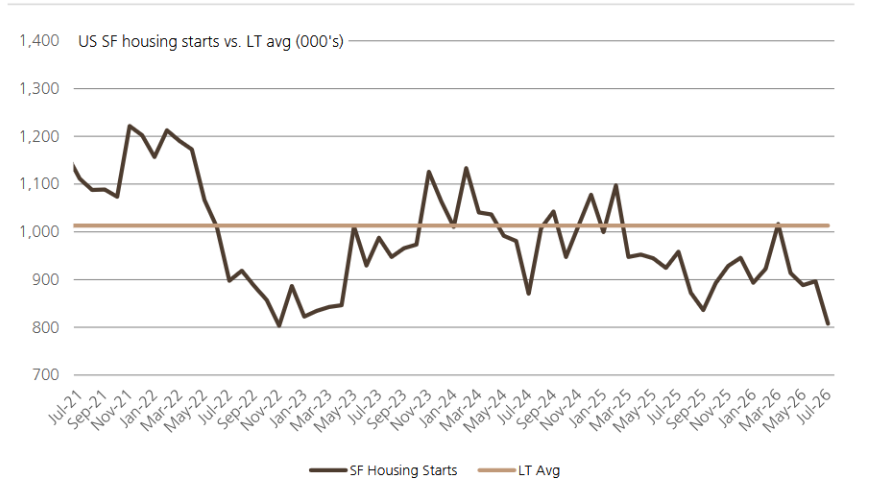
The next result of lock-ins and low confidence is the number of homes James Hardie is competing to build with its products is significantly constrained as show in the figure below.
Figure #7: US Macro conditions – Single family housing starts (construction) far below historical levels
Source: US Census Bureau, UBS
A recovery in housing should therefore be thought of as upside, rather than the investment thesis itself.
We originally purchased the James Hardie around $28 and have taken some profits as the shares moved higher in recent months. We continue to regard it as high-quality global building-products exposure. The investor day strengthened rather than changed our view.
The combination of product breadth, material conversion, repair and remodel exposure, distribution strength and AZEK synergies provides several paths to earnings growth which James Hardie itself can control. If US housing eventually provides a tailwind as well, so much the better.
For now, we are happy owning a business that does not require it.
The information in this article is of a general nature and does not take into consideration your personal objectives, financial situation or needs. Before acting on any of this information, you should consider whether it is appropriate for your personal circumstances and seek personal financial advice.