
This week in Investment Matters, we review results from Block, a US$50 billion US-domiciled, dual-listed company and a valuable alternative to the narrow range of financials on the ASX. Its ecosystem includes Square for merchant payments, software and business banking; Cash App for consumer payments and finance; and Afterpay.
Copyright 2026 First Samuel Limited
Read the previous Investment Matters here:
The market
Early reporting season
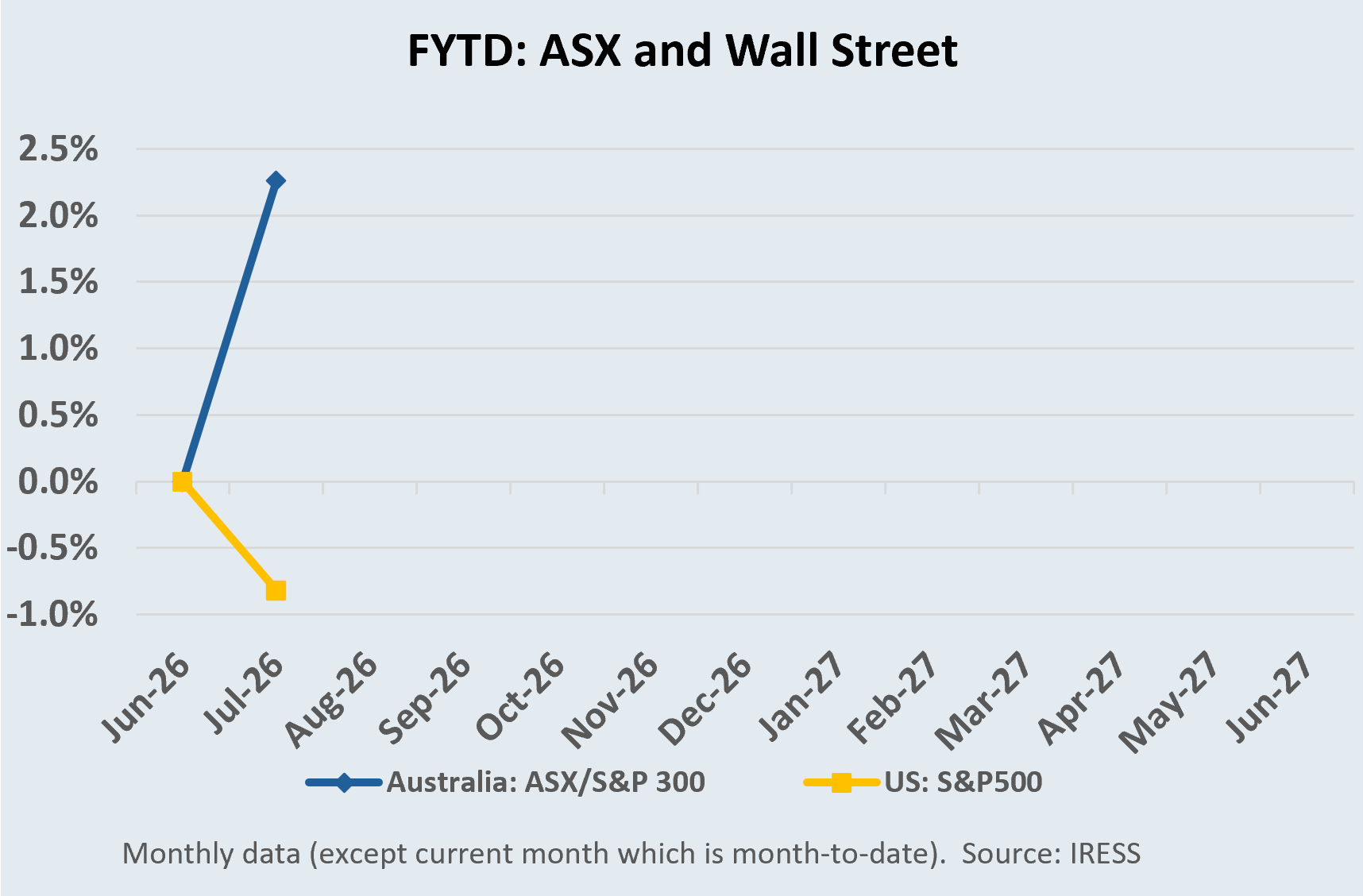
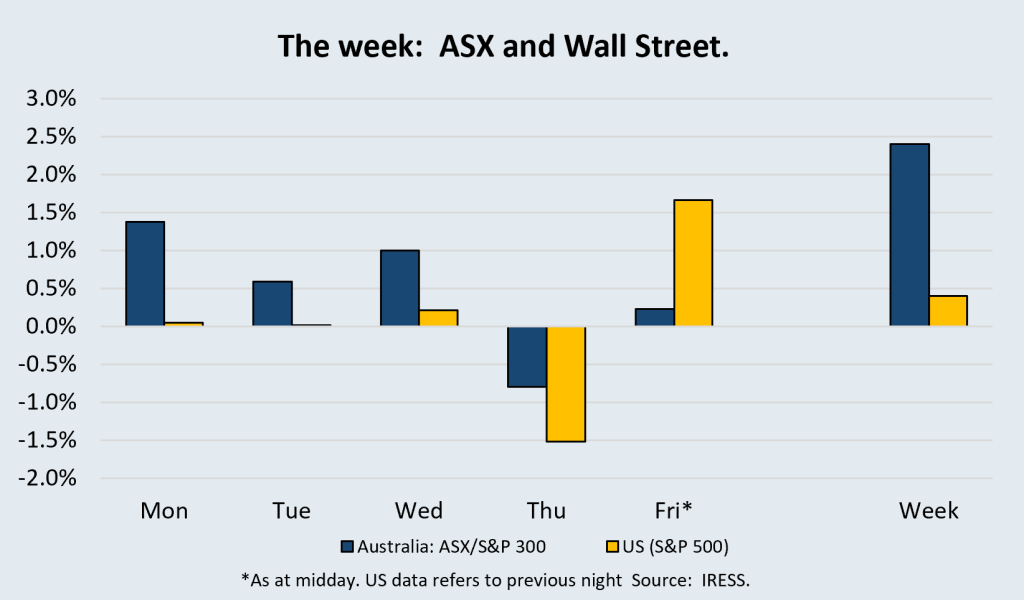
The first week of reporting season brought a strong rally in Australian markets and early signs of a move away from the most expensive stocks. More than 95% of companies are still to report.
We could have written about Germany’s weakening economy, the decline of its car industry, or the resemblance between today’s AI investment boom and earlier railroad booms. They certainly produce interesting charts. Instead, the team focused on companies building internal AI systems to improve products and margins. Block is one of them, and its development is relevant well beyond Block itself.
Block is a US$50 billion US-domiciled, dual-listed company and a valuable alternative to the narrow range of financials on the ASX. Its ecosystem includes Square for merchant payments, software and business banking; Cash App for consumer payments and finance; and Afterpay.
Block (XYZ)
Block (XYZ) – More than pumping Mount Eliza housing


Block has been a portfolio position since early 2025, is a top ten position in many client accounts and has returned about 60%. Alongside Macquarie, Challenger and, to a lesser extent, EarlyPay, it gives us exposure to financial companies built around services and innovation rather than interest margins protected by oligopoly and regulation.
This week Block released its 2Q26 result.
Results, reinvention and the bank that banks stopped being
We appreciated Block’s result released on 5 August 2026.
- Gross profit rose 25% to US$3.17 billion.
- Adjusted operating income reached US$864 million, and the margin rose to a record 27%.
- Adjusted earnings per share rose 65% to US$1.02.
- Cash App gross profit increased 31%.
- Square gross profit and payment volume both rose 13%, while US Square payment-volume growth reached about 10%, its best result since June 2023.
- Full-year gross-profit guidance rose to US$12.51 billion and adjusted operating-income guidance to US$3.47 billion.
FY27 earnings estimates are about A$7.50 per share. Even after a 10% discount for a more conservative accounting treatment, earnings would be A$6.75. At A$115, that is 17 times earnings. CBA has almost identical earnings per share, slower growth and trades at about 27 times earnings.
Block could become cheaper than much of the ASX 20 within two years.
Figure 1: Quarterly financial highlights the strong pace of growth in gross profit
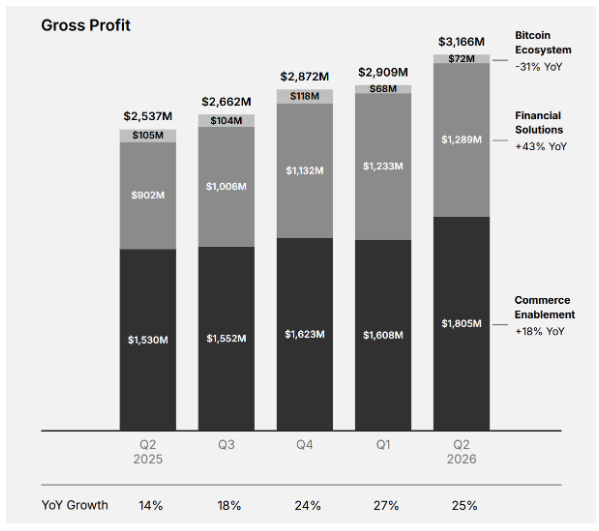
Source: Block (XYZ) Q2 FY26 Company Presentation
The stock fell 5% over the next two days. The market focused on expense growth, the timing of cost reductions, whether growth would hold and whether lending growth would lift bad debts.
These risks matter. They are why we value Block at A$125 rather than a much higher number. But the market missed the parts of the result that mattered most to us.
The existing business is getting stronger
Square’s recovery is broadening. Product development has accelerated, mid-market payment volume is growing, field sales are expanding, and the independent sales organisation channel now has more than 200 active partners. New sellers arriving through that channel rose more than 150% from the previous quarter.
Cash App is becoming a broader financial relationship. Active-user growth remains modest, but inflows per active rose 9%, commerce volume grew 17%, and consumer-lending originations rose 59%.
Block is not trying to maximise one transaction margin. It is combining distribution, financial products and services. Private banking has shown for centuries that businesses and individuals will pay higher margins when the products and services are worth paying for. Block can do this at mass scale: earn more because it helps customers do more, not because customers are trapped or poorly served.
The February letter from Founder Jack Dorsey
This result provides the first serious test of Jack Dorsey’s February letter. He announced that Block would cut more than 40% of its workforce, from more than 10,000 people to just under 6,000, because AI had developed so quickly that the company needed to reset its cost base and organisation.
Dorsey argued that a smaller company, built around its own intelligence tools, should produce more, move faster and cost less.
Six months later, Block had shipped 130 features in the first half, compared with 40 a year earlier, while AI touched almost every software change and review. Faster output arrived with record margins and stronger growth in Square and Cash App. This was not a standard redundancy program dressed up in AI language.
AI is easy to buy and difficult to deploy
Most companies can buy access to OpenAI, Anthropic or another provider. Far fewer can connect models to their own information, permissions, workflows and accumulated knowledge. The hard problem is allowing models to understand the business and complete work without surrendering control of the company’s data.
This is why Block’s internally developed tools matter. Goose and Buzz are model-agnostic, allowing Block to route tasks across frontier and open-source models according to intelligence, quality and cost. Goose connects models to real systems and work. Buzz gives people and agents a shared working environment.
Chinese open-weight models are one part of the story. Another is using older, much cheaper models for simpler tasks. The wider issue is the risk that corporate AI becomes concentrated around a few proprietary providers whose systems, prices and access conditions customers cannot control.
Block’s answer is not to build its own frontier model. It is to own the system around the model: its information, tools, permissions, customer experience and ability to replace the underlying intelligence.
An echo of AWS from the early 2000s
Amazon built the computing, storage and software infrastructure needed to run a global e-commerce business, then made those capabilities available to other organisations through AWS. AWS now generates most of Amazon’s operating profit and is commonly valued at more than US$1 trillion.
Goose, Buzz and Manager Bot, Block’s new tools and systems do not need to become the next AWS for the pattern to matter. Block built them to solve internal problems, is making parts available externally and is considering how to monetise them. The infrastructure lowers costs, speeds product development and may support external services. Your author can only ponder the difference between this thoughtful development and the mindless deployment of more debt-funded Nvidia chips into expensive data centres in Werribee.
And awareness of these products and skill set doesn’t exist in a vacuum. In the past 12 months, Block has worked extensively on its Independent Sales Organisation (IS) channel partnerships as Block now reaches larger businesses unlikely to onboard themselves online.
Block’s information becomes the product
The clearest near-term example is small-business lending. Square can see daily sales, seasonality, refunds and customer activity through the little white tile now common across small businesses. That information can support faster and better lending decisions than annual accounts and standard bank forms.
The loan is only one part of the value. Square can provide payments, deposits, credit and operating tools alongside AI native to the business. With the owner’s permission, it can answer why a restaurant’s margins fell, whether labour is mismatched to demand or whether cash flow can support another site.
This is a modern version of the skilled business banker, but available to millions of SMEs.
US Square sellers maintaining at least US$10,000 in savings can earn 3.5%, which Block says is eight times the national average. SMEs move from being targets of predatory banks to beneficiaries of technology built to help them grow.
Deposits deepen the relationship and provide lower-cost lending funds. Better information supports credit, useful software strengthens the SME, and a stronger SME processes more payments through Square. Block can grow margins and services together.
The Scale Multiplier
This is where Block connects to the transformation of Australian banking.
In the 1980s, banks supplied business credit, judgement and local knowledge. After deregulation, the commercial-credit losses of the early 1990s and the introduction of risk-weighted capital tilted the system sharply towards housing. Qualifying mortgages carried a 50% risk weight while business and personal loans generally carried 100%.
The Big Four then used what we call the Scale Multiplier. Lower capital requirements allowed them to uncouple absolute profitability from the real economic value of each loan. Even with a much thinner modern margin—1.90% rather than 3.50%—the modern bank extracts nearly eight times more absolute cash profit from the same customer volume because low capital weights allowed the loan engine to expand so dramatically.
That scale limited business lending and innovation, cemented oligopoly behaviour and starved SMEs. Mortgages were standardised, capital-light and capable of vast scale. Skilled business banking was difficult and dependent on judgement. Private loans gave way to credit cards, local knowledge to centralised rules, and transaction accounts to pools of cheap funding.
Since 1991, business lending’s share in our economy has fallen while housing’s has risen. Innovation and investment have waned, putting pressure on the government to increase its role in the economy.
Putting it bluntly, banks became grossly profitable, economically deleterious and less intelligent.
Business-credit demand is now rising faster than housing credit, as catch-up is required, and the distorting effect of negative gearing and CGT releases its grip on the economy. It is not clear that the Australian banks are ready for business credit growth, just as competition is rising across their core products.
The Scale Multiplier risks going in reverse; companies such as Block and Revolut are providing new intelligence to old problems, and new businesses are driving a wedge in business lending and customer deposits
Competition is returning, and challenge is broadening
Macquarie’s domestic bank shows that customers will move for better service and a better rate. Its savings accounts pay an ongoing 5% on balances up to A$2 million without monthly deposit hurdles or account fees. Macquarie’s share of deposits and customers keeps growing.
Regulators are also pushing back. ASIC identified about A$270 million of account-keeping and overdraw fees charged by CBA and Bankwest to roughly 2.2 million low-income customers over five years. CBA has committed about A$93 million of payments, not the full amount.
Fees are visible and attract outrage. Being short-changed on interest is quieter and so familiar that Australians accept it. Tricky savings tests and zero-interest transaction accounts play an outsized role in Big Four profits.
The prize is an SME solution that respects innovation and risk-taking without demanding the family home as collateral or using working capital as free funding for the bank.
Block says something different: maintain US$10,000 in business savings and earn 3.5%; use the platform for payments, management and credit; then use AI controlled by the business and informed by its own data to answer real operating questions.
This is genuine competition over who owns the customer relationship and supplies the information, finance and services banks once claimed as their economic purpose.
Block has millions of consumer and merchant relationships, live transaction data, lending experience, its own bank, distribution through Square and Cash App, and AI systems built around the company’s work. Better services attract customers and deposits; better information improves lending and advice; stronger customers create more transactions; and greater scale funds more product development.
Owning curiosity
A good portfolio should contain some curious companies with proprietary data. AI is changing too quickly for firms to rely only on established products or rented access to the same models as everyone else.
Block combines curiosity with its own information, financial infrastructure, distribution and willingness to rebuild as technology changes. Firms need curious people; they need to employ curious firms; and portfolios need exposure to genuinely curious companies.
Curiosity alone is not an investment thesis. Joined with valuable information, technical capability and commercial discipline, it becomes a powerful economic asset.
Block’s result showed an existing business getting stronger and a company using AI to change how it operates, what it builds and how quickly it can challenge some of the most profitable—and least curious—institutions in the economy.
The information in this article is of a general nature and does not take into consideration your personal objectives, financial situation or needs. Before acting on any of this information, you should consider whether it is appropriate for your personal circumstances and seek personal financial advice.
Estimated reading time: 11 minutes