
Copyright 2026 First Samuel Limited
This week’s National Accounts provided another useful update on the Australian economy. The headline was respectable enough: GDP grew 0.4% in the June quarter and 2.1% over the year.
But the more important numbers remain considerably less impressive. Real GDP per capita, the only measure that matters, is now in a four-year recession.
Australia continues to generate population growth much faster than improvements in individual prosperity. GDP per capita was flat in the June quarter and increased by a rounding error over the year. Put simply, the per-capita outcome remains an indictment on leadership and economic policy over the past 20 years. The economy is growing, but Australians are seeing remarkably little improvement in per capita economic output. Non-monetary measures that detract from this growth, such as quality of life, congestion, service provision, and efficiency, would easily outweigh the tiny per capita growth in the ABS statistics.
This has been a persistent feature of the post-pandemic economy. Population growth can make the economy look healthier in aggregate without producing anything like the same improvement in household living standards.
Read the previous Investment Matters here
The market
Figure #1: Per capita GDP is still below 2022 – what a waste of human resources and national endowment
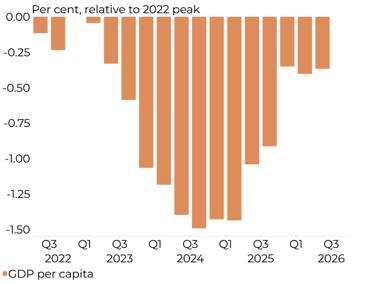
Source: ABS, Macrobond, Barrenjoey Research
The second problem, which in part drives the first, remains productivity.
GDP per hour worked was flat during the quarter and fell 0.2% over the year. This is especially disappointing because productivity ultimately determines how quickly an economy can increase real wages and living standards without creating inflation.
Australia continues to face the uncomfortable combination of mediocre underlying economic growth and poor productivity growth. That makes the task of monetary policy considerably more difficult. Weak demand alone does not guarantee lower inflation when the economy fails to generate more output per hour worked. But as investors, none of this was particularly surprising to us.
Figure 2: Productivity remains Australia’s biggest challenge
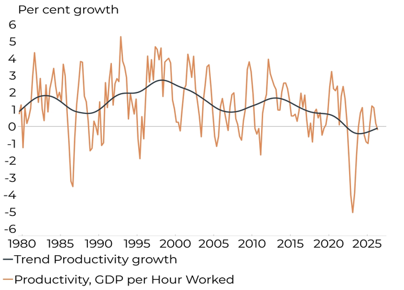
Source: ABS, Macrobond, Barrenjoey Research
Impact on monetary policy
Ordinarily, an economy producing such weak per-capita growth would be expected to generate lower inflation and eventually lower rates. But poor productivity complicates that relationship. If each hour worked produces little additional output, wages and other costs can rise faster than the economy’s capacity to absorb them. The RBA can therefore find itself confronting weak household outcomes without the inflation relief normally associated with a weak economy.
Rather, the National Accounts reinforce many of the themes around which we have increasingly built portfolios. We have been cautious about paying high prices for businesses dependent on a strong domestic economic cycle. We have maintained higher levels of cash, been selective within Australian cyclicals and increasingly sought businesses where returns can be driven by company-specific improvement rather than relying on rapid economic growth.
The National Accounts also highlight why we remain wary of portfolio strategies that rely heavily on a rapid return to very low interest rates. Australia may ultimately receive some rate relief, but without a sustained improvement in productivity the economy’s neutral cost of money may simply be higher than investors became accustomed to in the decade before Covid. That matters for valuations, leverage and the price we are prepared to pay for long-duration assets.
It is the reason why we pay careful attention to buying long-duration operating assets, not long-duration financialised assets. This is why clients will rarely see great hard assets such as Transurban (toll roads) or APA (pipelines) or investment in the property sub-portfolio that are purely land and building, not because we don’t appreciate the assets themselves, but because they are ultimately only an asset with regulated or controlled prices, structured in a way that is highly dependent on long-term interest rates. Long-dated operating assets such as Cleanaway or Reliance Worldwide are proving their value, at least in the eyes of suitors in this type of global environment.
It is also why companies such as EarlyPay and Emeco are interesting to us today. Their potential returns increasingly depend on better operations, improved capital allocation, stronger balance sheets and higher returns on existing assets — not relying on Australia suddenly producing 3–4% economic growth.
The Australian economy continues to grow. The more important challenge is that economic growth and prosperity remain two quite different things.
EarlyPay Limited (EPY) – the earnings are beginning to catch up with the opportunity
Underlying earnings are recovering — and the dividend is back
The most important features of EarlyPay’s FY26 results were the improvement in underlying earnings, the return to growth in the loan book, and the resumption of dividends.
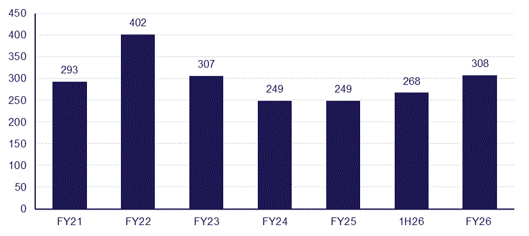
Underlying profit was $3.7m in FY26, but this backward-looking number understates the position from which the company enters FY27. Funds in Use finished June at $308m, 23% higher than a year earlier and well above the FY26 average of $269m. Combined with the benefits of completed restructuring, tighter cost control and a stronger contribution from both Invoice Finance and Equipment Finance, management expects underlying profit to increase to $4.8–5.2m in FY27. We think that is the more useful earnings number for shareholders to focus on.
Figure 3: EarlyPay – Group Funds in Use
Source: EPY FY26 Results, Henslow Research
At a share price of around 14 cents, the midpoint of FY27 guidance implies earnings of around 2 cents per share and a prospective P/E of only around seven times. EarlyPay also finished FY26 with net tangible assets of 14.76 cents per share, providing unusually strong asset backing for a profitable financial-services business with improving earnings.
Just as importantly, the stronger financial position has allowed the company to resume paying dividends. We regard this as an important milestone. EarlyPay has spent several years improving its funding structure, simplifying its operations and rebuilding balance-sheet flexibility. The dividend’s return is tangible evidence that management now believes the business can both fund its growth ambitions and return capital to shareholders.
That combination — recovering underlying earnings, substantial tangible asset backing, a very low earnings multiple and the resumption of dividends — provides a considerably better starting point for shareholders than the statutory FY26 profit number alone would suggest
Invoice Finance is growing again
The most encouraging feature of the result was renewed momentum in the core Invoice Finance business. June Funds in Use increased to $134m after a softer first half, with the business gaining momentum towards year-end. Margins remain very attractive, with Invoice and Trade Finance net revenue margins increasing from 18.5% to 20.7%, while credit losses remained well controlled.
This is important because Invoice Finance is EarlyPay’s highest-margin business. Growth has resumed just as the company has largely completed consolidating legacy systems onto a single platform. Operating costs should therefore grow much more slowly than revenue, creating the potential for strong incremental profitability.
Equipment Finance is increasingly important
The second source of growth is Equipment Finance.
June Funds in Use increased 39% to $174m, while originations were up strongly through the year. This business has attractive economics because Earlypay already has the funding structures, people and systems required to support a larger loan book.
Its funding warehouses provide substantial capacity and require Earlypay to contribute only a modest amount of its own capital. As the equipment-finance book grows, the company can therefore generate materially more revenue without needing an equivalent increase in shareholder capital or operating costs.
Credit losses will always be part of any asset-based lending business. Success is not about eliminating bad debts. It requires good underwriting when a loan is written, close monitoring as circumstances change, and disciplined execution when a borrower deteriorates.
In equipment finance especially, management needs to understand the value of the underlying asset and recognise the point at which continued support becomes less attractive than retrieval and sale. We were particularly pleased with management’s discipline around this process.
Capital management is becoming a strength
We were also pleased with the progress in EarlyPay’s funding and capital management.
For a number of years, we believed the company had an inefficient funding structure, partly reflecting decisions taken around five years ago. The improvement since then has been substantial. EarlyPay now has efficient warehouse funding, no corporate debt and sufficient capital to support further growth. This also creates an obvious capital-allocation opportunity.
We are not necessarily advocates of share buybacks in all circumstances. But when a profitable company is trading at or around tangible asset value and at approximately 7 times prospective earnings, repurchasing shares is compelling.
EarlyPay has already materially reduced its shares outstanding through buybacks, increasing the ownership of its remaining shareholders. There is also a broader strategic point.
We struggle to believe EarlyPay should ultimately remain a standalone business. Its Invoice Finance and Equipment Finance capabilities, customer relationships, underwriting systems, warehouse funding and distribution would potentially be more valuable within a larger financial-services platform.
The funding, distribution and operating synergies available to a larger owner could be very significant relative to EarlyPay’s current standalone profits. That makes the buyback doubly important. Every share EarlyPay retires cheaply increases the value accruing to remaining shareholders and raises the cost of waiting for any potential strategic buyer. In that sense, the buyback does more than improve earnings per share. It raises the price of inaction.
Emeco — increasingly worth more than its assets
Sales first, profits follow
We have been particularly pleased with the progress at Emeco. We met CEO Ian Testrow and CFO Theresa Mlikota over the past fortnight, and our discussions reinforced our view that management is focusing on the parts of the business that matter: improving maintenance capability, strengthening Force Workshops, increasing returns from the existing asset base, and converting those earnings into cash.
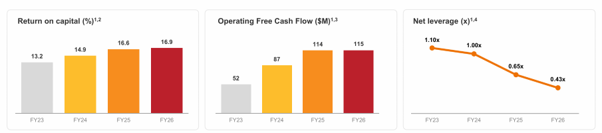
The market reacted positively to the FY26 result, despite conditions softening towards the end of the financial year. Revenue increased only modestly to $793m, but operating EBIT rose to $148m and operating NPAT to $89m. More important to us was another year of excellent cash generation. Adjusted operating free cash flow was approximately $115m, while net leverage fell to just 0.43 times.
Figure #4: Emeco: Consistent improvement in financial metrics
Source: EHL FY26 Results
This continued de-gearing (net leverage in chart above) is now becoming an important investment outcome. The balance sheet is no longer something Emeco needs to repair. It is increasingly something management can use.
Beyond NTA
In several recent results we have discussed companies moving “beyond NTA”. NTA, or Net Tangible Assets, is the value of a company’s tangible assets less its liabilities. For an asset-heavy business such as Emeco, it has historically provided a useful valuation reference point: what are the machines, workshops and other tangible assets worth after allowing for the debt funding them?
Emeco’s NTA has increased materially in recent years, reaching approximately $1.51 per share in FY26. But continued progress increasingly makes NTA the wrong destination for the valuation; the company is likely worth much more.
Historically, investors could reasonably question whether Emeco would consistently earn an adequate return on the enormous amount of capital invested in its fleet. The company carried more debt, earnings were more cyclical, and returns on the asset base were lower.
That has changed.
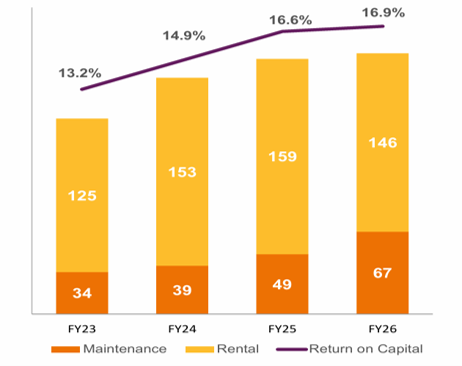
Emeco’s return on capital has risen from 13.2% in FY23 to 16.9% in FY26. At the same time, the balance sheet has strengthened, cash generation has improved and maintenance has become a larger and less capital-intensive part of the business.

A company consistently earning attractive returns from its tangible assets should ultimately be worth more than the accounting value of those assets. The fleet provides the NTA; the customer relationships, operating systems, national footprint, maintenance expertise and Force Workshops increasingly provide value beyond it.
Figure #5: Gross EBIT by Division and Group Return on Capital (ROC)
Source: EHL FY26 Results
Unfortunately, this creates another risk.
In recent weeks we have watched bidders emerge for both Cleanaway and Reliance Worldwide. In each case external investors have been prepared to look through short-term operating weakness and focus instead on strategic assets that would be difficult or expensive to recreate.
We are concerned that Emeco could ultimately attract the same level of attention if the share market remains too slow to recognise the improvement in the business.
Our preference is emphatically for that value to accrue to existing shareholders. But a company trading around or below its tangible asset backing while generating improving returns on capital and substantial free cash flow will inevitably become increasingly obvious to others.
Considerable earnings capacity remains unused
The softer conditions late in FY26 were not ideal, although some were temporary and weather-related.
Average surface fleet utilisation was 82% during FY26, while underground utilisation was only 67%. Importantly, Emeco generated $148m in operating EBIT and $115m in adjusted free cash flow at these utilisation levels.
Management expects its existing project pipeline to lift surface utilisation towards approximately 90% and underground utilisation towards 80% by the end of FY27.
That matters because much of the equipment required to generate this additional revenue is already owned.
The next dollar of revenue generated by putting an idle machine back to work therefore has very different economics from revenue growth that requires purchasing a completely new fleet. This is where the earnings power of the work undertaken over recent years should become increasingly evident. At the same time, Emeco continues to strengthen the maintenance capabilities for those assets.
Force Workshops is central to this improvement. On-site maintenance revenue grew strongly in FY26, while Force completed more than 140 major machine rebuilds during the year.
We increasingly regard Force as more than another source of revenue. It is a competitive advantage for the entire Emeco business. The capability to rebuild equipment internally extends asset lives, improves fleet availability, reduces the cost of maintaining the rental fleet and enables Emeco to provide customers with more fully maintained equipment solutions. Each of these improves the economics of the assets already sitting on Emeco’s balance sheet.
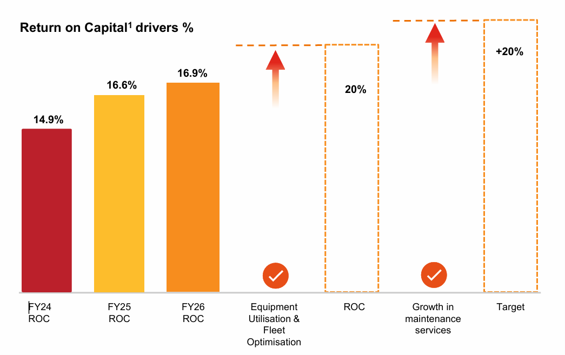
The destination is 20%. Management describes much of this progress through its ambition to increase Return on Capital to 20% by FY28.
We particularly appreciate this target.
For a capital-intensive company, EBITDA growth alone is a poor measure of success. Emeco could generate more EBITDA simply by buying more machines. The better outcome is to generate substantially more earnings from each dollar already invested in the business.
Higher utilisation contributes. Better contract pricing contributes. Extending asset lives through Force contributes. Growing less capital-intensive maintenance revenue contributes.
Most importantly, higher returns are being accompanied by excellent cash generation.
Management estimates that moving from the current 16.9% return on capital towards 20% could lift annual free cash flow from around $115 million towards approximately $140 million.
Figure 6: Driving a higher Return on Capital (ROC)
Source: EHL FY26 Results
From de-gearing to growth
Our discussions with the CEO and CFO also left us particularly interested in what Emeco can now do with its stronger balance sheet. We see two obvious acquisition opportunities.
The first is the addition of smaller maintenance businesses, workshops or contracts that can strengthen Force. Emeco already has the customer relationships, technicians, procurement capability and operating infrastructure. Compatible businesses may therefore be considerably more valuable as part of Emeco than they are independently.
The second opportunity is potentially more exciting: acquiring smaller equipment businesses that resemble Emeco itself. We would particularly like a bite-sized business with a strong underlying asset base, but where financing, utilisation or operating performance can be improved. Force could add considerable value to such an acquisition through rebuilding and maintaining acquired equipment before redeploying it across Emeco’s customer base.
For much of the past decade, the Emeco investment story was necessarily about fixing the balance sheet and improving the existing business.
That work has been successful.
The next stage can increasingly focus on using the balance sheet, lifting utilisation, and growing earnings from the assets already in place.
If Emeco reaches a 20% return on capital while continuing to generate cash at anything approaching current rates, the debate should no longer be whether the shares deserve to trade at NTA.
It should be how far beyond NTA a business of this quality deserves to trade.
Worley — a great story increasingly in need of proof
Worley remains one of the more strategically interesting companies on the ASX. Its exposure to global energy investment, electrification, critical minerals, LNG and the enormous capital requirements of the energy transition remains compelling. The shares are also inexpensive, relative to our valuation, in terms of market price-to-earnings ratio and to what the business could earn if management delivers.
The difficulty is that we are increasingly being asked to value the opportunity rather than the earnings actually produced.

CEO Chris Ashton and his management team have spent much of the past five years articulating a compelling story around sustainability, the energy transition, improving margins and, more recently, Full Project Delivery. Much of that strategic argument continues to make sense. But we are becoming tired of stories without sufficient delivery. At some point, the quality of the opportunity has to appear in the earnings received by shareholders.
For us, five issues now dominate the investment case.
Three disappointments in a year
Worley has now disappointed investors three times in relatively quick succession.
The February result contained substantial restructuring and transformation costs and renewed questions about the gap between statutory and underlying earnings. This was followed by a larger-than-expected impact from Middle East disruption and currency movements. The FY26 result then delivered a weaker FY27 growth outlook than investors had anticipated.
None of these disappointments individually destroys the investment case. Collectively they matter.
Management credibility is an asset. After several misses, investors rationally place less weight on forecasts and more weight on delivered earnings.
Earnings quality is becoming harder to assess
We are increasingly uncomfortable with the quality of the earnings being presented.
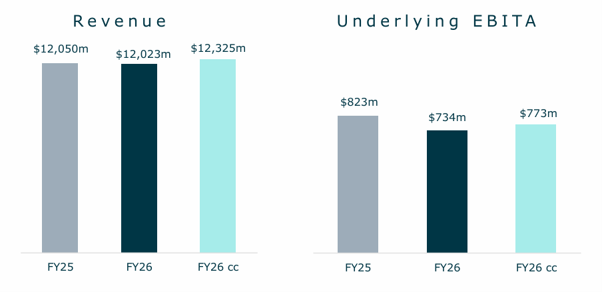
Worley generated underlying EBITA (constant currency) of $734m in FY26, but this excluded approximately $120m of restructuring and transformation expenditure. Management argues that these costs are creating a leaner organisation and have already produced substantial savings.
Figure 7: Worley – only just but not without significant massaging
Source: Worley FY26 Results
That may ultimately prove correct. But shareholders have now spent several years being encouraged to focus on underlying rather than statutory outcomes. At some point, restructuring costs, transformation expenditure and other adjustments need to stop being recurring features of the result.
Procurement revenue adds another complication.
At the first half, aggregated revenue grew 5.4%, but procurement revenue increased almost 35%. Excluding procurement, revenue actually fell almost 5%, while EBITA was essentially unchanged.
Procurement-through activity is real revenue, but it is not revenue we are prepared to value particularly highly. It can dramatically increase reported turnover while contributing comparatively little incremental margin, and it disappears as large projects move through different phases.
Worley can become a much larger company by putting more customer expenditure through its accounts. The more important question is whether it becomes a materially more profitable company.
The sustainability thesis needs to translate into shareholder value
This raises a more fundamental question about the investment thesis that has dominated Worley for much of the past five years.
Sustainability-related revenue has risen from roughly one-third of group revenue to almost 70%. That sounds extraordinary. Yet FY26 group revenue was effectively flat and underlying EBITA declined.
The nexus between more sustainability-related revenue and more shareholder value is therefore much less obvious than it once appeared. We remain convinced that the underlying investment cycle is enormous. The world will require extraordinary spending on power, grids, LNG, critical minerals, nuclear, renewables and associated infrastructure. But exposure to a thematic is not enough.
Worley needs to demonstrate that its privileged position within this spending cycle translates into sustainable growth in earnings, margins and cash flow.
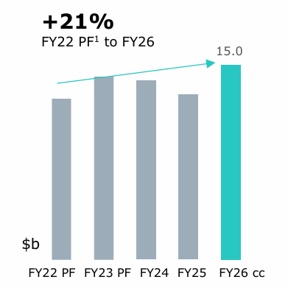
Figure #8 Backlog, $bn of work: Needs to generate stronger earnings at lower risk
Source: Worley FY26 Results
Worley is now in the sin bin
The FY27 outlook compounds our caution.
Management expects growth, but earnings are again expected to be weighted towards the second half. After three disappointments in relatively quick succession, we are no longer prepared to capitalise earnings that management says will arrive in six or twelve months. For the next twelve months, Worley is effectively in our and the market’s sin bin.
This is not because we no longer believe in the underlying franchise. Rather, we have become tired of an attractive strategic story repeatedly being accompanied by earnings that arrive later, are lower than initially expected, or require another explanation.
Chris Ashton and his team now need to demonstrate that the promised improvement is real. The next results need to contain more delivery and less promise.
Large EPC (Engineering, Procurement, and Construction) Projects change the risk
Management’s response to the growth challenge is increasingly centred on Full Project Delivery.
Historically, one of Worley’s great attractions was its engineering and intellectual capital. Consulting, design, engineering and project management can produce attractive margins without requiring large amounts of physical capital.
But engineering accounts for only a relatively small share of the total expenditure on a major project. Worley increasingly wants to participate further down the value chain through procurement, construction and broader EPC/EPCM delivery. The commercial logic is obvious. It dramatically expands the amount of customer spending Worley can capture.
The risk is that Worley solves its revenue-growth problem by changing the quality of the business.
Large projects introduce greater execution complexity, greater dependence on project timing and potentially greater customer concentration. Procurement and construction can generate enormous revenue at considerably lower margins than Worley’s traditional engineering activities.
Worley suggests it sensibly avoids the worst form of this business — competitively bid, fixed-price turnkey construction — but greater involvement in project execution nevertheless changes the risk profile. Many projects that fail are only understood in hindsight.
This would concern us less if the existing business were producing strong organic earnings growth. Instead, management is increasing the business’s complexity, while the earnings promised by the existing sustainability opportunity remain elusive.
A management team that has been in place for a long time now needs to demonstrate that Full Project Delivery creates shareholder value rather than simply scale.
A profitable investment — but not because we simply waited
Worley has nevertheless been a profitable investment for our portfolios over the past 6 years. Importantly, much of that return has come not from buying the shares and waiting for the entire strategic story to be realised, but from actively trading Worley through its valuation range — adding when disappointment has pushed the shares materially below our assessment of value and reducing the position when optimism has returned.
That history influences our approach today.
We do not need Chris Ashton and his team to deliver the entire long-term story for Worley to remain a useful investment. But after repeated disappointments, we are increasingly reluctant to pay in advance for earnings that have yet to arrive. There remains one particularly material source of near-term upside.
A resolution of conflicts in the Middle East would benefit several ASX-listed companies. Few would benefit more directly than Worley. The restoration of normal project activity, greater customer confidence, and reduced disruption to major energy investments could materially improve earnings. In the meantime, the underlying franchise remains strong, and the share price is sufficiently low for us to retain our holding.
But cheap is not necessarily the same as great value. For now, we are likely to hold. At prices above approximately $13 per share, however, we would review the position carefully.
Worley has the customers, backlog, skills and thematic exposure required to produce substantially better outcomes. The next twelve months need to demonstrate that management can finally turn them into earnings.
The information in this article is of a general nature and does not take into consideration your personal objectives, financial situation or needs. Before acting on any of this information, you should consider whether it is appropriate for your personal circumstances and seek personal financial advice.