Wry & Dry: a cynical and irreverent review of the week in politics, economics and life. For intelligent Readers who disdain the trivial.
Investment Matters
This week Craig reviews:
- Global bond markets limit Middle East de-escalation
- Federal budget fall-out deepens
- Brambles and Elders: two very different disasters
- Worley: 2026 Investor Day
- Ora Banda: ‘Drive to 300’
Read this week’s Investment Matters.
1. Wry & Dry’s ponderings…
Uncle Albo’s ideological instincts rose from the depths in his masterful but unmandated budget. But today he had to toss Grim Jim under the bus to ease the massive backlash. Victoria’s auditor-general has the spyglass on the 40-year lottery deal. Emperor Eleven’s revolving door of visitors. SpaceX to blast passive funds into space. Slow news day in the UK. It’s clear more laughter is needed, so we’ve added extra cartoons by Patrick Cook.
2. Uncle Albo tosses Grim Jim under the bus
Uncle Albo knew that he would have to put on his crash helmet to survive a post-budget baseball bat belting about broken promises. He didn’t expect it would be the worst received budget since August 1993.1, 2
And the budget sales-process didn’t survive untouched. Today, he announced that there would be no change to taxation of inheritances. It’s hard to see who is more embarrassed: Grim Jim for having his boss toss him under the bus. Or Uncle Albo himself, for being so out of touch with the community that he didn’t anticipate a problem with the ‘death tax’.
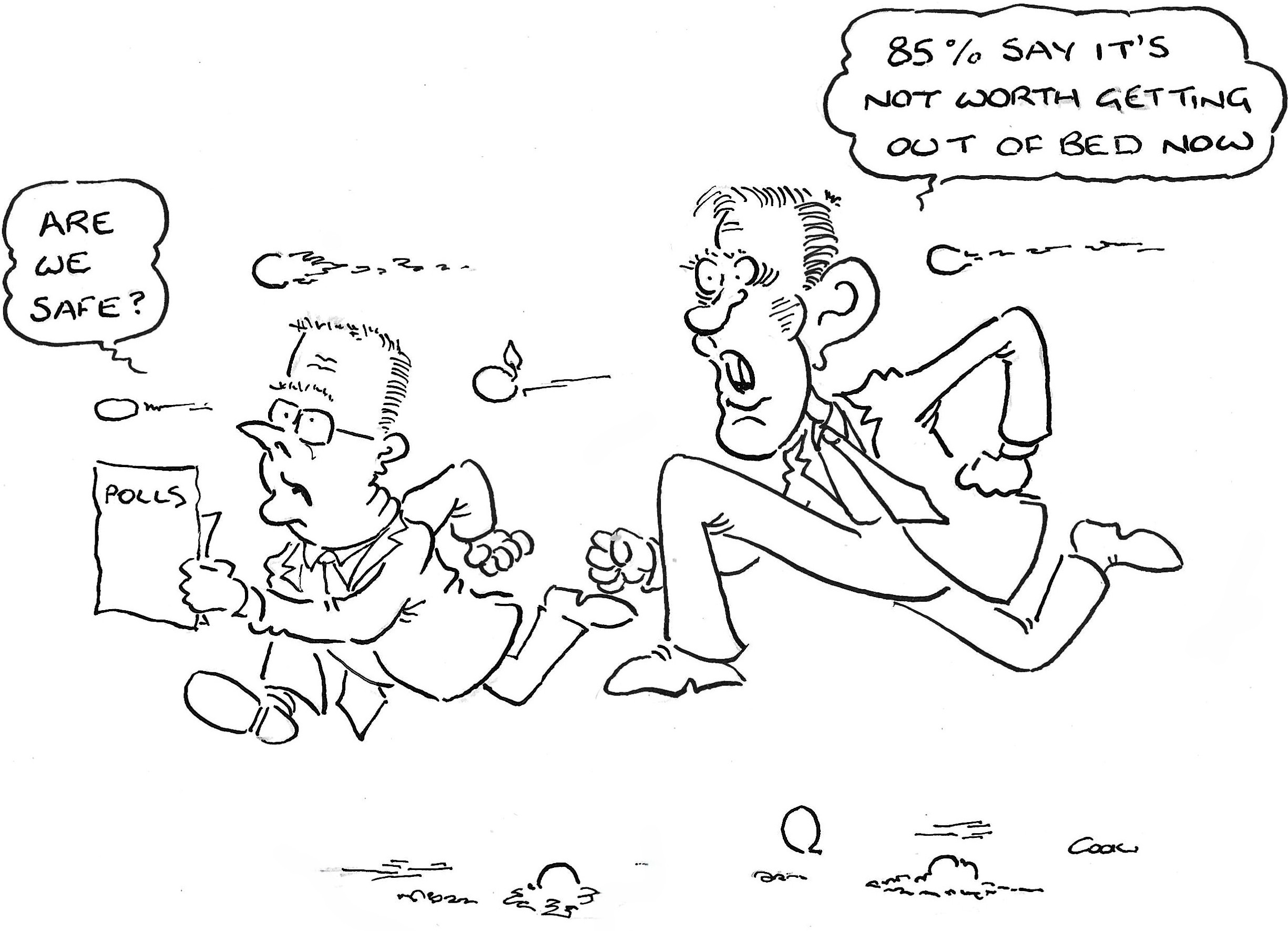
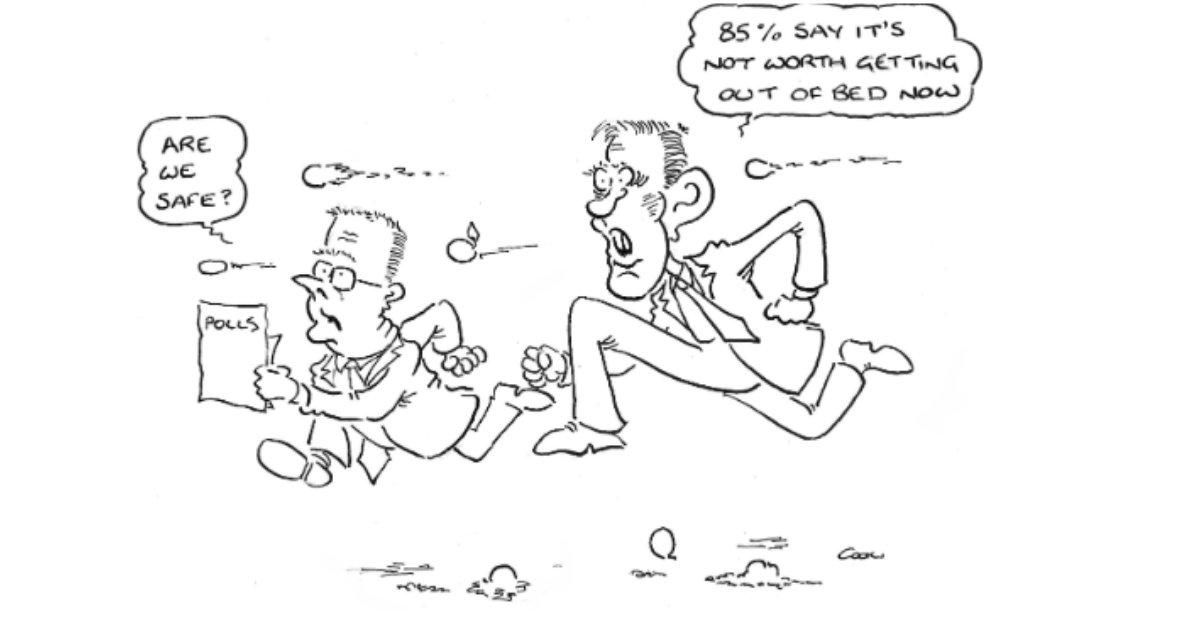
More generally, the informed media and informed economists were critical of what he didn’t say (no productivity enhancements, inactive debt management), and could have been more critical. But seemed to almost acquiesce to much of what he did say about the new taxation of trusts arrangements (fairness) and the changes to negative gearing (help first home buyers).
The kicking Uncle Albo received, and is receiving, is about (a) the broken election promises; (b) the CGT changes; and (c) the tax treatment of testamentary discretionary trusts. Some of this kicking is entirely justified, especially most of the CGT changes and his total inability to provide understanding, much less clarity, about testamentary trusts. On the latter, it is clear he (and Grim Jim, for that matter) just hadn’t done their homework.
But he can sleep soundly, safely ignoring both the sensible and the hysterical criticisms, as his changes will sail through both the House and the Senate. But expect the Greens to demand their 30 pieces of silver for their Senate votes.
Politically, the budget shows that Uncle Albo’s ideology has at last surfaced. He now leads the most economically left-wing political party since Attlee’s in immediate post war Britain. It’s not just the redistribution, but the investment disincentives, higher taxes on capital, and higher taxes overall. Did we-the-people vote for this?
Add to this budget’s changes the massive increase in government involvement in the economy over the past four years, with ‘off-budget’ spending of now $114 billion. There are cash deficits totalling over $265 billion over the next five years, all of which has to be borrowed.
Luckily for Uncle Albo, the disarray in and widespread incompetence of non-Labor parties mean that he will not have to face a credible or effective anti-Albo campaign in the time leading up to the next election.
The groundwork of Uncle Albo’s ‘economic reform’ is mostly complete. Now expect a turn to ‘progressive’ government. Treasurer Grim Jim will become less prominent, much to his chagrin. Ministers Burke, Butler and Bowen will be more noticeable.
And Uncle Albo can get on with spending Australian taxpayers funds on his fast train project, between two cities in New South Wales.
1 Source: Newspoll, Monday 18 May.
2 John Dawkins was Treasurer. Keating was Prime Minister.
3. Victoria: the lottery state
Nothing exemplifies the approach of the Victorian government to its stewardship of the state’s finances than its reliance on awarding a 40-year lottery licence to a gambling company to prop up its bank balance in FY-27, by a useful $1.15bn. Thereby giving an operating surplus of $1.05bn.
The massive deal was not put out to tender.
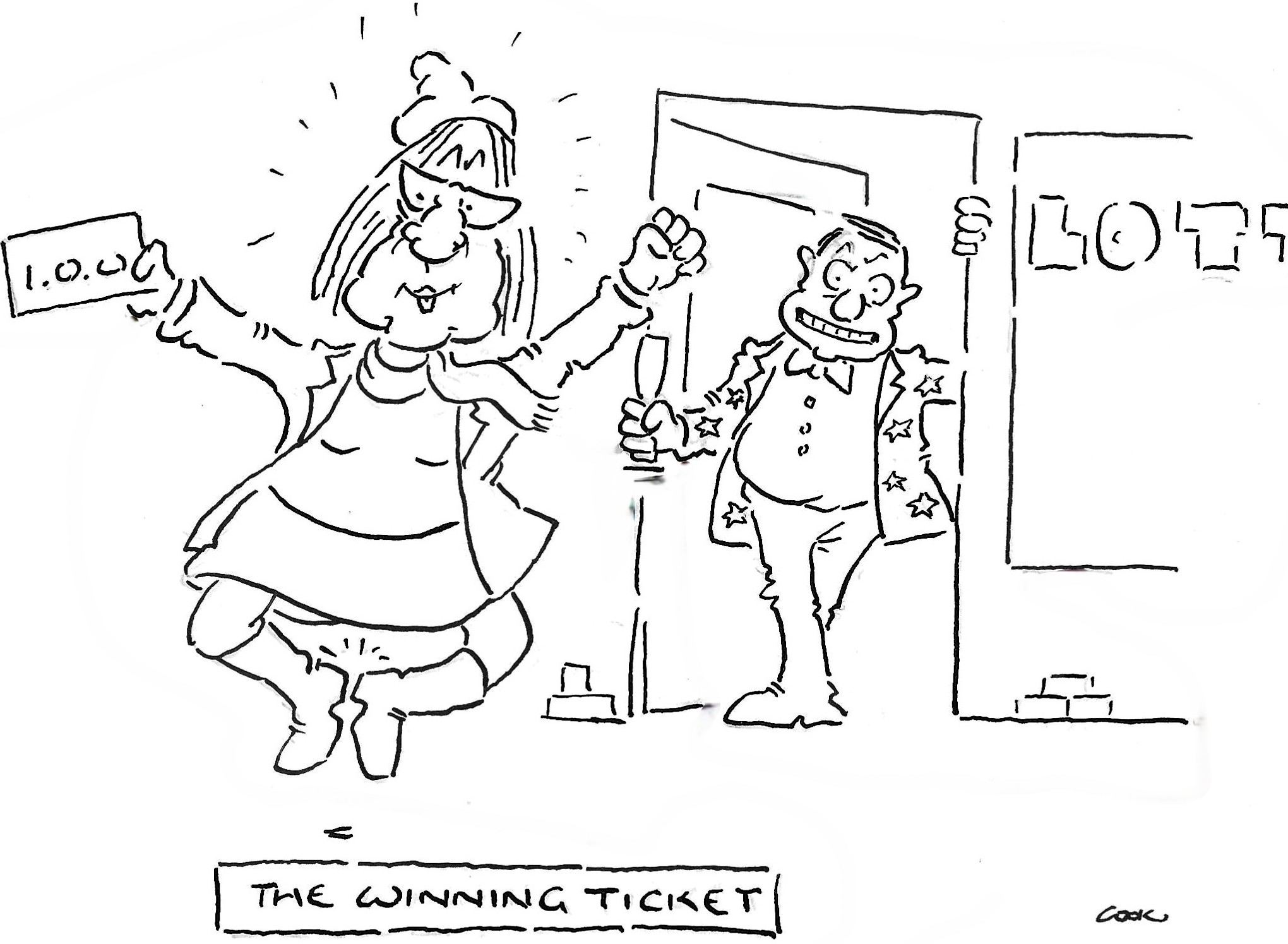
Gaming Minister Erdogan robustly defended the deal: “This licence extension is in fact the highest ever price paid for a lottery licence in our country.” This is a flawed statement for two reasons.
Firstly, without a tender, he will never know if he would have obtained a higher price. And neither will the Victorian taxpayers.
Secondly, the ‘highest price’ comparison is nonsense. The company has 40-year deals with New South Wales, South Australia and the Northern Territory, and a 65-year deal with Queensland, none of which is comparable to Victoria’s deal.
The Queensland deal was executed in 2007, and the New South Wales deal in 2010; values and state populations have risen in the meantime. South Australia and the Northern Territory have significantly smaller populations than Victoria.
Victoria’s auditor-general is now running his slide rule over the deal.
4. Trumpster to sell out Taiwan
Firstly, it was Iranian foreign minister Abbas Araghchi who knocked on Emperor Eleven’s door. That was about oil.
Last week, it was Trumpster, to ask Emperor Eleven’s consent to selling arms to Taiwan. As Wry & Dry has predicted, Trumpster will do to Taiwan what Nixon did, but for different reasons.
Nixon abandoned Taiwan so as to get China’s help in ending the Vietnam War. Trumpster will abandon Taiwan because he doesn’t have the cojones to stand up to Emperor Eleven.
Trumpster’s cowardice in dealing with Emperor Eleven at last week’s summit was clear. Y’see, a $14bn arms package for Taiwan has been sitting on his desk since March. The deal is clearly needed by Taiwan as a deterrent to Emperor Eleven. But Trumpster is vacillating about signing it so as not to upset the Emperor.
But America has a 44-year-old commitment not to negotiate with China over arms sales to Taiwan. But that is exactly what Trumpster did.
After telling reporters that “no, I didn’t say anything” about US arms sales, he then said the opposite: “…the whole thing with the arms sales was [discussed] in great detail, actually.” And that he saw it as a useful bargaining chip. The world awaits his decision, a process that he enjoys.
Trumpster, in a Captain Obvious statement, opined that Emperor Eleven felt “very strongly about Taiwan.” Meaning that he (Trumpster) didn’t. This is Munich 1938 all over again.
And as Trumpster left Emperor Eleven’s home through the exit door, Tsar Vlad strode in the entrance. That was all about gas. Tsar Vlad also went home empty handed: he didn’t get the 50 billion cubic-metre p.a. “Power of Siberia” gas pipeline.
Emperor Eleven bestrides the world like a colossus.
5. SpaceX to blow passive funds into space
Elon Musk’s upcoming initial public offering (IPO, ‘float’) of SpaceX will be a blockbuster. If 50% of the company’s shares are eventually floated with a valuation of $2tn, passive investors3 will have to buy $95bn of SpaceX stock. Which means they will need to sell $95bn of other stocks.
JPMorgan estimates that such rebalancing will mean that some $22bn of Nvidia stock, $17bn of Apple, $12bn of Microsoft, $10bn of Amazon, etc. will have to be sold.
The problem with index investing is that there will be a post-IPO pop in the share price, which means that investors will be buying at a weighty price. Passive funds will have to buy – they don’t have a choice.
But wait, there’s more! OpenAI (sooner) and Anthropic (later) have said they will also float their shares.
Of course, the market will absorb these floats. But the Wall Street trading frenzy will be like a pond of piranha fighting over a dead animal.
3 That is, those whose portfolio holds stocks weighted in proportion to the market capitalisation of the company to the whole index.
6. Sweden starts to meet its NATO requirements
Trumpster has been whingeing about NATO since he was in utero.
In one of his few pronouncements that is somewhat correct, NATO should not rely on the US to defend itself. Hitherto (from 2014), NATO has required countries to spend at least 2% of GDP on defence. Few countries did, but (a) Trumpster’s withdrawing of troops from Europe and (b) Tsar Vlad’s adventures mean they are now furiously buying kit.
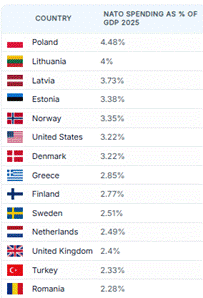
Source: World Population Review
Sweden was a latecomer to NATO (March 2024). Tsar Vlad’s unfriendly attitude to his neighbours caused a change of mind in the hitherto sort-of neutral country. Then its defence spending was then about 1.6% of GDP. And within two years has got its act into gear to boost it defences.
It will spend some $4.25bn on four ‘defence and intervention’ frigates, and in doing so will triple the country’s air defence systems and expand its maritime defence of the Baltic. The frigates will be built by France’s Naval group. Spain’s Navantia and the United Kingdom’s Babcock International were unsuccessful bidders. Greece has also bought four of the vessels.
In 2025, NATO announced a 5% target by 2035.It is probable that Poland, Denmark, Norway, Sweden, Finland and the Baltic states will reach, or get close to, the 5% target by 2035. After those countries, the willingness and capacity falls away, sharply.
Trumpster wants the US to hit 5% before then, but 5% of US’ GDP is a gargantuan number. And The UK will probably get close, only because its GDP will go down, not its defence spending go up.
7. Slow news day
It couldn’t possibly be a slow news day in the UK, with the government popularity shrinking faster than Andrew Mountbatten Windsor’s invitations to ‘At Home’4 events. Notwithstanding other news, the venerable The Times had resources to devote to a riveting article; that UK primary students have the most trouble with the simple arithmetic question: 9 x 6 = ?
The national multiplication test in primary schools was introduced in 2018 by the education minister, who himself could not answer ‘what is 8 x 9?’ on live television.
Someone has taken the trouble to interrogate over 250 million times’ tables answers by 317,000 primary school children over seven years. And found that the most difficult questions were 9 x 6, 6 x 9, 9 x 7 and 3 x 9, with almost 25% failing where 9 is the first digit in the question.
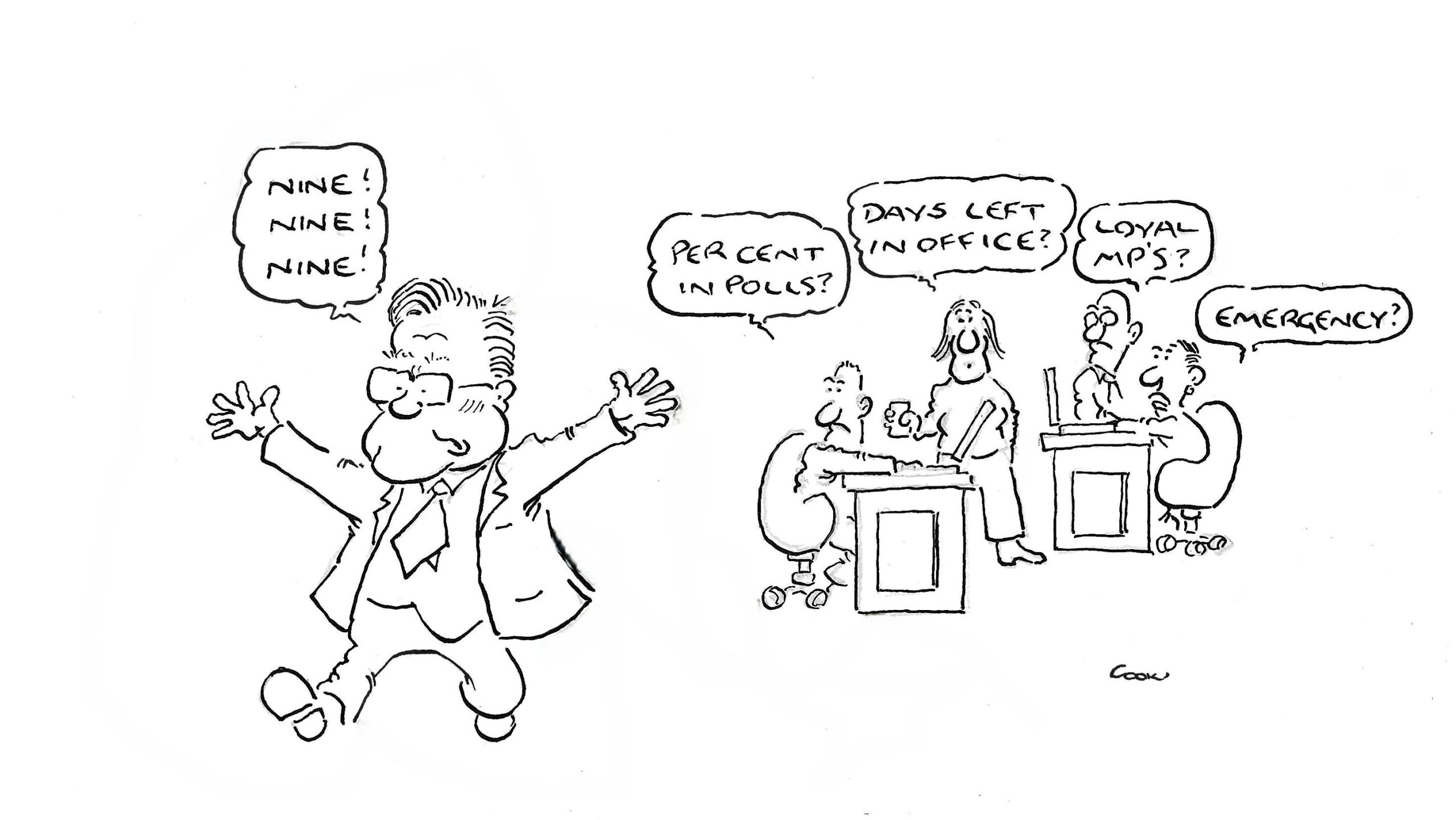
Doubtless a government committee of enquiry will be established to assess the significant implications of the number 9 in the future of UK education. For example, should the number be abolished to improve children’s education?
4 An ‘At Home’ event is a quaint English tradition. It is a small and short drinks-, cocktail- or dinner-party held at one’s private residence, to which one sends formal invitations. In yesteryear, one’s mantelpiece would be congested with At Home invitations for those coming to one’s At Home to see how popular one was.
By the way, last week A M-W was censured for failing to surrender his Freedom of the City of London, despite being asked to do so. This ancient City of London tradition is thought to date back to 1237 and allows recipients to ply their trade. Of course, A M-W has no trade to ply.
8. Freeze prices? Really?
The UK’s chancellor (i.e. treasurer) must have been in la la land when she suggested that UK supermarkets freeze the prices of essential groceries.
Ms Reeves has a master’s degree in economics and should know better. Her proposal means that supermarkets would have to pay for the increase in input costs that they cannot pass on to shoppers. The CEO of Marks and Spencer tactfully called the proposal “completely preposterous.” Quite right, too.
Ms Reeves has had second thoughts.
9. Starmer’s ministerial exit smash records
UK PM Starmer has had more ministerial resignations (14) faster than any recent UK PM.
Certainly, Borisconi had the steepest leap, but that was after over 1,000 days in office. The others, in grey lines on the chart below, from the bottom right are Cameron (7 ministers giving themselves the DCM), Thatcher (8), Major (10), Blair (12), Brown (16), and May (41). Truss lasted only 50 days in office, the shortest of any UK PM; none of her ministers had time to resign.
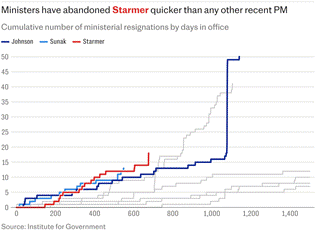
Chart source: UK Telegraph
Starmer’s only challenger, so far, Andy Burnham (the mayor of Manchester), would defeat him in a head-to-head contest 59-37, according to a recent poll. But Andy first has to win a by-election to get into the Commons. And then he might have other challengers from the right of the party, who would be dismayed at Andy’s spend-thrift economics. UK 10-year gilts are already yielding 5%.
Andy doesn’t seem to realise that fixing the buses in Manchester doesn’t mean the same fix-it approach can fix the dire state of the UK economy.
10. Tsar Vlad’s war cost 3% of Russia’s population
The Economist estimates that Tsar Vlad’s Ukrainian adventure has cost about 3% of Russia’s pre-war male population of fighting age, about 1.3m casualties.
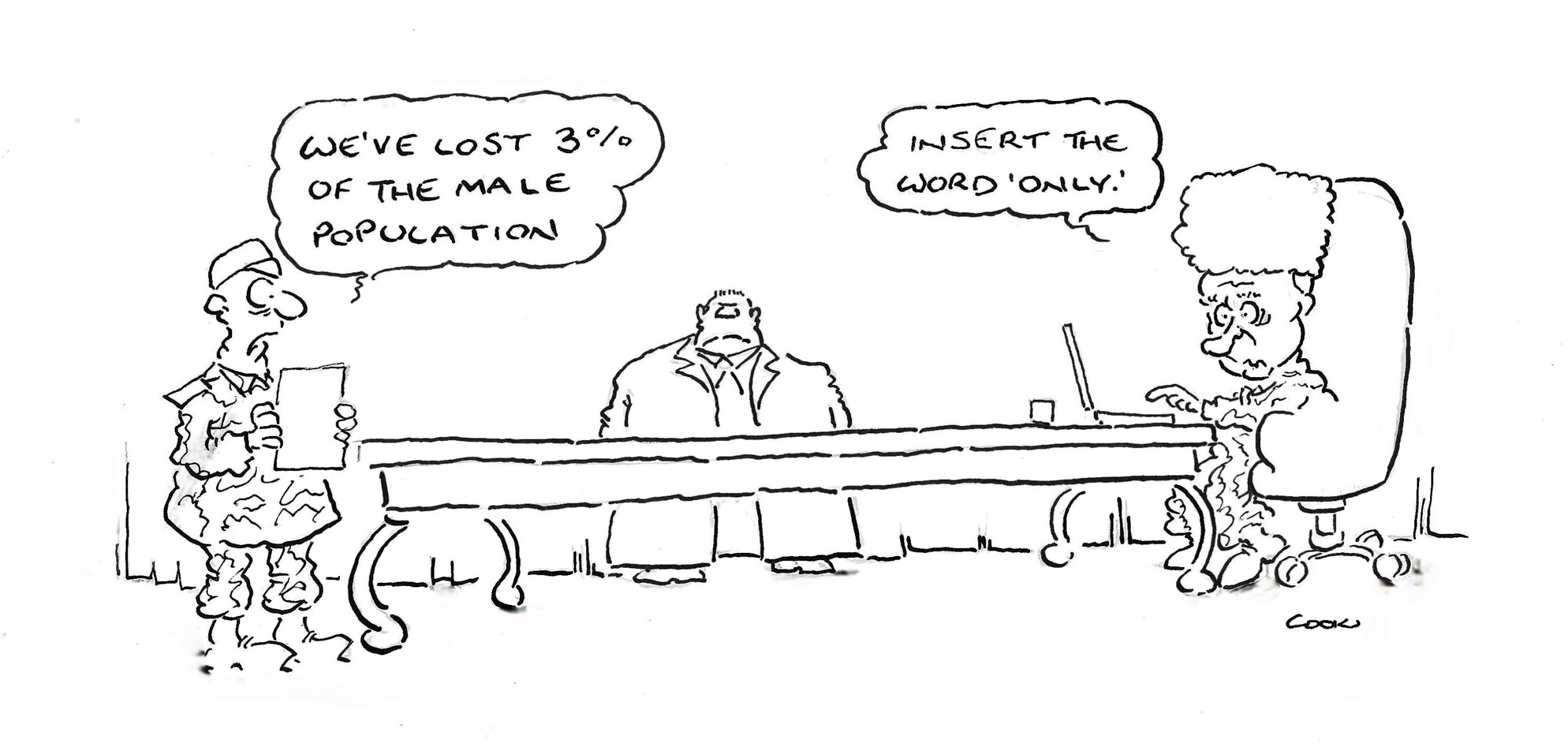
At what stage will someone in the Kremlin ask Tsar Vlad about the high cost of this meat-grinder war and ask him to find a way out?
- When the increasing cost to Russia’s economy becomes too high;
- When the increasing number of Made in Russia body bags finally hits the media;
- When Trumpster finally shows some spine and provides massive military support to Ukraine; or
- Never.
Close. But no cigar. The correct answer is d. Tsar Vlad has staked too much on this adventure. The only way for Russia to withdraw is for Tsar Vlad to somehow get the DCM.
11. Inflation hits World Cup. Or just greed?
Wry & Dry always provides charts of the most important economic data. The critical chart, below, thanks to The Economist, is presented without comment.
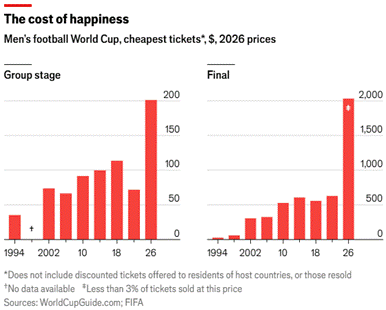
Chart source: The Economist
Snippets from all over
Sultan Erdoğan’s power grip tightens
A court in Ankara has ruled to remove the leadership of Turkey’s biggest opposition party in a landmark decision that could tighten President Recep Tayyip Erdoğan’s hold on power and spark market turmoil. (Financial Times 22 May)
Wry & Dry comments: Turkish stocks fell 6% in response.
AI use to cause 15% jobs cut
Standard Chartered will cut 15 per cent of its back-office roles by 2030 as the Asia-focused bank increases its use of AI under chief executive Bill Winters’ new strategy. (Financial Times 19 May)
Wry & Dry comments: That’s about 7,800 people to get the DCM.
Circumventing
A terror group that claimed responsibility for a series of arson attacks on the Jewish community in London has been officially outed as a proxy of the Iranian state. (The Times 19 May)
Wry & Dry comments: Harakat Ashab al-Yamin al-Islamiya (Hayi) has been linked to half a dozen arson attacks in London on Jewish ambulances and synagogues, as well as a drone attack on the Israeli embassy.
Bourbon glut
[Because the world is awash with bourbon] Jim Beam is trialling zero-alcohol drinks—the first time an alcohol-free product has carried its brand since Prohibition. (Wall Street Journal 18 May)
Wry & Dry comments: Wait for Trumpster to now provide government support to bourbon producers.
Labour split over Brexit
Andy Burnham, Greater Manchester’s mayor [and putative PM if he wins the by-election to get into the Commons], said he was “not advocating” for Britain to rejoin the European Union after Wes Streeting, who resigned as health secretary on Thursday, declared Brexit a “catastrophic mistake”. (Economist 18 May)
Wry & Dry comments: Britain doesn’t need to split even further. Any move to revisit Brexit will fail. Better to achieve much the same thing under the guise of something else.
It figures
- 4.5%: Australia. Unemployment rate in April, up from 4.3%. 4.5% is the peak rate assumed in the budget.
- 5%: UK. Unemployment rate in April, up from 4.9% in March.
- -15%: China. Car sales in April compared to previous corresponding period.
- 4.3%: USA. Unemployment rate in April. Unchanged.
- $385,000: Panama Canal. Cost at a ‘spot auction’ i.e. not booked in advance, of a transit slot. Up from $140,000 pre-war. But the Panama Canal is only the 9th busiest choke point:
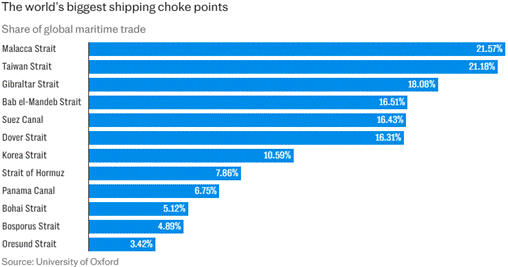
Chart source: UK Telegraph.
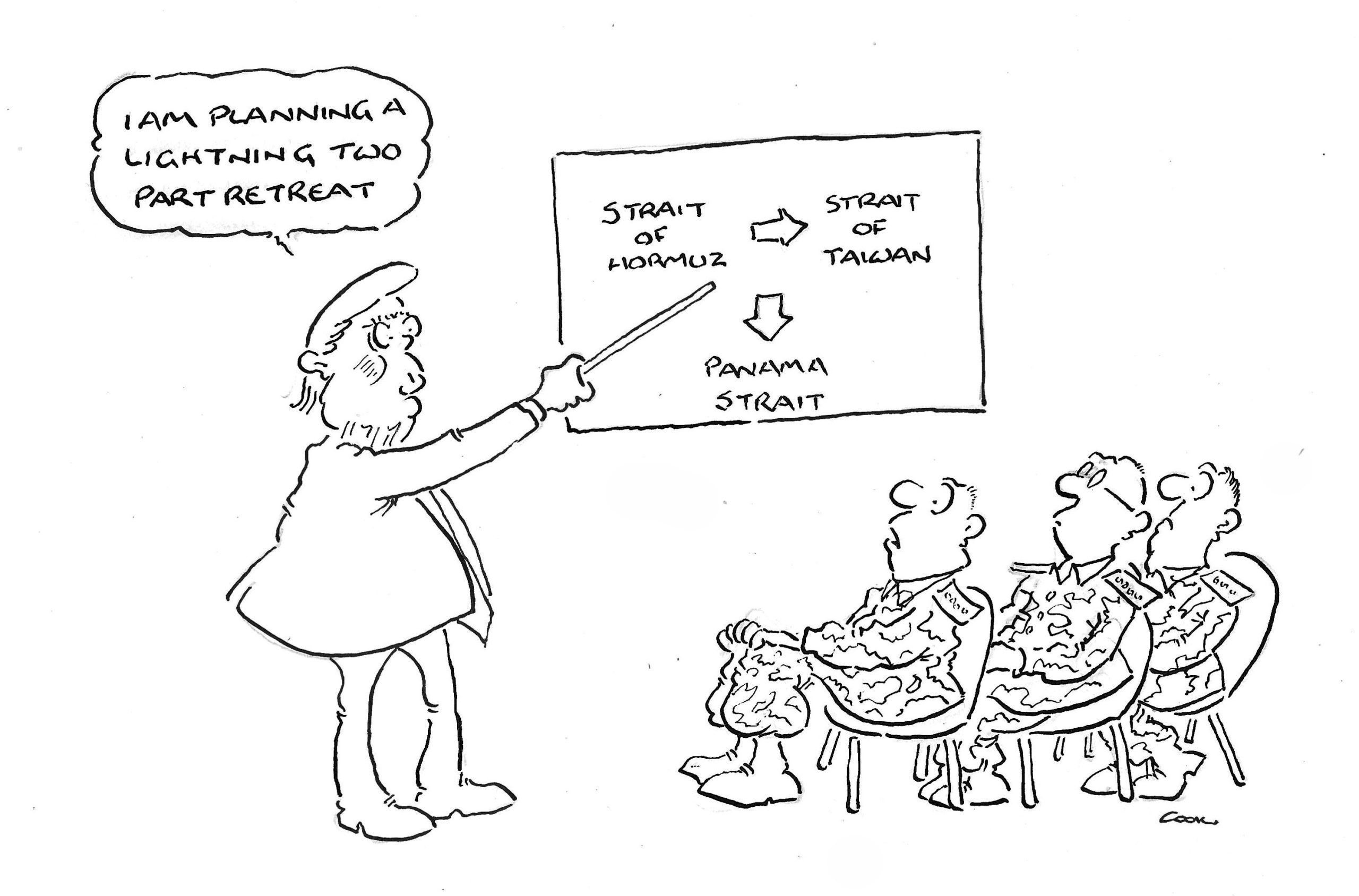
And the Strait of Malacca carries 30% of the world’s oil trade, compared to 25% for Hormuz.
And to soothe your troubled mind…
“Minefields don’t even need mines to be effective as long as everyone thinks they might be there.”
John Pentreath, a former rear admiral in the Royal Navy, speaking of the problem of mines in the Strait of Hormuz.
Wry & Dry comments: The comment was made in a discussion about the use of drone minesweepers. Ukraine has pioneered their use.
Disclaimer
The comments in Wry & Dry do not necessarily reflect those of First Samuel, its Directors or Associates.
Cheers!